The Day My Trainers Nearly Ruined a Levada Walk in Madeira
The levada that changed my footwear for good
I’d read enough about Madeira before we landed to know the island runs on levadas, so on our second morning I laced up the trainers I’d worn on the flight and drove up to Queimadas to walk the Levada do Caldeirao Verde. White trainers, thin soles, no tread to speak of. In my head, a levada was a canal path: flat, tame, the kind of thing you do in whatever’s on your feet. I’d read the word “irrigation channel” and translated it, wrongly, into “gentle stroll.”
It is flat, technically. That was the trap. Flat said nothing about what the surface was actually like underfoot.
Twenty minutes in, the path narrows to a ledge barely wider than my shoulders, the laurissilva forest dripping onto it from above, moss and algae greening the concrete edge, and a drop on the other side with no rail. My trainers, built for pavement, slid on the wet strip the moment I put weight on the outside edge. Not a dramatic fall — a small, controlled skid that stopped my heart for a second and made me grab the rock wall with both hands. It happened again ten minutes later. By the time we reached the first of the route’s four tunnels, I was walking with my eyes fixed entirely on foot placement instead of the forest around me, which rather defeats the point of being there.
The tunnels were the part nobody had adequately warned me about, even though I’d read about them. Reading “unlit tunnel” and standing inside one with a phone torch and slick trainer soles are different experiences entirely. The tunnel floor was uneven rock, wetter than the open path, and the light from my phone cast just enough of a beam to see where the ceiling dropped low, not enough to see whether the next footfall was solid ground or a puddle over a dip. My partner, in proper trail shoes, moved through steadily. I shuffled, one hand on the wall, testing every step before committing my weight to it.
We turned back before the fourth tunnel. Not because the trail was closed or the weather had turned, but because I’d worked out, standing in the dark with wet feet and a shoe that gave me no confidence at all, that continuing was a bad trade against getting to the far end. That’s the part of this story I keep coming back to: the walk itself was well within our fitness, well within our day’s plan, and entirely undone by something as small as which shoes I’d grabbed that morning.
Why the shoes mattered more than the distance
The Caldeirao Verde walk is roughly thirteen kilometres there and back, mostly flat, and well within an averagely fit walker’s range in the right footwear. Distance was never the problem. The problem was three things stacked together: a wet, mossy, unrailed ledge; four stretches of near-total darkness; and shoes with a smooth sole and no ankle support. Any one of those three is manageable. Together, in trainers, they add up to something closer to genuinely risky than “an easy flat walk,” which is exactly the phrase I’d used to describe it to myself the night before.
A proper hiking shoe or light boot solves the grip problem directly — a lugged sole bites into wet concrete and rock in a way that a running trainer simply doesn’t. It solves a second problem I hadn’t even considered before that day: the path camber constantly tips your foot sideways, and a stiffer sole with some ankle support stops a rolled ankle on a ledge where there’s nowhere safe to put a foot down and recover. A headtorch, not a phone light, solves the third. None of this is exotic kit. It’s the standard packing-list advice for mountain weather and what to wear on Madeira, and I’d skimmed straight past it.
The mistake I don’t want to repeat by overcorrecting
It would be easy to leave this story here and conclude that every levada in Madeira demands boots, but that isn’t true, and saying so would just trade one bad generalisation for another. A few days later we walked Levada dos Balcoes from Ribeiro Frio in the same trainers, and it was genuinely fine — wide, shaded, no tunnels, barely any exposure, over in under an hour.
The things to do around Ribeiro Frio and the walk to Balcoes sit at the easy end of the scale for a reason. What went wrong at Caldeirao Verde wasn’t the category “levada,” it was a specific route with specific conditions that I hadn’t matched to specific footwear.
That distinction is the whole lesson. Before picking a levada now, I check three things rather than assuming: does it have tunnels, how wide is the ledge, and what’s the surface been like recently. The guide to levada safety in tunnels and vertigo and the general rundown of the best levada walks both spell this out route by route, which would have taken me five minutes to read the night before instead of learning it the hard way in the dark.
What I’d do differently
If I were planning that morning again, I’d have packed the trail shoes I’d brought for exactly this and left the trainers for the airport. I’d have also read the practical basics on trail fees and permits before setting off, since the official PR-numbered routes now require a booked pass — a separate lesson from the same over-confident morning, and one that’s worth its own read rather than folding in here.
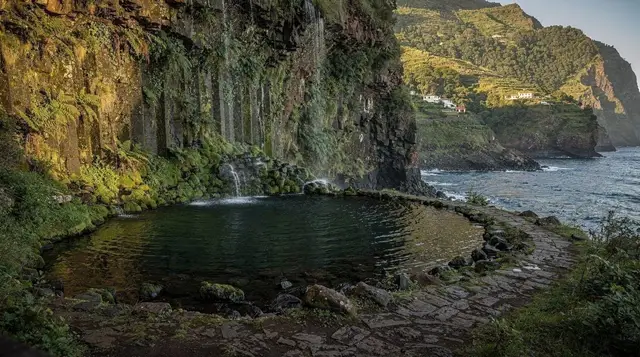
We did go back to Caldeirao Verde two days later, properly shod this time, and finished it without a single slip. The waterfall at the end, dropping into a cold green pool inside the forest, was worth every bit of the thirteen kilometres. It just wasn’t worth the version of the walk I’d nearly attempted in trainers, hand on the wall, torch battery dropping, still two tunnels from turning back.
If you want the guided version of that same walk without gambling on your own footwear judgement, a half-day walking and 4x4 tour run by people who know exactly which sections need grip is a reasonable way to hedge the mistake I made. We booked a similar guided levada walk at Rabaçal and 25 Fontes later in the trip and the guide checked our shoes before we’d even reached the trailhead — which tells you how ordinary this mistake actually is.
For anyone building out a longer stay, the one-week hiking itinerary is a good place to plan footwear route by route rather than packing one pair and hoping. And if you want the short version of what I’m describing here from someone else who’s made the same call, what nobody tells you about levada walking and what changed when the levadas started charging are both worth five minutes before you pack your bag.
We also broke up the hiking days with a walking tour through Funchal’s food and wine culture on the day my feet needed a rest from rock, and finished the trip with a private half-day walking and 4x4 tour that mixed easier paths with a driven stretch — proof that not every day on this island needs to be decided by your shoes.
Footwear questions from readers who’ve made (or want to avoid) the same mistake
What actually went wrong wearing trainers on a levada?
The soles had no grip on wet, algae-covered concrete, so my feet slid sideways rather than forward. On the narrow sections beside the water channel, with no rail on the drop side, that sideways slide was the frightening part, not the distance walked.
Which levada was it, and why does that matter?
It was the Levada do Caldeirao Verde from the Queimadas forest park, which crosses four unlit tunnels and clings to a rock face for most of its length. A flatter, wider, better-lit route would have punished the same shoes far less.
Do all levada walks need hiking boots?
No, and saying so would be its own kind of exaggeration. Short, wide, well-maintained paths like Levada dos Balcoes near Ribeiro Frio are genuinely manageable in trainers with decent tread. The risk scales with tunnels, ledge width, and how wet the surface is on the day, not with the word levada itself.
What should I wear instead of trainers?
A shoe with a proper lugged sole and some ankle support: a light hiking boot or a trail shoe built for wet rock, not a running or lifestyle trainer. A headtorch matters just as much on any levada with tunnels, trainers or not.
Is it just about grip, or something else too?
Grip was the immediate problem, but ankle support mattered more than I expected. The path camber tips your foot sideways constantly, and a stiffer sole and higher cut stop a rolled ankle on a ledge where there’s nowhere safe to put it down.
Could I have turned back once I realised the mistake?
I did, partway through the third tunnel, and that was the right call. Turning back cost us an afternoon; carrying on in the dark with no grip would have cost more than that.
What’s the one levada where trainers are genuinely fine?
Levada dos Balcoes from Ribeiro Frio: short, wide, mostly shaded, no tunnels, and a gentle gradient the whole way. It’s the route I’d point a first-timer in ordinary trainers towards, with everything else on this list left for proper footwear.
tours.levada-walks
Verified deep-linked GetYourGuide tours. Book through these links and we earn a small commission at no cost to you.
GetYourGuide does not provide a product photo for this activity — the image shows the meeting point, photographed by us.