Levada Safety: Tunnels, Vertigo and Trail Closures Explained
Are levada walks in Madeira dangerous?
Not inherently, but several risks recur on almost every levada regardless of how flat the route looks: unlit tunnels, paths with no barrier above a drop, and surfaces that turn slick when wet. Check trail status with the IFCN before setting out, since heavy rain closes routes with little notice.
The hazards every levada shares, whichever one you pick
Every individual levada guide on this site — Levada das 25 Fontes, Levada do Caldeirão Verde, Levada dos Balcões and the rest — will send you here rather than repeat the same warnings on every page. That’s deliberate.
The risks below aren’t specific to any one route; they’re a property of how levadas were built, and they turn up on gentle half-hour strolls just as often as on all-day routes. Understanding what a levada actually is before you walk one changes how you read a trail description, and none of this should be treated as scaremongering — thousands of people walk these paths safely every week. It should be treated as the checklist you run before you leave the car park.
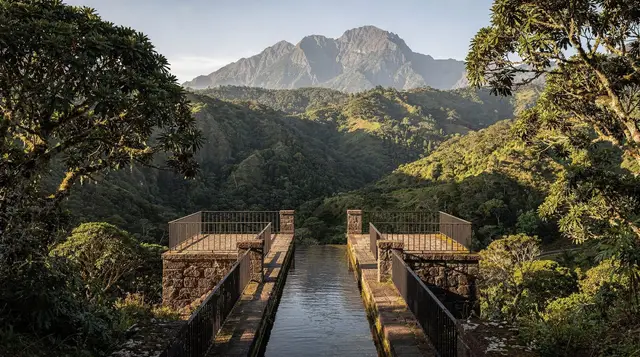
A levada is an irrigation channel, not a hiking trail that happens to carry water. The path beside it was cut for maintenance workers, at the width needed for one person and a tool bag, following the exact contour of the hillside rather than a route designed for visitors. That origin explains almost every hazard on this page: the paths are narrow because nobody widened them for tourism, they run along cliff edges because the water had to hold its level, and they duck through solid rock in tunnels because that was faster than routing around a headland. None of this was built with a handrail in mind.
Tunnels: why a head torch is not optional
Several of Madeira’s best-known levada walks pass through tunnels bored directly into the mountain, and this is the single most common way a route catches out an unprepared walker. Some tunnels run for a few dozen metres and you can see daylight at the far end before you enter. Others run for several hundred metres, curve partway through, and put you in complete darkness with an uneven, often wet floor underfoot and a low or irregular ceiling that catches the head of anyone who forgets to duck.
A phone torch is not an adequate substitute for a proper head torch. It leaves one hand occupied, its beam is usually too narrow and too dim for an uneven surface, and cold, damp conditions drain phone batteries faster than most people expect — precisely when you need the light most. Carry a head torch with genuinely fresh batteries (or a spare set), even if the route description only mentions “a short tunnel.” Short is relative, and a tunnel with no lighting of its own is not somewhere to discover your battery is flat.
A few practical points that apply in any levada tunnel:
- Walk at a pace where you can react to the floor changing underfoot — tunnel floors are frequently uneven, and some carry a shallow channel of running water you can step in without seeing it.
- Expect the ceiling height to vary. Tall walkers in particular should assume it drops without warning rather than checking once and relaxing.
- If a tunnel is long enough that you can’t see either entrance from partway through, resist the urge to hurry — a fall in complete darkness is a worse outcome than a slower walk.
- Groups should stay within sight and sound of each other in a tunnel; it’s the easiest place on any levada to become separated.
No guardrail, real drop: why “flat” doesn’t mean “safe”
This is the hazard most often missed by people who haven’t walked a levada before, and it’s the one that matters most for anyone uneasy with heights. The defining feature of a levada path is that it follows a level line across a hillside — which means large stretches of it run along the top of a drop, sometimes a substantial one, with nothing between the path and the edge but the path’s own width.
Treat this as independent from difficulty ratings based on distance or ascent. A route billed as “easy, mostly flat” can still carry twenty minutes of walking along an exposed ledge with a fall of many metres to one side, precisely because the flatness and the exposure come from the same feature — the channel holding its level around the contour. Don’t assume that a short or gently graded walk is automatically comfortable for someone who struggles with heights; check the specific route’s exposure, not just its stated difficulty, before committing a nervous member of your group to it.
A short comparison of what “difficulty” language typically does and doesn’t tell you:
| What a trail description usually covers | What it usually doesn’t cover |
|---|---|
| Total distance and estimated time | Whether any section has an unguarded drop |
| Overall ascent and descent | Path width at its narrowest point |
| Whether the surface is paved or natural | Presence or length of unlit tunnels |
| General fitness level required | Suitability for vertigo specifically |
If in doubt, read ahead to the specific guide for the levada you’re considering — most flag exposure and tunnels explicitly — or ask a guide directly. Checking the weather and dressing for the mountain is a related habit worth building into the same pre-walk routine.
Underfoot conditions: slippery is the default, not the exception
Levada paths are frequently damp even on a dry day, because water seeps from the channel itself, because the north side of the island stays wetter for longer, and because many stretches run through permanent shade under the Laurissilva forest canopy where the sun barely reaches the ground. Moss, algae and worn concrete are common, and all three get noticeably more slippery after rain — including rain that fell the previous day rather than during your walk.
Footwear with real tread matters more here than on most European day walks. Trainers with a smooth or worn sole are a frequent cause of slips on levada paths, and the margin for a slip is smaller than usual given the drops discussed above. Trekking poles help on uneven or wet sections, and a slower pace on damp concrete or exposed tree roots costs you a few minutes, not the walk.
Closures after rain: why you check the morning of, not the week before
Madeira’s authorities close individual trail sections after heavy rain, landslides or rockfall, and these closures can appear with very little notice and lift again within days once a route has been inspected and cleared. The body responsible is the IFCN — the Instituto das Florestas e Conservação da Natureza, Madeira’s forestry and nature conservation institute — which publishes current trail status.
The practical habit this demands is simple: check status the morning you intend to walk, not when you book a tour or plan your itinerary days in advance. A trail open on Monday can close on Tuesday after an overnight storm and might not reopen before your holiday ends. This is also one of several reasons a fixed, rigid itinerary built weeks ahead is riskier on Madeira than one with some flexibility — see what to pack and how to plan around mountain weather for more on building in that slack.
Two related points worth keeping in mind:
- A closed trail is closed for a reason tied to the terrain, not administrative caution. Rockfall risk after rain is real on cliff-cut paths, and closures should be respected rather than treated as a bureaucratic inconvenience to route around.
- Since 2021, most official waymarked routes also require a paid reservation — a separate matter from safety, but one to sort out at the same time you check trail status; see permits and trail fees for the current process.
Who should think twice, and what to do instead
None of this means levada walking is only for experienced hikers — most routes are genuinely accessible, which is exactly why the hazards above catch people out; they don’t look like a “serious hike.” But a few situations are worth flagging honestly:
- Anyone with significant vertigo should ask specifically about exposure on their chosen route rather than relying on a distance-and-time summary, and should consider a shorter, less exposed walk such as Levada dos Balcões over routes known for long unguarded stretches.
- Young children are harder to keep a constant eye on in a tunnel or on a narrow exposed section; match the specific route to the child rather than the general reputation of levada walking as family-friendly.
- Anyone walking alone on a quieter route, particularly outside peak season, should tell someone their planned route and expected return time — mobile signal is patchy or absent on several of the more remote levadas.
- Uncertain first-timers on any of the higher-profile routes — the walk to Pico Ruivo via the Achada do Teixeira, or the full Vereda do Arieiro — often get more out of a guided day than a solo one on their first visit, simply for the local judgement calls a guide makes on marginal weather.
A guided option removes none of the physical hazards described above, but it does put someone experienced in charge of the calls that matter most: whether to enter a tunnel, whether to turn back, and whether the forecast justifies the walk at all. For routes with tunnels and real exposure, that’s often worth the cost of a private or small-group guide rather than going in blind.
a guided hike along the mist-prone Fanal trail with transfer included takes the route-finding and weather judgement off your plate entirely, which matters on a path that alternates between forest and open moorland with little warning. For something shorter and less exposed, a guided sunrise walk to the Balcões viewpoint is a gentler introduction to levada walking with a guide managing timing and pace.
Walkers wanting a fuller day with a local guide handling the tunnels and exposed sections themselves might look at a full-day guided hike from Ribeiro Frio to Portela, while anyone set on the island’s signature high route should weigh a guided option such as a guided hike across the exposed ridge from Pico do Arieiro to Pico Ruivo against tackling its tunnels and drops solo.
A minimal kit list built around these specific risks
This isn’t a general hiking packing list — see what to pack for Madeira for that. It’s the short list of items that directly address the hazards above:
- A head torch with fresh (or spare) batteries, carried even when the forecast is clear and the route sounds short
- Boots or shoes with real tread, not smooth-soled trainers
- A light waterproof layer, since the north side and the mountains generate their own weather independent of Funchal
- A fully charged phone, kept in a pocket rather than a bag, for the stretches where signal does reach
- Trekking poles, genuinely useful on wet concrete and loose or root-covered ground
Before leaving, confirm the trail’s current status with the IFCN and, if the route requires it, that your paid trail reservation is booked and ready to show — see the permits and fees guide for how that works. Build in a turnaround time rather than an end point, so a change in weather partway through changes your plan rather than your safety margin. For a broader sense of which routes suit which walkers, our roundup of the best levada walks sorts routes by these same factors rather than by distance alone, and common mistakes first-time visitors make covers several that trace directly back to skipping this page.
Levada Safety: Your Questions Answered
Do I really need a head torch for a levada walk?
Yes, for any route that mentions a tunnel. Some levada tunnels run for several hundred metres with no lighting and an uneven floor, and a phone torch is not a reliable backup if the battery drops in the cold. Carry a proper head torch with spare batteries, even on a walk billed as short.
Is a flat levada automatically safe for people afraid of heights?
No. The gradient of a levada tells you nothing about the drop beside it. Many of the flattest sections run along a channel cut into a cliff face with no guardrail, so the walking is easy while the exposure is real.
How do I check if a levada trail is open before I go?
Check the current status with the IFCN (Instituto das Florestas e Conservação da Natureza), Madeira’s forestry and nature conservation body, which publishes trail closures after landslides and heavy rain. A route can close overnight and reopen days later, so check the morning you plan to walk, not the week before.
What should I wear on the levadas?
Boots or trail shoes with real grip, not trainers with a smooth sole — the paths are often damp concrete or packed earth even in dry weather. Layers matter too, since the temperature at Rabaçal or Queimadas can be several degrees below Funchal.
Are levada trails suitable for children?
Some are, but assess each one on its exposure and tunnels rather than its distance. A short walk with an unguarded drop or a long dark tunnel is a poor choice for a young child, even if the total walking time is under an hour.
What happens if it starts raining while I’m on a levada?
Turn back rather than push on. Rain raises the risk of slippery paths, rockfall and sudden closures, and the narrow width of most levadas leaves little room to wait out a downpour safely. Building in a turnaround time before you set out is the simplest way to avoid this decision being made for you.
Do guided levada tours reduce the risk?
A local guide adds real value on trails with tunnels or exposure: route knowledge, a fixed turnaround plan, and equipment that’s already sorted. It doesn’t remove the underlying hazards, but it does mean someone experienced is making the calls on a wet or marginal day.
tours.levada-walks
Verified deep-linked GetYourGuide tours. Book through these links and we earn a small commission at no cost to you.
GetYourGuide does not provide a product photo for this activity — the image shows the meeting point, photographed by us.