The Quiet Back Door to Madeira’s Highest Point
Most visitors who want to stand on Madeira’s summit hear about Pico do Arieiro first, and about the famous PR1 traverse that links it to Pico Ruivo across roughly 7km of ridge, tunnels and exposed staircases.
Achada do Teixeira rarely gets mentioned in the same breath, which is odd, because it is the only other way onto that summit, and by some distance the shorter one. From this car park at the end of a paved mountain road, Pico Ruivo is about 2.8km away on foot, one direction. There is no traverse, no second car needed at the far end, and no need to arrange transport back to a different trailhead. You park, you walk up, you walk back down, and you drive home.
That simplicity is exactly why this page exists on its own. Achada do Teixeira is not a shortcut version of the Arieiro sunrise hike, and it is not a lesser cousin of PR1 - it is a different, self-contained route to the same summit, officially numbered PR1.2, and it deserves to be planned as its own outing rather than an afterthought. It is also, unfortunately, one of the routes people most often assume is easy simply because it is short.
It is not flat, it sits above 1,800m for its entire length, and since August 2021 it has required the same paid trail permit as every other official PR path on the island. None of that makes it a bad choice - if anything it makes it the single most efficient way to reach Madeira’s rooftop - but it is worth arriving with accurate expectations rather than the vague idea that this is the “easy” way up.
Getting to Achada do Teixeira
Achada do Teixeira sits above the village of Santana on the island’s north side, reached by a paved road that climbs out of the lower valleys into open mountain grassland. From Funchal, the drive takes roughly 45 to 55 minutes depending on which route you take through the interior, and the road itself, while narrow in places, is sealed the entire way - unlike some of the access tracks elsewhere in the central massif. There is a car park at the trailhead with space for a reasonable number of vehicles, though on a clear weekend morning in summer it does fill, and drivers who arrive late sometimes end up parking along the verge some distance below.
No public bus service runs directly to Achada do Teixeira, which means the practical choices are a hire car, a taxi arranged for a fixed return time, or a transfer booked through a hiking operator. A number of the operators that run the Pico do Arieiro sunrise hike and the full PR1 traverse also offer transfers specifically to and from Achada do Teixeira, which is useful if you would rather not manage a mountain road yourself before dawn, or if you want to walk one direction and be collected rather than retracing your steps.
a return pickup service between Funchal and Achada do Teixeira removes the driving question entirely and is worth considering if you are staying without a car, or if you would simply rather not tackle mountain roads in the dark.
The Route: PR1.2 in Practice
From the car park, the trail begins as a paved path, then narrows to a well-built stone and gravel track as it climbs. The first stretch passes close to Pico do Areeiro’s lesser-known neighbour peaks before the path settles into a steady, switchbacking ascent toward the ridge. Unlike PR1, which threads through several unlit tunnels cut directly through rock, PR1.2 stays largely in the open, so a headtorch is far less essential here - though still worth carrying if you are walking for sunrise or sunset, when the light either side of the walk will be low.
The gradient is consistent rather than brutal: there is no single killer section, but there is also no real flat stretch to recover on, and the thinner air above 1,800m means even fit walkers often notice their pace slowing. Stone steps have been built into the steeper sections, which helps with footing but does nothing to reduce the effort of the climb itself. Most people cover the 2.8km in something close to an hour and a quarter going up, a little faster coming down, though photographers and anyone stopping often for the views over the Laurissilva forest and the ridgelines toward Curral das Freiras should allow more.
Roughly two-thirds of the way along, the path passes close to the Pico Ruivo mountain refuge, a stone building with basic toilet facilities that sits just below the final approach to the summit. It is not a café, and it is not always staffed, so it should not be relied on for food or water - but it is a useful landmark and a sheltered spot to pause if the wind picks up, which it often does as the trail nears the top.
The final approach to the summit gains height quickly over a short distance, and then opens onto the survey point at 1,862m, Madeira’s highest ground. On a clear day the view extends across most of the island’s interior and, depending on cloud, down toward both the north and south coasts simultaneously - a genuinely rare vantage point, since so much of Madeira only shows you one coastline or the other at a time.
Achada do Teixeira Versus the Full Arieiro Traverse
The comparison that matters most for planning is with PR1, the longer and considerably more demanding route that links Pico do Arieiro to Pico Ruivo across the full ridge. Both trails end at the same summit, both require the same trail permit, and both sit in the same weather-exposed mountain zone - but they are not interchangeable experiences, and choosing between them should come down to time, fitness and appetite for exposure rather than which one sounds more impressive.
| Achada do Teixeira (PR1.2) | Pico do Arieiro to Pico Ruivo (PR1) | |
|---|---|---|
| Distance one way | About 2.8km | About 7km |
| Typical time one way | 1 to 1.5 hours | 3 to 4 hours |
| Tunnels | None of note | Three unlit tunnels |
| Exposure | Open path, no significant drop-offs | Narrow ridge sections with real drops |
| Return logistics | Same car park both ends | Needs transport between two trailheads |
| Trail permit | €3 per person, per day | €3 per person, per day |
For walkers who want the summit but are short on time, uneasy with narrow exposed ridgelines, or simply want a route where the car is waiting exactly where they left it, Achada do Teixeira is the clear choice.
For those chasing the full mountain experience - the tunnels, the ridge, the sense of crossing the island’s spine - the longer PR1 traverse from Pico do Arieiro remains the more complete outing, and its own dedicated sunrise experience is a different kind of morning entirely. Several operators also run one-way itineraries that combine both, starting at Arieiro and finishing at Achada do Teixeira, which lets you experience the full traverse without needing to retrace it.
a guided hike across the full ridge from Pico do Arieiro to Pico Ruivo is the option to look at if the traverse itself is the goal, with transport handled at both ends so you are not left arranging a car swap.
The Permit, and Why It Isn’t Optional
It is worth saying plainly, because guidebooks and blog posts written before 2021 still circulate and get this wrong: PR1.2, like every numbered PR trail on Madeira, is not free to walk. Since August 2021, hikers on the island’s official trail network have needed to book a paid permit in advance, at roughly €3 per person, per trail, per day, through the regional government’s booking platform. The permit is checked at the trailhead, and turning up without one can mean being turned away, particularly at popular routes during peak season. Full detail on how the system works, and how to book it correctly, is covered in our guide to hiking permits and trail fees - read it before you drive up, not after.
The trail system also closes sections after heavy rain or rockfall, and the central mountain routes are among the first to be affected given how exposed they are to weather coming off the Atlantic. Checking current trail status before setting out is not a formality here; a closure notice posted the night before is common enough that it should be part of the routine, not an afterthought.
Weather, Altitude, and What to Actually Bring
At 1,862m, Pico Ruivo sits in a different climate to the coast, and the gap between the two can be startling for anyone who has only experienced Madeira’s mild lowlands. It is entirely possible to leave Funchal in a t-shirt at 21°C and arrive at the summit to find it close to freezing with a stiff wind, particularly in the early morning or in winter. Cloud can also form and clear within the space of an hour, which is part of what makes the summit views so unpredictable - and part of why an early start genuinely matters, since the central peaks are typically clearest before mid-morning cloud builds from the valleys below.
Practically, that means a proper layering system rather than a single jacket: a base layer, an insulating mid-layer, and a windproof and ideally waterproof outer shell, even on a day that looks settled from the coast. Solid walking shoes or boots with grip are worth having given the stepped, sometimes loose sections of trail. A hat and gloves are not excessive for an early morning start outside the height of summer. Water and some food should be carried rather than assumed available, since the mountain refuge near the summit is not a reliable source of either. For general guidance on dressing for Madeira’s mountain zone across the seasons, see our guide to mountain weather and what to wear.
Making a Day of It
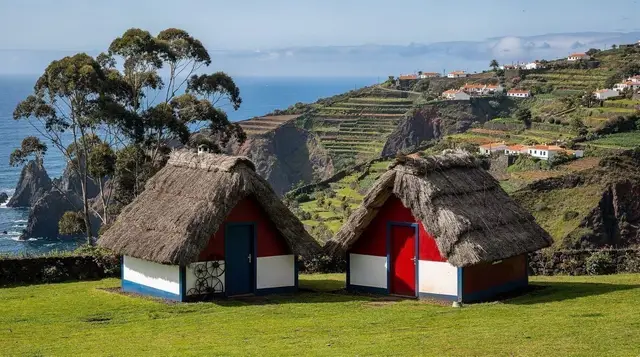
Because the walk itself only takes half a day at most, Achada do Teixeira pairs naturally with other stops in the central mountains rather than standing alone as a full-day plan. Many visitors combine it with a drive or walk near Ribeiro Frio, home to one of the easier and more rewarding short walks on the island, or with a stop at the Queimadas forest park, the starting point for the long walk to Levada do Caldeirao Verde. Santana, with its distinctive thatched houses, sits at the base of the access road and makes a pleasant final stop on the way back down.
For anyone building a longer stay around walking, our hiking week itinerary sets out how a route like this one fits alongside the island’s other signature trails without repeating terrain or wasting driving time. And if the choice between this route and the fuller traverse is still not obvious, our comparison of the short Pico Ruivo route against the full option, and our broader piece asking whether the Arieiro sunrise is worth the early alarm, both go into more detail on how to decide.
Achada do Teixeira will never carry quite the same reputation as the Arieiro sunrise or the full ridge traverse - it is simply a shorter story to tell. But for anyone who wants to stand on the highest point of Madeira without giving up most of a day, without navigating unlit tunnels, and without leaving a second car at a different trailhead, it remains the most efficient route on the island to the same summit, and one that a surprising number of visitors never realise exists.
a transfer that starts at Pico do Arieiro and returns you via Achada do Teixeira is worth a look if you’d rather see both ends of the ridge without walking the whole traverse, and if sunrise itself is the priority rather than the summit route, a private sunrise hike based at Pico do Arieiro covers that experience directly.
Achada do Teixeira and Pico Ruivo: Your Questions Answered
How long is the walk from Achada do Teixeira to Pico Ruivo?
About 2.8km one way, roughly 5.6km return. Most walkers take 1 to 1.5 hours up and slightly less coming down, so budget 2 to 3 hours for the round trip including time at the summit.
Is the Achada do Teixeira trail free?
No. Like every official PR trail on Madeira, PR1.2 has required a paid permit since August 2021, around €3 per person per day, booked online in advance and checked at the trailhead.
Is this route easier than the Pico do Arieiro to Pico Ruivo traverse?
It is shorter and has less exposure than PR1, but it is not flat or effortless. Expect a steady, stepped climb, altitude above 1,800m, and weather that can turn quickly.
Can I drive all the way to Pico Ruivo?
No. Achada do Teixeira is the closest a car can get. From the car park, Pico Ruivo is reached on foot only, on PR1.2.
Do I need a guide for Achada do Teixeira to Pico Ruivo?
No, the trail is well marked and manageable independently for a reasonably fit walker who books the permit and checks conditions. A guide adds context and can arrange a one-way transfer if you want to combine it with the longer PR1 route.
What should I wear for the walk to Pico Ruivo?
Layers, a windproof shell, and proper walking shoes. Temperatures at 1,862m can sit close to freezing early in the morning even when Funchal is warm, and wind at the summit is common.
Is there a shelter at Pico Ruivo?
Yes, the Pico Ruivo mountain refuge sits just below the summit and has basic facilities, including toilets, but it is not always staffed and does not sell food reliably, so bring your own water and snacks.