The village every postcard of Madeira is trying to look like
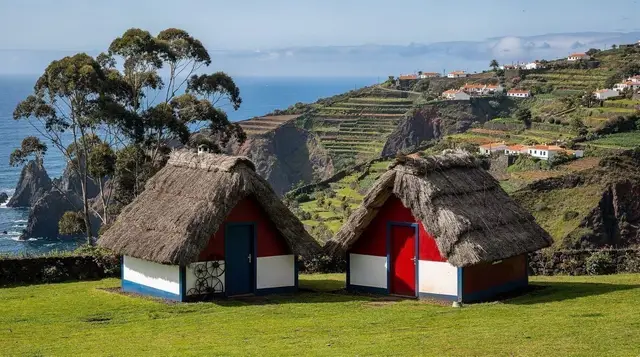
If you have seen a photo of Madeira with a toy-like triangular house, red roof sloping almost to the ground, painted in bands of white and blue — it was very likely taken in Santana. The town sits on the north coast between Faial and São Jorge, a working agricultural centre with a supermarket, a school and ordinary traffic, wrapped around a small cluster of buildings that has become the single most photographed piece of vernacular architecture on the island.
Those buildings are the casas de colmo, and this page covers exactly that: what they are, which ones you can actually walk into, how to get there, and the one thing almost every quick write-up gets wrong about them. It does not cover the Queimadas forest park or the Levada do Caldeirão Verde, which start a short drive from Santana and have a page of their own — see the Caldeirão Verde levada guide if that waterfall hike is what brought you here.
What a casa de colmo actually is
A casa de colmo is a small rectangular house with a steeply pitched roof, thatched with a local grass called colmo, coming down low on both sides — from a distance the roofline looks almost like a tent pitched on stone walls. The design is old and practical: the north coast of Madeira gets the island’s heaviest rain, and a steep thatched roof sheds water fast and insulates against the damp far better than the flat or lightly pitched tiled roofs common in the sunnier south.
The style was never unique to Santana. Versions of it were built across the parishes of the north, wherever families farmed small terraced plots and needed cheap, weatherproof shelter close to the fields. What made Santana specific is that it became the place where the style was preserved and put on display, rather than left to fall down as families moved into concrete houses with proper plumbing — which is what happened almost everywhere else on the island over the second half of the twentieth century.
The single fact worth carrying with you: the houses you photograph in the centre of Santana are maintained reconstructions kept for visitors, not surviving originals and not anyone’s home. Three of them sit together on a small green in the middle of the village, painted in the traditional red, white and blue, furnished inside with period tools and household objects, and they exist specifically so the style does not disappear from view.
A handful of genuine, older thatched houses do survive scattered through the surrounding countryside and in neighbouring parishes, still used as sheds or occasionally as holiday lets, but they are private property, not part of any organised visit, and you should not expect to find or enter one on a casual stop.
The three houses in the village centre
The visitable trio sits close together, a short walk from Santana’s main car park, and the visit is unhurried and free. Each house is small enough that you spend a couple of minutes inside — there is a living space with a table, chairs and a wood-fired hearth, and a sleeping area furnished to suggest how a farming family would have used the space. None of it is roped off or staffed with much fanfare; you simply walk in, look around, and walk back out into the garden between them.
Because they are reconstructions rather than fragile originals, there is no ticket, no timed entry and no guide required, which makes them one of the easiest “free thing to do” stops on the whole island. The trade-off is that you are looking at a curated, tidied version of the style rather than a lived-in building with decades of genuine wear — worth knowing before you arrive so the visit is judged for what it is.
| What | Detail |
|---|---|
| Cost to enter | Free |
| Time needed | 10-20 minutes for all three houses |
| Photography | Allowed, no restrictions noted |
| Interior condition | Furnished, maintained, not original fabric |
| Nearby parking | Village car park a short walk away |
Getting to Santana
Santana sits on the ER101 coast road roughly 45 km from Funchal, and the fastest route is inland via the VE1 expressway before dropping down to the coast — figure on around an hour with normal traffic. It is one of the more comfortable north-coast drives on the island: the approach roads are wider than the older coastal lanes further west, though you are still on Madeira, so expect tight bends and steep gradients once you are off the expressway. See driving in Madeira and car rental in Madeira if you have not booked a car yet — a small manual hire remains the easiest option for this kind of trip.
Public buses reach Santana from Funchal, run by the operators covering the north coast, but services are infrequent enough that a self-drive day or an organised tour is the more realistic option for most visitors, especially if you want to combine the village with other north-coast stops in a single day. If you would rather not drive the mountain roads yourself, a guided 4x4 tour through the emerald forest and waterfalls of the north typically routes through or near Santana as part of a wider loop, which removes the driving without losing the scenery.
Making a day of it
On its own, Santana is a short stop — most visitors are back in the car within an hour or two. It earns a fuller day when paired with the rest of the north coast, and the village works well as a midpoint rather than a final destination.
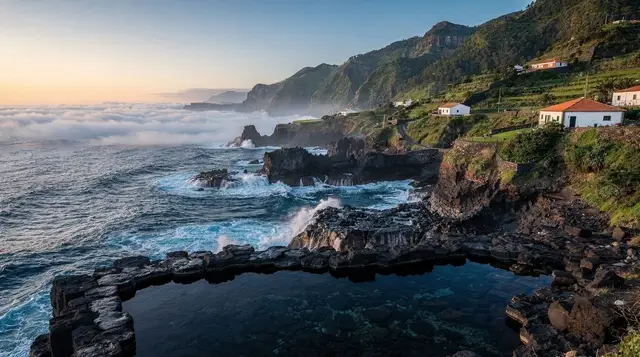
To the west, São Vicente and Porto Moniz add lava caves and natural swimming pools to the same loop; to the east, Porto da Cruz and Faial sit close by, with the dramatic outline of Penha de Águia visible from the coast road.
Inland and slightly south, São Jorge, Arco de São Jorge and Boaventura are quieter farming parishes on the same stretch of road, worth a slow drive-through if you like the rural, unpolished side of the north over its headline attractions. For a full route suggestion, the north Madeira day trip guide lays out a sensible order for stringing these together, and the wider north versus south Madeira comparison explains why this coast looks and feels so different from Funchal’s side of the island.
A private 4x4 tour along the north and east coast is a practical way to see several of these villages in one outing without retracing your own route by car, and it takes the pressure off route-planning on a coast where road signage between small parishes is not always generous.
Eating and drinking in and around Santana
Santana sits in genuine wine and cider country, and the parish is known locally for small-scale, traditional winemaking distinct from the fortified Madeira wine produced around Funchal and Câmara de Lobos. If a wine visit interests you, a wine tasting and harvest experience with lunch in Santana pairs a working vineyard visit with a sit-down meal, and makes a natural anchor for the middle of the day if you are not rushing between the thatched houses and the next stop on the coast.
For background on the island’s wine traditions generally — including how they differ from what you will taste here — the Madeira wine explained guide and the poncha guide cover the two drinks visitors ask about most.
For food, the village has straightforward local restaurants serving Madeiran staples rather than a dense restaurant scene, so do not expect Funchal-level choice. The Madeira food guide and the page on espetada and bolo do caco are worth reading before you go if you want to recognise what is on the menu; a stop in Santana is a reasonable place to try both away from the more tourist-oriented restaurants of Funchal’s old town.
Photographing the houses well
Because the three visitable houses sit close together on open ground, the best light is early or late in the day, when the sun is low enough to pick out the texture of the thatch and the paint without flattening everything under midday glare. The village also sits at real risk of north-coast cloud, so a plan that treats Santana as a flexible stop rather than a fixed appointment — visited whenever the weather along this stretch of coast happens to be clear — will generally produce better photographs than a rigid itinerary.
Worth noting for anyone chasing a specific shot: because the houses are a maintained display rather than a lived-in street, you will usually have the small garden between them largely to yourself outside of tour-bus arrivals, which cluster around midday. Arriving in the first or last hour of opening hours tends to avoid the busiest window.
A short history
The thatched-roof style itself is old, tied to Santana’s particularly wet microclimate and to a farming economy of small terraced plots that needed cheap, quickly built shelter close to the land being worked. As concrete construction spread across Madeira through the twentieth century, the style disappeared from daily use almost everywhere, including in Santana’s own working farms.
The maintained examples in the village centre were established specifically to keep the look visible to residents and visitors after it had stopped being how anyone actually built new houses — a preserved sample of a building tradition, not a surviving village of them. For the island’s broader story, from its 1419 discovery by Portuguese navigators onward, see history of Madeira.
Santana and the thatched houses: your questions answered
Are the thatched houses in Santana real, original buildings?
No. The three casas de colmo at the centre of the village are maintained reconstructions built and kept up to preserve the local building style for visitors. They are furnished and looked after, but nobody lives in them, and they are not original structures that have survived unchanged since they were first built.
Is it free to visit the thatched houses?
Yes, there is no ticket or entry fee to walk around and into the three houses in the village centre. The visit is quick, informal and unstaffed in any noticeable way, which makes it an easy stop to slot into a longer north-coast drive.
How long should I plan for a visit to Santana?
Most visitors need 10 to 20 minutes for the three houses themselves, and an hour or two for the wider village if you add a coffee, a wander through the streets, or a wine tasting. Santana works best as one stop within a longer north-coast day rather than as a full day on its own.
How do I get from Funchal to Santana?
The most direct route is by car via the VE1 expressway to the ER101 coast road, taking around an hour for the roughly 45 km. Buses run from Funchal but with limited frequency, so most independent visitors either self-drive or join a guided tour that includes Santana as part of a wider north-coast loop.
Does Santana cover the Levada do Caldeirão Verde or Queimadas forest park?
No. This page is about the village and its thatched houses only. Queimadas forest park and the Levada do Caldeirão Verde walk that starts from it are a short drive from Santana and are covered on their own dedicated page, linked above, since they are a separate half-day hike rather than part of a village stop.
Can I stay overnight in a thatched house in Santana?
Not in the three maintained houses in the village centre — those are a visitor display, not accommodation. A small number of genuine or reproduction thatched-style properties do exist as private holiday lets elsewhere in the parish, but they are booked as ordinary self-catering accommodation rather than through any visit to the village display.
Is Santana worth visiting if I have already seen photos of the houses online?
Most visitors still find it worthwhile in person, mainly because Santana works well as a stop within a wider north-coast day rather than as a standalone destination — the drive itself, through terraced hillsides and past the coastline near Faial and Porto da Cruz, is a large part of the appeal. Treat the houses as a short, free anchor point for a longer loop rather than the whole reason for the trip.
What else is nearby if I have a full day?
Porto Moniz and its natural pools, São Vicente’s lava caves, and the smaller parishes of São Jorge and Arco de São Jorge all sit within a comfortable drive of Santana along the same stretch of coast. A private remote sunrise 4x4 tour of the island’s eastside wonders or a route from Porto Moniz along the north coast by 4x4 are two ways to see several of these places without planning the route yourself.