Espetada and Bolo do Caco, Madeira's Two Essential Dishes
What are espetada and bolo do caco?
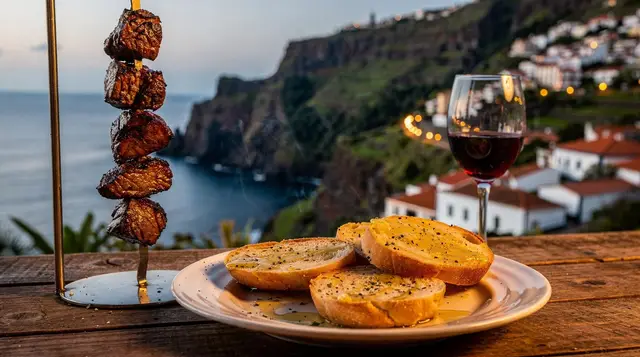
Espetada is beef cut into cubes, seasoned with sea salt and garlic, and grilled on a skewer cut from fresh laurel wood, usually served hanging from a hook at the table. Bolo do caco is a flat, round griddle bread made from a dough that includes mashed sweet potato, split and filled with garlic butter. They are eaten together constantly, but they are separate dishes with separate histories.
If you eat only two things on Madeira, they will almost certainly be these. Espetada and bolo do caco turn up on nearly every menu on the island, get ordered together so often that visitors assume they are one dish, and are both, underneath the routine, genuinely specific pieces of island cooking rather than generic grill fare. This page sticks to those two dishes: what actually goes into each one, how they are properly made, and where around Câmara de Lobos and beyond to find them done right. For the wider spread of Madeiran cooking, poncha, and where to eat by area, see the general food guide and the where-to-eat-by-area guide instead.
Two Dishes You’ll Eat Every Day in Madeira
Espetada and bolo do caco share a table constantly, which is exactly why they get blurred together. Order espetada in almost any tavern and a basket of bolo do caco, halved and gleaming with garlic butter, arrives alongside it as a matter of course, often used to mop up the meat juices rather than eaten as bread on its own. But they come from different parts of the island’s cooking: one is a method of grilling beef that predates restaurant menus by generations, the other is a griddle bread whose defining ingredient, sweet potato, is easy to miss unless someone points it out. Treating them as a single “meat and bread” combo misses what makes each one worth seeking out specifically.
Espetada: Beef on a Laurel Skewer
What actually goes into it
Espetada is beef, cut into generous cubes, usually from rump or sirloin, threaded onto a skewer and grilled over wood or charcoal. The seasoning is deliberately minimal: coarse sea salt, crushed garlic, sometimes a bay leaf tucked between the cubes, and nothing that would mask the meat itself. There is no heavy marinade, no sauce, no spice rub. That restraint is part of the point — it is a dish built around a good cut of beef and a hot fire, not around seasoning.
The skewer matters as much as the meat. A proper espetada is grilled on a length of fresh laurel wood (loureiro), cut with the bark still on. As the wood chars slightly over the coals it gives off a faint aromatic smoke that seasons the meat as it cooks, something a metal skewer cannot replicate. Laurel is not a decorative choice: it grows across Madeira’s hillsides and gives its name to the island’s ancient Laurissilva forest, so using it for espetada is as much a piece of local material culture as a cooking technique. If you want the ecological side of that same wood, the Laurissilva UNESCO forest guide covers it properly; this page stays with what ends up on the plate.
How it’s served
Espetada is usually brought to the table still on its skewer, hung from a hook or a small metal or wooden stand so the meat keeps its heat and juices rather than sitting flat in them. Diners pull the cubes off themselves, piece by piece, which is part of the ritual as much as the presentation. It is a communal, unhurried way to eat, and rushing it rather defeats the point.
Where it’s made properly
Câmara de Lobos, the fishing town just west of Funchal, has the strongest claim on espetada as everyday tavern food rather than a tourist set-piece. Several grill houses along its waterfront and back streets still cook over wood or charcoal, and prices stay closer to what locals actually pay than in the busier parts of central Funchal. Winston Churchill painted here in 1950, and the town’s working character — boats, nets, and grill smoke — hasn’t been entirely smoothed away since. The Câmara de Lobos destination page has the wider picture of the town; the things to do in Câmara de Lobos guide covers activities beyond eating.
For a first evening there without guessing which grill house is worth the walk, an evening out in Câmara de Lobos led by someone local takes you through the streets and bars where espetada and poncha are ordinary, not staged for visitors. It is a better introduction to the town’s food culture than picking a restaurant off a map at random.
Funchal has plenty of good espetada too, particularly in and around the Old Town, but quality is more mixed there simply because there are more restaurants competing for passing trade. If you have one evening for it, Câmara de Lobos is the safer bet.
Bolo do Caco: The Sweet Potato Griddle Bread
Not just bread
This is the piece most guides skip past, and it is the one thing worth getting right before you order: bolo do caco is not ordinary bread with a local name. Its dough includes mashed sweet potato worked in alongside the wheat flour, which is what gives the finished bread its faint natural sweetness, dense chew, and a crumb with a pale orange tint if you look closely. Leave the sweet potato out of the dough and what you have is a flatbread, not bolo do caco — the ingredient is the whole identity of the dish, not a garnish or a regional footnote.
The name comes from how it’s cooked, not what it’s called: caco is the flat volcanic stone traditionally used as a griddle, heated over an open fire. The dough is shaped into a round, cooked directly on the hot stone until it puffs and chars lightly on both sides, then split open while still warm.
How it’s served
The near-universal way to eat bolo do caco is split in half and filled with manteiga de alho — garlic butter, worked with crushed garlic and parsley, melting into the warm bread as soon as it’s spread. That combination, warm split bread and garlic butter, is what people mean when they order bolo do caco at a restaurant; a plain, unfilled version does exist as a side bread in some places, but it’s the exception. Some kitchens also fill it with chouriço, but garlic butter remains the dish’s defining pairing and the version to try first.
Bolo do caco turns up everywhere from bakery counters to smart restaurants, but it is at its best fresh off the griddle in a tavern kitchen, still hot enough that the butter has properly soaked in rather than just sitting on top.
Where to find it
The stalls and bakeries around the Mercado dos Lavradores in Funchal sell bolo do caco by the piece, useful for a quick taste while you’re already there for the market’s flower and fruit stalls — the Mercado dos Lavradores guide has the rest of what’s worth seeing there, including a warning about vendors who offer free samples of fruit and then charge by weight. In Câmara de Lobos, most of the same grill houses that do espetada well also make their own bolo do caco in-house rather than bringing it in, which is generally the tell for a kitchen taking the dish seriously.
Eating Both Together, and Getting Oriented First
Espetada and bolo do caco are ordered together so routinely that most menus list them as a natural pair rather than two separate dishes, and there’s no real reason to break the habit — the bread does genuine work soaking up the meat’s juices and the garlic butter, and the meal is built to be eaten that way.
If you’d rather see Câmara de Lobos itself before deciding where to sit down, a tuk-tuk tour around the fishing village is a quick way to get your bearings among the harbour, the old town streets, and the grill houses tucked into them, so you’re choosing a restaurant on the basis of having seen the town rather than guesswork. It pairs naturally with an evening spent eating afterwards.
A comparison, side by side
| Espetada | Bolo do Caco | |
|---|---|---|
| Base ingredient | Beef, cubed | Wheat flour dough with mashed sweet potato |
| Cooking method | Grilled on a laurel skewer over wood or charcoal | Cooked on a flat volcanic stone (caco) |
| Seasoning | Coarse sea salt, garlic, bay leaf | Garlic butter, spread after cooking |
| Typical serving | Hung from a hook or stand at the table | Split open, warm, filled |
| Where it’s strongest | Câmara de Lobos grill houses | Câmara de Lobos taverns, Funchal market bakeries |
| Rough price, per portion | 12–20 euros for a full espetada plate | 2–4 euros for one bolo do caco |
Prices move around by restaurant and season, but that range holds fairly steady across the island as of 2026, and Câmara de Lobos generally sits at the lower end of it compared with the busiest streets of central Funchal.
Pairing It With Wine or a Guided Evening
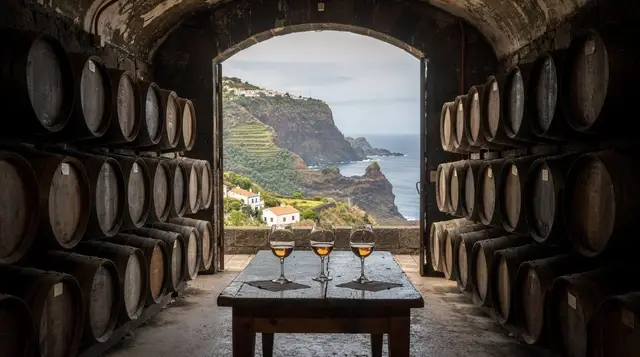
Espetada’s plain, salty grill flavour sits well against Madeira’s local reds, and a growing number of visitors combine a food-focused evening with a proper introduction to the island’s wine rather than treating the two separately. a half-day trip built around Madeira wine tasting gives context for what’s in the glass before or after a grill-house dinner, which is a more useful order than tasting wine cold with no food anchor at all.
For the wine itself, in more depth than fits here, the Madeira wine explained guide and the wine tastings in Funchal guide cover the four noble grapes and where to taste them properly.
If poncha is more your interest than wine, the dedicated poncha guide explains the fisherman’s citrus version served in Câmara de Lobos bars, and the poncha crawl account is a first-hand read on doing exactly that in one evening, espetada included.
Beyond Câmara de Lobos
Both dishes travel well across the island, and it’s worth knowing they aren’t exclusive to one town. In the north, Santana — better known for its triangular thatched houses — has its own tradition of grill taverns serving espetada to visitors who’ve come for the thatched houses and stayed for dinner.
In Funchal, restaurants around the Old Town’s painted-door streets serve both dishes late into the evening, useful if Câmara de Lobos isn’t on your route. Wherever you eat them, the same two questions are worth asking before you order: is the espetada actually beef on laurel wood, and does the bolo do caco actually contain sweet potato. If both answers are yes, you’re eating the real thing.
For the island’s other signature plate, grilled scabbard fish with banana, the scabbard fish account is a useful companion read, and the wider food guide ties espetada, bolo do caco, and everything else on a Madeiran table into one overview.
Questions About Espetada and Bolo do Caco
Is bolo do caco just Madeiran bread?
No. Ordinary bread on the island is wheat dough. Bolo do caco is made with sweet potato worked into the flour, which is what gives it a faint sweetness, a dense chew, and its pale orange-tinged crumb. Leave the sweet potato out and it stops being bolo do caco.
Why is espetada served hanging from a hook?
It is a presentation carried over from the way it was cooked at home and in taverns: the laurel skewer is long enough to rest across the top of the plate or a small tabletop stand, so the meat keeps cooking gently in its own fat and juices as it is pulled off piece by piece, rather than sitting in a puddle on a flat plate.
Why laurel wood specifically?
Laurel (loureiro) grows across Madeira’s hillsides and the island’s own laurel forest, the Laurissilva, gives its name to the tradition. Fresh-cut laurel branches release a faint aromatic smoke as they char slightly over the coals, which is part of the flavour. A metal skewer works but a proper espetada uses wood.
Is espetada always beef?
Traditionally yes. Espetada in Madeira means beef, usually a cut like rump or sirloin cubed generously, marinated only in coarse sea salt, garlic and bay leaf, and never heavily spiced. Menus that put chicken, pork or fish on a skewer and still call it espetada are stretching the word for tourists.
Where is the best place to eat espetada, Câmara de Lobos or Funchal?
Both serve it well, but Câmara de Lobos has the stronger claim: it is a working fishing town where grilled beef on skewers has been standard tavern food for generations, and several restaurants there still grill over wood or charcoal rather than gas. Funchal has more restaurants overall, so quality varies more.
What should I drink with espetada and bolo do caco?
Poncha is the everyday match, particularly the citrus fisherman’s version, and a glass of local red wine works with the beef. Neither is compulsory: plenty of Madeirans order espetada with a beer.
Do I need to book ahead in Câmara de Lobos?
For the well-known grill houses on weekend evenings, yes, or expect to wait. Midweek lunchtimes are far easier and the food is identical.
Is bolo do caco always filled with garlic butter?
That is the standard fill and the one worth ordering first. Some places also serve it plain as a side, or with other fillings such as chouriço, but garlic butter (manteiga de alho) is the dish’s defining pairing.
Food, wine and poncha tours on GetYourGuide
Verified deep-linked GetYourGuide tours. Book through these links and we earn a small commission at no cost to you.
GetYourGuide does not provide a product photo for this activity — the image shows the meeting point, photographed by us.