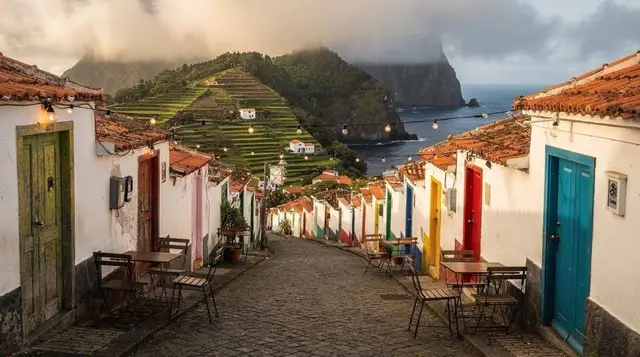
Funchal Old Town: Rua de Santa Maria and the Painted Doors
What makes Rua de Santa Maria and Funchal's Old Town worth a visit?
Rua de Santa Maria is the heart of Funchal's Zona Velha, known for the painted doors of the Arte Portas Abertas project (running since 2010) and its dense run of evening restaurants. The street is quiet and workaday by day, then fills with diners and open shutters after dark, so timing changes what you actually see.
Funchal’s old town, the Zona Velha, is a compact tangle of cobbled lanes squeezed between the seafront and the modern city centre. At its core is a single street, Rua de Santa Maria, that does more to define how visitors picture Funchal than almost anywhere else on the island. It is not the oldest-looking street in Portugal, nor the grandest — what sets it apart is a wall of painted doors running for several hundred metres, and a reputation, well earned, as the place locals and visitors alike go to eat after dark.
This guide stays close to that one street and its immediate lanes. The nearby fish and flower market and the Monte cable car both have their own dedicated pages, since they are different experiences with different logistics; here the focus is the doors, the restaurants, and the very real difference between how this neighbourhood feels at midday and how it feels at ten in the evening.
Where the Old Town Sits in Funchal
The Zona Velha occupies the eastern edge of central Funchal, roughly bounded by São Tiago Fortress and the small pebble beach near the sea on one side, and the approach to the marina on the other. It sits a few minutes’ walk east of the cathedral and the main shopping streets, and a similarly short walk from the Mercado dos Lavradores, though the market itself, with its flower stalls and the fish hall where the black scabbard fish is laid out on ice, deserves its own visit rather than a rushed detour — see the separate market guide for that.
Rua de Santa Maria runs roughly parallel to the seafront, a street or two back from the water, and is easy to find on foot from almost anywhere in central Funchal. It is not large: walking its full length at a relaxed pace, without stopping, takes well under fifteen minutes. What slows visitors down is the doors.
Rua de Santa Maria and the Painted Doors
The street’s roll-down security shutters, the kind every restaurant and shopfront in southern Europe uses to close up overnight, would ordinarily be the least interesting thing about a street. In Funchal’s old town they are the main event. Since 2010, a community initiative called Arte Portas Abertas — “open doors art” — has invited artists, some local, some visiting, to paint these shutters and doors rather than leave them blank.
The results are genuinely varied: portraits, abstract patterns, scenes referencing Madeiran history and folklore, tributes to the buildings’ own past uses, and the occasional piece of pure whimsy. New doors have been added steadily since the project began, so the street is not a fixed gallery — a door painted a decade ago may since have been repainted, and gaps get filled as new artists take part. Walking the full length of Rua de Santa Maria and its immediate side lanes, at a pace that allows for photographs, is the simplest and most rewarding thing to do here, and it costs nothing.
A useful detail that catches first-time visitors out: because the doors being painted are the same shutters restaurants roll down at closing time and up again at opening, the fullest view of the artwork is only available when those shutters are down — which, on a street built around evening dining, means during the day. That single fact is behind the recommendation, further down, to see the street twice.
Funchal’s Old Town by Day
By day, Rua de Santa Maria is quiet, almost workaday. Many of the restaurant fronts are shuttered until the afternoon or early evening, which means their painted doors are fully visible without diners, chairs, or a queue of tourist photographers in front of them. The light along the narrow street is softer and more even in the morning than it is in the harsh midday sun, which matters if photography is the goal.
Daytime is also when the street is at its most walkable: fewer people, no need to weave between outdoor tables, and time to actually read the small information panels that accompany some of the more established pieces. A handful of shops, cafés, and a bakery or two stay open through the day, so it is possible to get a coffee and sit for a few minutes, but this is not the atmosphere the street is best known for.
Combined with a stop at Funchal Cathedral or a slow loop toward the marina, a daytime pass through the old town fits comfortably into a half-day of central Funchal sightseeing — the one-day Funchal itinerary and the broader one-day-in-madeira plan both build in time for exactly this.
Visitors who want the doors explained rather than simply photographed sometimes prefer a guided pass through the neighbourhood. A walking tour through the old town covers Rua de Santa Maria’s history and points out doors and details that are easy to miss on a self-guided walk, and it runs at a daytime hour when the street is at its calmest.
Funchal’s Old Town by Night
This is the point worth repeating: the old town after dark is not the same place as the old town at midday, and treating it as though it were is the single most common way visitors misjudge a return visit. From roughly seven in the evening, the shutters that carried painted artwork all day start rolling up. Restaurant fronts open, tables and chairs move out onto the cobbles, strings of lights come on above the street, and within an hour or two Rua de Santa Maria fills with the noise and movement of one of Funchal’s busiest dining strips.
Some of the painted doors vanish behind open doorways, staff boards, and seated diners until the following morning — a door photographed at 9am may simply not be visible at 9pm. In exchange, the street gains an atmosphere that daytime does not offer at all: live music from more than one restaurant at once, the smell of grilled espetada and garlic bread drifting between tables, and a genuinely sociable crush of people that makes this one of the better places in the city for an evening out rather than a sightseeing stop.
Neither version is more “real” than the other; they are simply different, and a visitor who only sees one is missing half of what the street is about. Anyone with the time is better served by two short visits — a daytime walk for the doors, an evening return for dinner — than by trying to force both experiences into one pass through.
Tuk-tuks are a common sight buzzing through the old town’s lanes in the softer evening light, and for visitors short on time they combine a look at the district with onward transport. A tuk-tuk tour through the old town typically finishes with a drop-off near the Cristiano Ronaldo museum, which works well for anyone continuing east along the seafront afterwards.
Where to Eat in the Zona Velha
Rua de Santa Maria is, by volume, Funchal’s most concentrated restaurant street. That concentration cuts both ways. On one hand, there is real choice: fresh fish grilled to order, espetada served on its traditional bay-leaf skewer, simple grilled chicken piri-piri places, and a scattering of newer, more design-led spots aimed squarely at visitors. On the other hand, being the most visible strip in the city means prices sit a notch above the Funchal average, and quality is genuinely uneven from one door to the next — a beautifully painted shutter says nothing about what is coming out of the kitchen behind it.
A few practical habits help. Menus are posted outside almost every restaurant, so it costs nothing to compare two or three before sitting down. Restaurants that are busy with a mix of Portuguese and foreign customers, rather than exclusively tourists, are usually a reasonable signal. And the side lanes running off Rua de Santa Maria itself, one or two streets back, tend to be a little calmer and a little cheaper than the main run, while still being a short walk from the same atmosphere.
For a broader view of where to eat across the city, including areas outside the old town, the where-to-eat guide and the general Madeira food guide cover ground this page does not, and the poncha guide is worth reading before ordering the local sugarcane spirit here, since tourist-facing fruit versions differ a lot from the traditional lemon poncha.
| When to visit | What you get | What you miss |
|---|---|---|
| Late morning / early afternoon | Full view of painted doors, quiet lanes, easy photography | Restaurants mostly closed, no evening atmosphere |
| Early evening (from ~7pm) | Open restaurants, live music, full street atmosphere | Many doors hidden behind open shutters and diners |
| Two short visits | Both the art and the atmosphere | An extra half-hour or so of walking overall |
Beyond Rua de Santa Maria
The Zona Velha is small enough that a few minutes’ extra walking covers most of what surrounds the main street. São Tiago Fortress, a squat 17th-century harbour defence painted deep ochre-red, anchors the seaward end and is worth a look even from the outside. Toward the water, a short pebble beach and a low seafront promenade give a place to sit that the narrow lanes themselves do not offer. Heading the other way, the walk toward the marina passes cafés and small squares that see far fewer visitors than Rua de Santa Maria itself.
For a longer day that folds in more of central Funchal, the old town pairs naturally with a walk to the cathedral, a look at the market while it is open in the morning, and, for anyone with an afternoon to spare, the ride up to Monte on the cable car — full details in the separate Monte cable car and toboggan guide.
Visitors who would rather have all of this narrated and sequenced for them, including stops the average walking route misses, often choose a wider city tour: options include a ninety-minute Funchal city tour that takes in the old town alongside the wider centre, and, for a more flexible pace, a private custom tour with a local guide that can be built around the old town specifically if that is the priority.
Practical Notes
Getting to Rua de Santa Maria needs no transport beyond walking shoes for anyone already staying in central Funchal; it sits within easy reach of the marina, the cathedral area, and most hotels in the city centre. There is no entry fee and no set opening hours for the street itself, since it is a public lane rather than an attraction with a gate — the only “hours” that matter are the restaurants’ own, which is exactly why day and night look so different here.
Photography is unrestricted and the doors are the obvious subject, but a polite habit worth keeping is not to photograph directly into occupied restaurants during service, since several of the painted doors double as working entrances once the evening trade starts. Cobbles throughout the old town are uneven and can be slippery when wet, which is a minor point in summer and a more relevant one during Madeira’s wetter months.
Anyone planning a full evening should book a table in season, particularly in the run-up to the New Year fireworks and through the busiest summer weeks, since the most photogenic doors also tend to front the most popular restaurants. Outside those peaks, walking the street and choosing on the spot works perfectly well.
FAQ: Rua de Santa Maria and Funchal’s Painted Doors
What is Arte Portas Abertas?
It is the community art project, running since 2010, that invited local and visiting artists to paint the roll-down shutters and doors of Rua de Santa Maria and its side lanes. Hundreds of doors have been painted over the years, and the project keeps adding new ones, so the street changes gradually rather than staying fixed.
Is Rua de Santa Maria worth visiting during the day?
Yes, but for a different reason than in the evening. By day the shutters are down over many restaurant fronts, so more of the painted doors are visible, the light is better for photographs, and the narrow lane is easy to walk without crowds or queues.
Is the old town different at night compared with the day?
Noticeably. From around 7pm the restaurant shutters that were painted doors by day roll up to become open dining rooms, tables spill onto the cobbles, and the street fills with people and noise. Some of the artwork disappears behind open doorways and diners until the following morning.
Is Funchal’s old town safe to walk around at night?
Yes, the Zona Velha is a well-lit, busy restaurant district in the evening and is one of the safer parts of Funchal to walk after dark, with normal city-centre caution around bags and pockets.
How long do you need in the Zona Velha?
Forty-five minutes to an hour covers a daytime walk along Rua de Santa Maria and the surrounding lanes at an easy pace with photo stops. Returning for dinner effectively makes it a second, separate visit.
Are the restaurants on Rua de Santa Maria good value, or just for tourists?
Both exist side by side. The street is Funchal’s most visible restaurant strip, so prices sit a little above the city average and quality varies a lot between neighbouring doors, which rewards checking a menu rather than picking on décor alone.
Where exactly does the old town start and end?
The Zona Velha runs roughly from São Tiago Fortress and the seafront eastward to the marina area, with Rua de Santa Maria as its spine running parallel to the sea a couple of streets back from the water.
tours.funchal-sightseeing
Verified deep-linked GetYourGuide tours. Book through these links and we earn a small commission at no cost to you.
GetYourGuide does not provide a product photo for this activity — the image shows the meeting point, photographed by us.