Poncha in Madeira: What It Really Is and Where to Drink It
What is poncha and where should I drink it in Madeira?
Poncha is Madeira's traditional drink of aguardente de cana (sugarcane spirit), honey and citrus, stirred with a wooden caralhinho. The original is poncha pescador, made with lemon; the bright fruit versions sold to tourists are a modern variation. Camara de Lobos, the old fishing village west of Funchal, is where it is drunk most authentically.
A drink built by fishermen, not by marketing
Long before poncha turned up on cocktail menus with a slice of pineapple balanced on the rim, it was a working drink. Fishermen in Camara de Lobos mixed aguardente de cana — the fiery spirit distilled from Madeira’s sugarcane, the same crop that first drew Portuguese settlers to the island in the fifteenth century — with honey and whatever citrus was to hand, usually lemon. It was cheap, it was warming, and it did the job after a cold morning on the water. That original recipe, poncha pescador, is still what a lot of visitors never actually taste, because the version handed to them in Funchal’s tourist strip has usually been sweetened, coloured and softened into something else entirely.
Understanding that difference is the whole point of this guide. Poncha is not one drink with several optional flavours. It is a specific, honey-and-lemon working man’s spirit, and a family of fruitier, more recent variations that grew up around it once the island discovered that visitors would happily pay for something bright pink with a straw in it.
What actually goes into a poncha
Three ingredients, traditionally:
- Aguardente de cana — sugarcane spirit, distilled locally, typically somewhere in the 40-50% ABV range before mixing. This is the backbone of the drink and the reason poncha has a kick that honey and lemon alone can’t disguise.
- Honey — usually a runny, mild honey, added for sweetness and body rather than flavour dominance.
- Citrus — lemon in the original pescador version, though orange and tangerine both have older, legitimate places in Madeiran poncha too.
The mixing matters almost as much as the ingredients. A proper poncha is made in a wide bowl or cup with a caralhinho, a forked wooden stick that’s twirled between the palms to crush the citrus, dissolve the honey and aerate the whole thing into a pale, slightly cloudy mixture. It’s a small piece of theatre in itself — ask at a bar in Camara de Lobos and most will let you watch, or have a go.
Poncha pescador, the fisherman’s poncha, sticks to this lemon-honey-aguardente formula and nothing else. It’s sharp, strong and not especially sweet. If a menu lists “poncha tradicional” or “poncha de limão,” this is generally what arrives.
Where fruit poncha comes from — and why it isn’t the traditional drink
Somewhere along the way — as Madeira built its modern tourism industry around Funchal’s hotels and cruise terminal — bar owners started swapping or adding fruit: passion fruit, maracuja syrup, orange, even pineapple. These versions are genuinely pleasant, and there is no reason not to order one if that’s what you fancy. The problem is only ever one of labelling: a lot of visitors leave the island believing poncha is a sweet, brightly coloured fruit cocktail, when that’s a modern branch of the tree, not the trunk.
If you want to try the drink as it actually developed, start with poncha pescador. Then, if you like, work outward from there. Ordering it in the other order — fruit poncha first, traditional poncha never — is the single most common way visitors miss what the drink is meant to be.
an evening walk through Camara de Lobos with a local guide, which typically threads in a stop at one of the village’s long-standing poncha bars along the way, is a straightforward way to get the traditional version explained in context rather than guessed at from a menu.
Camara de Lobos: the place to drink it properly
If Funchal is where most visitors first come across poncha, Camara de Lobos is where it belongs. This is still a working fishing village — brightly painted boats pulled up on the shingle, nets drying, a harbour that smells of the sea rather than sun cream — and it has the island’s highest concentration of proper, unpretentious poncha bars, several of them family-run for decades.
Winston Churchill famously painted the harbour here in 1950, and the village trades a little on that association, but the poncha bars predate the postcard version of the place by a long way. The bars worth seeking out tend to be small, standing-room or a handful of stools, no cocktail menu on a laminated card, just aguardente, honey, lemon and a caralhinho behind the counter. Evenings are the natural time to go: the fishing boats are in, the terraces along the harbour fill up, and a poncha or two before dinner is simply how the village winds down.
Beyond Camara de Lobos itself, poncha bars turn up along much of Madeira’s south coast — in Estreito de Camara de Lobos up the hill, and scattered through Funchal’s old town around the marina and the Lido promenade — but none of them match Camara de Lobos for sheer density or authenticity of the drink on offer.
Ordering poncha without ending up with the tourist version
A few practical pointers help avoid the sweetened, fruit-forward default:
- Ask for poncha pescador or poncha de limão by name. A general request for “a poncha” in a busy Funchal bar will often get you whichever version is easiest and most popular with visitors that week, which is rarely the traditional one.
- Watch how it’s made. If the bar mixes it to order with a caralhinho in front of you, that’s a good sign. Pre-batched poncha poured from a jug is faster but a step removed from the ritual that makes the drink what it is.
- Expect it to be strong and a little sharp, not a sweet cocktail. If what arrives tastes like fruit punch, you’ve been given the touristic branch, not the trunk.
- One is usually enough to start with. Aguardente de cana is a genuine spirit, and poncha is often drunk as an aperitif or nightcap rather than something to work through several rounds of.
Poncha, aguardente and Madeira wine: not the same drink
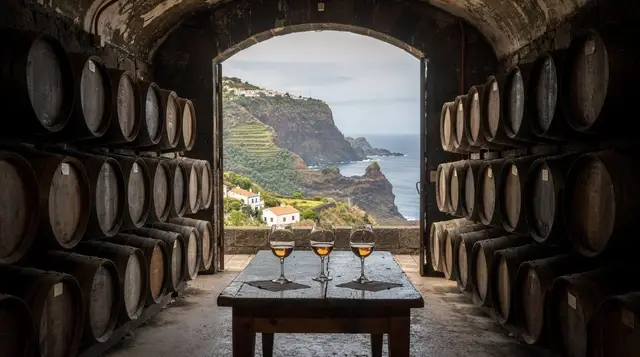
It’s worth being clear about one thing this guide deliberately leaves out: Madeira wine. Poncha and Madeira’s famous fortified wine come from the same island and sometimes get lumped together by visitors who assume every local drink is “the Madeira wine thing,” but they are unrelated products — one a distilled sugarcane spirit mixed fresh at the bar, the other a wine aged and heated over months or years. If you want the wine side of the island’s drinking culture, the Madeira wine guide covers the four noble grape varieties, the estufagem and canteiro ageing methods, and where to taste properly in Funchal.
A number of half-day tours pair the two anyway, since both are quintessentially Madeiran and both happen to converge around the Camara de Lobos and Estreito area, where sugarcane fields once stood alongside the terraced vineyards on the hillsides above the coast. a half-day tour that combines Madeira wine tasting with a look at the island’s drinking traditions is a reasonable way to cover both without having to plan two separate outings.
A tuk-tuk view of poncha country
Camara de Lobos itself is small and easily walked, but the steep lanes above the harbour and the views back down over the fishing boats are worth seeing from somewhere other than pavement level. a tuk-tuk tour through the fishing village and its backstreets covers that ground quickly, usually finishing somewhere with time to stop for a poncha at street level once the tour itself is done.
For visitors basing themselves further along the coast near Cabo Girao, a combined Cabo Girao and Camara de Lobos wine-tasting tour from Funchal is one of the more efficient ways to see the skywalk, the terraced vineyards and the poncha bars in a single half-day out.
What to eat alongside it
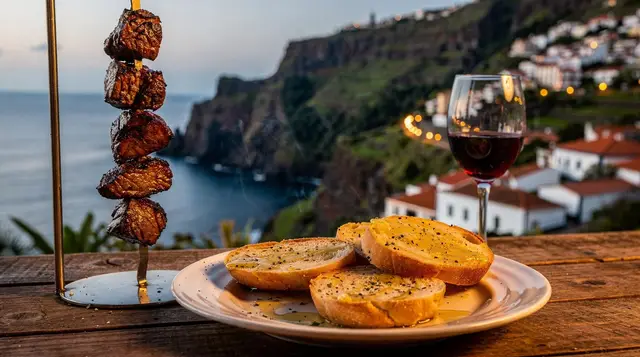
Poncha bars in Camara de Lobos are rarely restaurants themselves, but they sit close to some of the island’s better espetada spots — beef skewers cooked over laurel wood and served hanging from the fork, a genuinely Madeiran pairing with a strong, honeyed spirit. The espetada and bolo do caco guide covers that pairing in detail, and the broader Madeira food guide and where to eat by area page are useful if you’re building an evening around Camara de Lobos rather than just passing through.
If your evening starts in Funchal, the Mercado dos Lavradores is worth a daytime visit first — the market’s fish hall gives a sense of what the fishermen who invented poncha were actually working with, even if the market itself closes long before poncha hour begins. The old town and painted doors walk is a good way to fill the afternoon before heading out to Camara de Lobos for the evening.
Planning a poncha evening
| When to go | Why |
|---|---|
| Early evening (from around 18:00) | Fishing boats are in, terraces fill up, bars are lively without being rowdy |
| Weeknight | Quieter, easier to get a stool at the smaller family-run bars |
| Weekend evening | Livelier atmosphere, sometimes music, but busier bars |
| Straight after a sunset viewpoint stop | Camara de Lobos itself has good sunset views over the harbour before the bars fill up |
| Poncha style | What’s in it |
| Poncha pescador | Aguardente de cana, honey, lemon |
| Poncha de tangerina / laranja | Aguardente, honey, tangerine or orange |
| Fruit poncha (maracuja, mixed fruit) | Aguardente, honey, fruit syrup or juice |
| Home-mixed | Aguardente, honey, lemon, no caralhinho |
Getting there and around
Camara de Lobos sits about 15 minutes west of Funchal by car or taxi, and it’s an easy stop on the way to or from Cabo Girao and the west coast. Public buses run from Funchal, but for an evening out with a poncha or two involved, a taxi back is the sensible choice rather than driving Madeira’s steep, narrow coastal roads afterwards — see the driving in Madeira guide for why that matters even on short, familiar-looking routes.
For general planning around the island’s drinking and eating culture, the things to do: wine and poncha category and the things to do in Camara de Lobos page round up other options nearby, and honest first-hand accounts from other visitors sit in a poncha crawl in Camara de Lobos and tap water, tipping and other small things.
Poncha questions answered
What is poncha made from?
Traditional poncha is aguardente de cana (sugarcane spirit distilled in Madeira), honey and citrus, muddled and mixed with a wooden stick called a caralhinho until the honey dissolves and the drink turns cloudy.
What is the difference between poncha pescador and fruit poncha?
Poncha pescador, the fishermen’s version, uses only lemon juice alongside the aguardente and honey. Fruit ponchas made with passion fruit, maracuja syrup or other flavourings are a later, more colourful adaptation aimed largely at visitors, not the original recipe.
Where is the best place to drink poncha in Madeira?
Camara de Lobos, a working fishing village around 15 minutes west of Funchal, has the highest concentration of long-standing poncha bars and is generally considered the drink’s spiritual home on the island.
Is poncha strong?
Yes. Aguardente de cana typically runs somewhere around 40-50% ABV before it is mixed, and even diluted with honey and citrus a single poncha carries a real kick, especially on an empty stomach.
Can I make poncha at home?
Yes, with aguardente de cana (sold in most Madeiran supermarkets and at the airport), runny honey and fresh lemon, muddled together. A caralhinho is not essential; a strong wooden spoon does the same job, just less traditionally.
Is poncha safe for someone driving afterwards?
No. Poncha is a spirit-based drink and should be treated like any strong cocktail. If you are driving Madeira’s mountain roads afterwards, skip it or stick to one and wait it out.
Do poncha bars serve food too?
Most poncha bars in Camara de Lobos and along the coast are simple, often standing-room places built around the drink itself, though several sit close to espetada restaurants and share the same evening crowd.
Food, wine and poncha tours on GetYourGuide
Verified deep-linked GetYourGuide tours. Book through these links and we earn a small commission at no cost to you.
GetYourGuide does not provide a product photo for this activity — the image shows the meeting point, photographed by us.