Two Places, One Name
Madeira has two Câmara de Lobos, and confusing them is the single most common mistake a first-time visitor makes when planning this stretch of the south coast. Down at sea level sits the fishing village that most guidebooks mean when they say “Câmara de Lobos”: a working harbour, brightly painted boats, and the poncha bars where Winston Churchill famously set up his easel in 1950. Above it, climbing the slope on the road towards Cabo Girão and the west, is Estreito de Câmara de Lobos — a separate civil parish, its own centre, its own church, and a landscape defined not by boats but by vines.
“Estreito” means narrow or tight, describing the constricted shelf of land the settlement occupies on the hillside. If you are chasing the poncha-and-fishing-village image, you want the coastal village, not this one. If you want to see where the grapes that go into Madeira wine and the cane that goes into poncha are actually grown, this is the place, and it deserves a stop of its own rather than a glance from a passing car.
The two places sit only a few kilometres apart by road, and it is entirely possible to visit both in a single outing — but they are not the same stop, and treating them as interchangeable is how visitors end up circling the harbour looking for vineyards that are not there.
Getting There
Estreito de Câmara de Lobos sits on the hillside above Câmara de Lobos proper, reached by the ER101 or minor roads climbing inland from the coast, roughly 15 to 20 minutes’ drive from Funchal. There is no direct bus service tuned to tourists, so this is realistically a stop made with a hire car, on the way toward Cabo Girão, Quinta Grande and Ribeira Brava further along the west coast.
The roads here are typical of inland Madeira — narrow, steep in places, with tight bends between the terraces — so a small car makes the drive considerably less stressful than a large one. Anyone unfamiliar with Madeira’s mountain roads should read a guide to driving in Madeira before setting out, and check the basics of car rental in Madeira if this is a first visit to the island.
There is no fee to visit the village itself, no ticket booth, and no reservation system — a straightforward contrast with the paid official trails elsewhere on the island.
The Terraces (Poios)
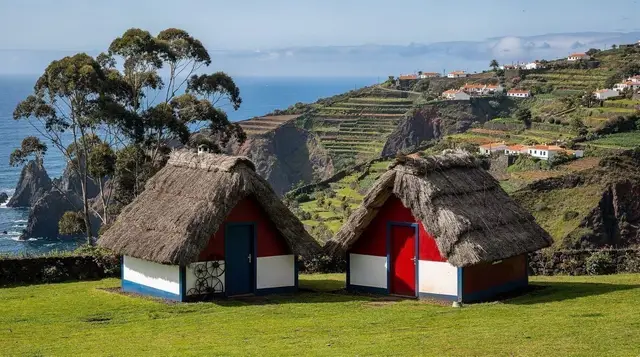
What makes Estreito de Câmara de Lobos worth the detour is visible the moment the road climbs above the port: tier upon tier of stone-walled terraces, known locally as poios, cut into the hillside to create flat ground on slopes that would otherwise be unfarmable. These terraces are Madeira’s answer to the island’s defining problem — almost no land is naturally level — and nowhere on the south coast is the pattern more concentrated or more photogenic than the slope above Câmara de Lobos. The stone retaining walls, built by hand over generations, hold back the soil and catch the sun that pours onto this south-facing hillside for most of the year.
The crop on these terraces is overwhelmingly the grape, and this parish is one of the traditional heartlands of Madeira wine production. The vines here are typically trained on pergolas rather than low bushes, keeping the fruit up off the damp ground and making the most of every available strip of sun-facing terrace. Walking or driving slowly through the lanes between plots in late summer, when the bunches are ripening, gives a far more direct sense of where Madeira wine actually comes from than a tasting room in Funchal ever can — for background on the wine itself, a guide to how Madeira wine is made fills in what the vines eventually become.
Wine and Poncha, from the Ground Up
Two Madeiran traditions trace back to this hillside, and it is worth being specific about which is which. The first is Madeira wine, the fortified wine matured by gentle heating (estufagem in industrial tanks, canteiro in the traditional method under the roof beams) rather than by ageing alone.
Estreito de Câmara de Lobos and the surrounding terraces are part of the supply chain that feeds the wine lodges of Funchal, including Blandy’s Wine Lodge in the city centre, where the finished product is tasted rather than grown. A visitor curious about the process end to end can read the fuller explanation in the guide to Madeira wine and the seasonal detail in the piece on vineyards and the wine festival.
The second tradition is poncha, and here the connection runs through sugar cane rather than grapes. Poncha is built from aguardente de cana — cane spirit — mixed with honey and citrus and stirred with a wooden implement called a caralhinho. Sugar cane has been grown on Madeira’s warmer lower slopes since the earliest Portuguese settlement, and while the poncha bars themselves are concentrated down in the coastal village, the raw material historically came from plots like the ones on this hillside.
The full picture of how the drink is made, and which versions are traditional versus tourist-oriented, is covered in the dedicated poncha guide — worth reading before ordering, since the citrus-based “poncha pescador” is the traditional version and the elaborate fruit cocktails sold to tourists are a more recent addition.
It is this double role — wine grapes on the terraces, cane in the lower ground, and both feeding drinks that define Madeiran culture — that gives Estreito its identity, distinct from the fishing and painting associations of the port below.
Walking the Lanes
There is no signed tourist trail through Estreito de Câmara de Lobos in the way there is at the Rabaçal levadas or the Ponta de São Lourenço, and that is part of its appeal: this is a place to wander rather than to hike a marked route. The narrow lanes between the terraces are public, mostly quiet, and give walkers a close-up view of the stone walls, the pergola-trained vines and the working smallholdings that most coach tours never see. Good footwear still matters — the lanes are steep, uneven in places, and offer no shade in the middle of the day.
For visitors who want a proper walking route in this part of the island rather than an informal wander, the nearest waymarked option is the levada network further along the west coast around Serra de Água and Prazeres, reachable within half an hour’s drive.
A guided option through this terrain is the scenic levada walk from Serra de Água, which covers similar terraced, cultivated hill country a short drive further west. Those wanting a private, slower-paced version with more explanation of the landscape and its agriculture can look at the private guided levada walk near Prazeres instead.
Views Over the Bay
Because the parish sits on the hillside rather than at sea level, several points along its roads and lanes open onto wide views back down over Câmara de Lobos port and the ocean beyond — a different angle from the postcard shot taken from the harbour itself, and usually far quieter. Late afternoon light, coming in low from the west, picks out the terraces and the stone walls particularly well, making this a worthwhile stop for photographers heading toward Cabo Girão for sunset. There is no dedicated viewpoint platform or car park built for tourism here — the views are found along the ordinary village roads, which is exactly why the village rarely appears crowded.
Where This Fits on a West Coast Day
Estreito de Câmara de Lobos works best as one stop within a longer loop of the south-west coast rather than a destination in its own right. A typical half-day or full-day sequence starts in Funchal, calls first at the coastal village of Câmara de Lobos for the port and its poncha bars, climbs to Estreito for the terraces, continues to the skywalk at Cabo Girão, and finishes further along at Ribeira Brava or Campanário.
Anyone assembling this kind of route without a rental car can look at organised alternatives — the 4x4 safari through Madeira’s wild west covers much of this same coastline with a driver-guide, while the sunset jeep tour to Paúl do Mar pushes further west and times the drive for the evening light the terraces are known for.
A fuller west coast itinerary, with timings for each stop, is laid out in the west Madeira day trip guide, and the broader food-and-wine angle is covered in the Madeira food and wine weekend itinerary for travellers building a trip specifically around eating and drinking well.
Practical Notes
| Detail | Information |
|---|---|
| Distance from Funchal | Around 12 km, 15–20 minutes by car |
| Entry fee | None |
| Parking | Limited, on-street; arrive early or mid-morning |
| Best light for photos | Late afternoon, looking toward the coast |
| Harvest season | August–September, when the terraces are busiest |
| Facilities | A handful of local cafés; no tourist infrastructure |
There is no bus route aimed at visitors, no organised walking tour confined to the parish itself, and no admission gate — which also means there is no official body monitoring opening hours or conditions the way the IFCN does for the levada trails. This is a place visited on your own schedule, ideally with a car and a willingness to follow minor roads rather than the coastal highway.
Estreito de Câmara de Lobos: Frequently Asked Questions
Is Estreito de Câmara de Lobos the same as Câmara de Lobos?
No. Câmara de Lobos is the coastal fishing village with the harbour, the colourful boats and the poncha bars associated with Winston Churchill. Estreito de Câmara de Lobos is a separate, higher parish on the hillside above it, known for its terraced vineyards rather than its port. They share a name but not a location, and searching for one while standing in the other is a common source of confusion.
How do I get to Estreito de Câmara de Lobos?
By car, via the ER101 or minor roads climbing inland from the coastal village, around 15 to 20 minutes from Funchal. There is no dedicated tourist bus service, so a hire car or a private driver is the practical option.
Can I visit the vineyards themselves?
The terraces are mostly private smallholdings without formal visitor facilities, so the experience is one of walking the public lanes between plots and viewing the vines from the road rather than a ticketed vineyard tour. For a structured wine experience, the tastings at Blandy’s Wine Lodge in Funchal are the better option.
Is there an entry fee or trail permit for Estreito de Câmara de Lobos?
No. Unlike Madeira’s official PR-numbered levada trails, which have required a paid permit since August 2021, there is no fee to walk the lanes or roads of Estreito de Câmara de Lobos.
What is the connection between this village and poncha?
Poncha is made from cane spirit, honey and citrus, and sugar cane has historically been grown on Madeira’s lower, warmer terraces, including those around Câmara de Lobos. The drink itself is served in the bars of the coastal village below, but the agricultural roots of the tradition sit partly on this hillside.
When is the best time to visit?
April to October gives the clearest views over the terraces and the coast, and late afternoon light is best for photography. The grape harvest in August and September is the most visually active period, with pickers working the poios.
How much time should I plan for?
Half a day is enough to drive up, wander the lanes, take in the views and continue toward Cabo Girão or Ribeira Brava. It works well as one stop within a longer west coast loop rather than a standalone destination.
Should I combine this with the coastal village or visit separately?
Combining both makes sense given the short distance between them, but plan for two distinct stops with two distinct characters — the port for boats and poncha, Estreito for terraces and vines — rather than expecting one visit to cover both.
faq:
- question: “Is Estreito de Câmara de Lobos the same as Câmara de Lobos?” answer: “No. Câmara de Lobos is the coastal fishing village with the harbour, the colourful boats and the poncha bars associated with Winston Churchill. Estreito de Câmara de Lobos is a separate, higher parish on the hillside above it, known for its terraced vineyards rather than its port. They share a name but not a location, and searching for one while standing in the other is a common source of confusion.”
- question: “How do I get to Estreito de Câmara de Lobos?” answer: “By car, via the ER101 or minor roads climbing inland from the coastal village, around 15 to 20 minutes from Funchal.
There is no dedicated tourist bus service, so a hire car or a private driver is the practical option.”
- question: “Can I visit the vineyards themselves?” answer: “The terraces are mostly private smallholdings without formal visitor facilities, so the experience is one of walking the public lanes between plots and viewing the vines from the road rather than a ticketed vineyard tour. For a structured wine experience, the tastings at Blandy’s Wine Lodge in Funchal are the better option.”
- question: “Is there an entry fee or trail permit for Estreito de Câmara de Lobos?” answer: “No.
Unlike Madeira’s official PR-numbered levada trails, which have required a paid permit since August 2021, there is no fee to walk the lanes or roads of Estreito de Câmara de Lobos.”
- question: “What is the connection between this village and poncha?” answer: “Poncha is made from cane spirit, honey and citrus, and sugar cane has historically been grown on Madeira’s lower, warmer terraces, including those around Câmara de Lobos.
The drink itself is served in the bars of the coastal village below, but the agricultural roots of the tradition sit partly on this hillside.”
- question: “When is the best time to visit?” answer: “April to October gives the clearest views over the terraces and the coast, and late afternoon light is best for photography.
The grape harvest in August and September is the most visually active period, with pickers working the poios.”
- question: “How much time should I plan for?” answer: “Half a day is enough to drive up, wander the lanes, take in the views and continue toward Cabo Girão or Ribeira Brava. It works well as one stop within a longer west coast loop rather than a standalone destination.”
- question: “Should I combine this with the coastal village or visit separately?” answer: “Combining both makes sense given the short distance between them, but plan for two distinct stops with two distinct characters — the port for boats and poncha, Estreito for terraces and vines — rather than expecting one visit to cover both.”