A West Madeira Day Trip: Cabo Girão, Porto Moniz and Ponta do Pargo
What does a west Madeira day trip actually cover?
A loop from Funchal to Cabo Girão, Porto Moniz, Seixal and Ponta do Pargo, returning either along the coast or over the Paul da Serra plateau. Done at a reasonable pace it takes a full day, roughly 8 to 10 hours door to door, and needs a car or a guided tour rather than public buses.
Why the west coast works as one loop
Madeira’s west is where the island’s two personalities sit closest together: the dry, terraced south coast around Câmara de Lobos and Ribeira Brava, and the wetter, wilder north-west coast around Porto Moniz and Seixal. A single day can join both, provided the plan respects how the roads actually behave rather than how they look on a map.
This guide sets out the logical order — Cabo Girão, then Porto Moniz, then Seixal, then optionally Ponta do Pargo — and the realistic time each leg costs. For the practical detail on any one stop, the linked guides below cover opening hours, facilities and photography angles in full; this page stays focused on the sequence and the driving.
The short version: leave Funchal by 8.30am, be at Cabo Girão by 9am before the coach groups arrive, reach Porto Moniz by late morning, eat lunch there, walk Seixal in the early afternoon, and either push on to Ponta do Pargo or turn back over the Paul da Serra plateau by mid-afternoon. Done this way it is a full day, not a rushed one, and it leaves room for the one thing that cannot be scheduled on this coast: the weather.
The route at a glance
| Leg | Distance | Driving time | Suggested stop |
|---|---|---|---|
| Funchal to Cabo Girão | ~15 km | 25–30 min | 45–60 min |
| Cabo Girão to Porto Moniz | ~50 km | 1 h–1 h 15 | 60–90 min |
| Porto Moniz to Seixal | ~15 km | 20–25 min | 45 min |
| Seixal to Ponta do Pargo (optional) | ~25 km | 35–40 min | 30–45 min |
| Return to Funchal (via Paul da Serra) | ~65–75 km | 1 h 30–1 h 45 | — |
These are dry-road, no-traffic times. Add a margin for the tourist coaches that share the same stops, and for slowing down on the narrower stretches beyond Ribeira Brava — this is not a road to drive to the printed time.
Stop one: Cabo Girão
The VR1 expressway carries you fast along the south coast through tunnels past Câmara de Lobos, the fishing village where Winston Churchill used to paint, and on to the turn-off for Cabo Girão. At around 580 metres, it is one of the highest sea cliffs in Europe, and since 2012 a glass-floored skywalk has let visitors stand out over the drop with the banana terraces and the ocean directly beneath their feet.
It is free to visit and takes under an hour including photos, which is why it works best as the first stop of the day, before the cruise-ship coaches fill the car park from mid-morning. The full detail on angles, opening times and the short walk from the car park is in the Cabo Girão skywalk guide.
From Cabo Girão, the road continues through Ribeira Brava, where the ER101 properly begins its long run along the north-west coast. This is the point where the character of the drive changes: fewer tunnels, more open bends, and the sea often visible far below on the passenger side. It is a spectacular stretch and also the one where speed needs to come down — allow the driving time above rather than what the distance alone suggests.
Stop two: Porto Moniz and its natural pools
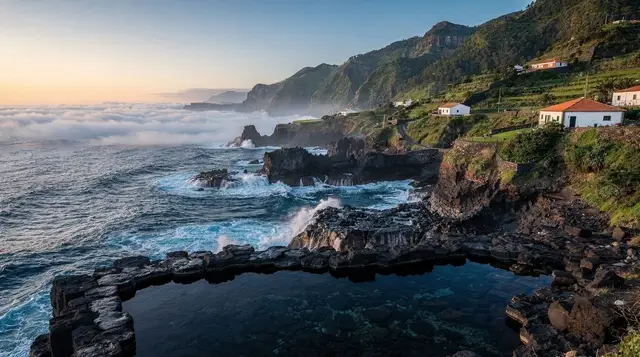
Porto Moniz sits at the island’s north-western corner, where lava flows reaching the sea centuries ago left behind hollows that the ocean now fills and drains with the tide. There are two separate things to know before arriving, and conflating them is the most common mistake visitors make.
First, there are two pool areas, not one: a managed, walled complex with changing rooms and an entrance fee, and the older natural pools further along the shore, open and free. Second — and this is the point worth repeating rather than assuming — the natural pools close when the Atlantic swell is running too high for safe swimming, which happens on a meaningful number of days, especially from autumn through spring, and it can happen without warning in summer as well.
Nobody can promise from a website that the pools will be open on the specific day of your visit. Treat the walled pools as the reliable option, the natural pools as a bonus if conditions allow, and never structure a trip around swimming in the natural pools alone. The full breakdown of both areas, admission and how to check conditions before you set off is in the natural lava pools guide and the dedicated Porto Moniz natural pools page.
Porto Moniz village itself is small and built almost entirely around this coastline — a scatter of seafood restaurants with terraces facing the pools makes it a natural lunch stop, and by late morning you will have earned it. If a car feels like too much for this leg alone, a direct transfer option exists too: a direct day transfer from Funchal to the Porto Moniz volcanic pools covers the drive without the responsibility of doing it yourself, though it fixes your schedule to theirs rather than leaving room for Seixal and Ponta do Pargo on the same day.
Stop three: Seixal
Fifteen minutes east along the coast from Porto Moniz, Seixal is smaller and less visited, and for many people the more striking of the two. A black-sand beach sits below cliffs with cascades that, after rain, run directly down onto the road, and a second set of natural pools offers a quieter, less crowded alternative to Porto Moniz’s — subject to the same swell-dependent closures. The village is widely reckoned the most photogenic on the north coast, and forty-five minutes is enough to walk the shoreline path and take it in without feeling rushed.
Between Porto Moniz and Seixal, and again continuing east, the road runs close under São Vicente, a possible detour if you have extra time and want to see the lava tube caves rather than continue further west — though on the itinerary as set out here, the priority runs the other direction, towards Ponta do Pargo.
Stop four: Ponta do Pargo, if the day allows it
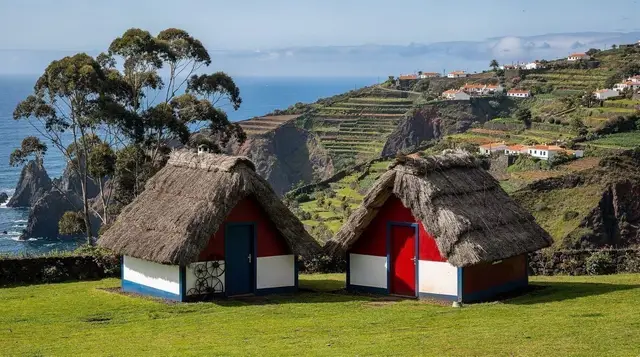
Beyond Seixal the road climbs and turns inland briefly through Achadas da Cruz, known for its small service cable car that drops steeply down to a cultivated ledge by the sea — dramatic, and often closed by wind, so treat it as a possibility rather than a plan. Continuing on brings you to Ponta do Pargo, the island’s westernmost point, marked by a lighthouse with clifftop views back along the coast you have just driven. It is a genuinely different mood from anywhere else on this route — quieter, more agricultural, more exposed.
The honest trade-off: Ponta do Pargo adds roughly 40 minutes of driving each way beyond Seixal, which on a day that started at Funchal and already includes Cabo Girão, Porto Moniz and Seixal is a meaningful extension. If you started later than 9am, or you are travelling with young children, skipping Ponta do Pargo and turning back at Seixal keeps the day comfortable rather than a race against the light.
Getting back: two ways to close the loop
From Ponta do Pargo, or from Seixal if you turned back earlier, there are two sensible ways home. The first retraces the coast road, which by late afternoon is familiar and predictable. The second cuts inland and up onto the Paul da Serra plateau before dropping back down through Encumeada to the south coast — longer in distance but often quicker in practice, and it adds a completely different landscape, open, flat and frequently wrapped in cloud, to a day that has otherwise been all coastline. Either way, plan to be back on the VR1 before dusk: the mountain and coastal roads on this side of the island are not ones to learn after dark.
Doing it with a guide instead
Self-driving gives control over pace and stops, but several operators run this coast as a set day trip, generally with the advantage of including Fanal — the misty laurel forest at the edge of Paul da Serra that is genuinely difficult to add to a self-drive west coast day without cutting something else. A guided 4x4 option: a full-day 4x4 tour covering Porto Moniz, Seixal and Fanal Forest follows broadly the same logic as this guide but with an experienced local driver on the narrower stretches, which is worth the cost for anyone uneasy about the road beyond Ribeira Brava.
A smaller-group, more flexible version is available as a private full-day tour taking in Cabo Girão and Porto Moniz which can be adjusted on the day if the natural pools turn out to be closed. For travellers who want the coastal drama without committing a full day, a shorter option exists as a tour focused on the western coastline and Cabo Girão’s cliffs, and for those based nearer the north coast already, a locally-run alternative, a 4x4 tour of the north coast starting from Porto Moniz, covers the same stretch from the opposite direction.
Practical notes for driving it yourself
A hire car is close to essential for this route on your own schedule — the guidance on choosing one and picking it up is in the car rental in Madeira guide. Once on the road, the driving in Madeira guide covers what the VR1 versus the older coast roads actually feel like, including the steep ramps and tight village streets that appear once you’re off the expressway. A smaller car is a genuine advantage on the ER101 west of Ribeira Brava, where oncoming traffic on blind bends is common and a compact car simply has more room to work with.
Fuel up before leaving Funchal or in Ribeira Brava — stations thin out past that point. Parking at Cabo Girão and Porto Moniz is straightforward outside peak coach hours; Seixal has limited roadside space that fills by midday in high season.
What to expect from the weather on this coast
The west behaves differently from the south coast around Funchal. Expect more cloud and a meaningfully higher chance of rain at Porto Moniz and Seixal than you’ll have left behind in Funchal that same morning, particularly outside the summer months — this coast faces the prevailing weather rather than sitting in its shadow. It is also the reason the swell that closes the natural pools builds here rather than on the sheltered south coast. None of this rules out the trip; it does mean packing a light waterproof even on a day that starts sunny, and not treating a forecast checked in Funchal as valid for Porto Moniz.
When not to attempt swimming, and what to do instead
If you arrive at Porto Moniz and find the natural pools closed, do not treat it as a wasted stop. The walled pool complex nearby is built precisely for days like this, sitting slightly back from the open coast and generally staying open when the natural pools cannot. Failing that, the seafront itself — cafés, the small harbour, the view out to where the swell is breaking — is worth the visit on its own, and Seixal’s black-sand beach a short drive on gives a second, calmer option for time by the water even without swimming. The point worth carrying into the day is simple: build the route around the drive and the landscape, and let swimming be a bonus if conditions cooperate, never the fixed plan.
Who this day trip suits, and who it doesn’t
This route rewards travellers comfortable with a full day of driving and a genuine appetite for coastal scenery rather than a checklist of beaches. It suits photographers, first-time visitors wanting to see the island’s other coast beyond Funchal, and anyone basing their trip around a one-week Madeira itinerary with a free day to allocate to the west. It suits less well families with very young children facing a long day in the car, and anyone nervous about narrow cliff-edge roads, for whom one of the guided options above removes the main source of stress.
For a wider read on how the seasons change this side of the island, the best time to visit Madeira guide and the swimming safety in the Atlantic guide are worth reading before you go, and for the layout of the island as a whole, comparing this route against the north and east makes the case for doing the west as its own dedicated day rather than folding it into a faster circuit of everything at once.
Frequently asked questions about the west Madeira day trip
Can I swim in the Porto Moniz natural pools on the day I visit?
Not guaranteed. The volcanic pools close when the Atlantic swell is up, which happens often between October and March and can happen in summer too. Build in a plan B, such as the paid, walled pools nearby, and never treat the natural pools as the fixed centrepiece of the day.
How long does the west Madeira route take by car?
Allow 8 to 10 hours from Funchal and back, including stops. The driving itself is only 3 to 4 hours, but Cabo Girão, Porto Moniz and Seixal each deserve 45 minutes to an hour, and the roads are slower than the map suggests.
Is the road to Porto Moniz difficult to drive?
The VR1 south coast section to Ribeira Brava is fast and easy. Beyond that, the ER101 along the north-west coast is narrower, with tunnels, tight bends and steep drops, and needs a confident, unhurried driver. A small hire car is easier to manage than a large one.
Should I book a 4x4 tour instead of self-driving the west?
It removes the driving stress and usually adds a stop at Fanal that is hard to combine with Porto Moniz and Seixal in a single self-drive day. It costs more than a hire car and takes control of the pace away from you, which is the trade-off to weigh.
Is Ponta do Pargo worth the extra drive from Porto Moniz?
If you have the time, yes, for the lighthouse and the sense of reaching the island’s western edge, but it adds roughly 40 minutes each way beyond Porto Moniz. On a tight day, most people skip it and turn back at Porto Moniz or Seixal instead.
What is the best order to do this route in?
Cabo Girão first, then Porto Moniz, then Seixal, then Ponta do Pargo if time allows, returning via the Paul da Serra plateau or back along the coast. Doing Cabo Girão early avoids the worst of the midday cruise-ship crowds there.
Can I do this trip without a car?
Not easily as a self-planned day. Bus routes exist but do not link these stops on a timetable that supports one day, so most car-free visitors either book a guided west coast tour or split the sights across the public bus network over more than one day.
Day trips to Porto Santo on GetYourGuide
Verified deep-linked GetYourGuide tours. Book through these links and we earn a small commission at no cost to you.
GetYourGuide does not provide a product photo for this activity — the image shows the meeting point, photographed by us.