North versus South Madeira: Which Side Should You Base Yourself On?
What's the real difference between north and south Madeira?
The south, around Funchal, is sunnier, drier and holds most of the hotels, restaurants and nightlife. The north, around São Vicente and Santana, is wetter, greener and holds the Laurissilva forest, the lava caves and several of the island's best levada walks. Most visitors base themselves in the south and treat the north as a series of day trips, not the other way round.
Two coastlines, two different islands
Madeira is small enough to cross in under an hour, yet it holds two climates that barely resemble each other. Stand in Funchal on a bright October morning and you’d assume the whole island is having the same weather. Drive north through one of the tunnels under the central mountains and you might arrive in São Vicente to find cloud sitting on the hills and rain on the windscreen. This isn’t a fluke of one particular day — it’s the normal state of things, and it’s the single most useful fact to understand before you plan where to stay and what to do.
The reason is the mountains themselves. Madeira’s interior peaks rise past 1,800m, and the Atlantic trade winds arrive loaded with moisture from the north-east. When that air hits the island, it’s forced upward over the central ridge, cools, and drops its rain on the northern slopes. By the time the same air spills over the top and down towards Funchal, it has largely dried out. The result is a south that’s sunny and comparatively dry for most of the year, and a north that’s green, damp and considerably cooler — often by several degrees on the same afternoon.
That contrast isn’t a minor detail for photographers chasing dramatic skies. It shapes almost every practical decision a visitor makes: where the hotels are, where the restaurants cluster, which coastline gets crowded in August, and — most importantly — which side holds the landscapes that make Madeira worth the flight in the first place. Treating the north as an optional extra, tacked onto a week otherwise spent by a Funchal pool, is one of the more common ways visitors undersell the island.
The south: where almost everyone stays
The vast majority of Madeira’s accommodation sits along the southern coast, concentrated around Funchal and stretching out towards Câmara de Lobos and Calheta to the west. This is where the island’s infrastructure for tourism was built: the cruise port, the hotel zone along the Lido promenade, the restaurants of the old town, the marina, and the airport itself, all on the drier, sunnier side.
There are good reasons this pattern holds. Funchal gets noticeably more sunshine hours across the year than the north coast, the sea along this stretch tends to be calmer, and the density of restaurants, bars and organised tours means you’re never short of something to do in the evening. If your priority is a week that mixes beach or pool time with city wandering and a manageable drive to the mountains, the south does that job well. See our guide on where to stay in Madeira for how the different southern towns compare.
The trade-off is that the south, for all its convenience, is the more developed and more visited side of the island. What it doesn’t have is the ancient forest, the lava caves or several of the walks that regularly top “best of Madeira” lists — those belong to the north.
The north: green, wet, and not remotely a consolation prize
It’s tempting, looking at a map with all the hotels clustered in the south, to assume the north is a secondary attraction — somewhere to glance at from a viewpoint before heading back to the pool. That reading gets the island backwards. The north holds the Laurissilva forest, a UNESCO World Heritage relic of laurel woodland that is the largest surviving example of its kind anywhere, covering close to a fifth of the island on the northern slopes.
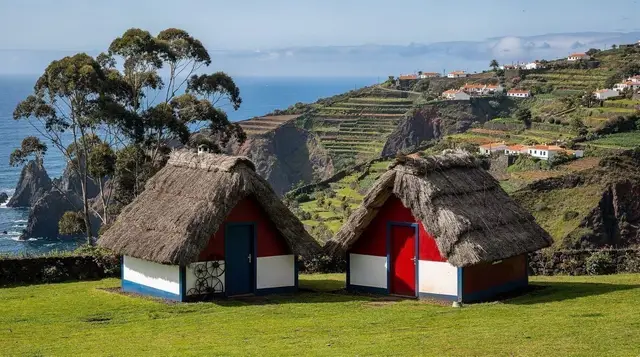
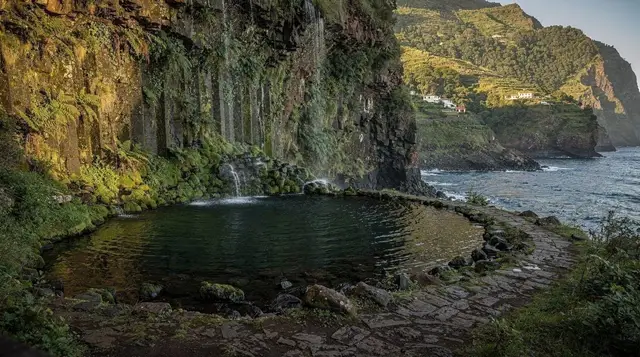
It holds the lava tubes at São Vicente, the tide-fed natural pools at Porto Moniz and the black-sand pools of Seixal. It holds the triangular thatched houses of Santana, and it’s the starting point for the Levada do Caldeirão Verde from the Queimadas forest park, one of the walks most guides put at the very top of the list.
None of this is scenery you can substitute from the south coast. If a week in Madeira skips the north entirely, it skips the forest that gives the island its UNESCO status, the coastline that produces its most photographed waterfalls-onto-roads, and several of its signature levada walks. The north isn’t the quiet cousin of Funchal — it’s where a large share of what makes Madeira distinctive actually is.
What it lacks is Funchal’s polish. Towns like São Vicente and Porto Moniz are small, hotel options are thin on the ground, and the weather works against long beach days — there’s no real beach to speak of on most of this coast anyway. This is why the north works best as a base for exploring rather than a base for staying: day trips in, memorable hours out, back to drier ground by evening.
North versus south at a glance
| South (Funchal & west) | North (São Vicente & Santana) | |
|---|---|---|
| Typical weather | Sunnier, drier, warmer | Cloudier, wetter, cooler |
| Where the hotels are | The large majority | Very limited |
| Signature landscape | Coastal cliffs, Funchal city, terraced vineyards | Laurissilva forest, lava caves, waterfalls onto roads |
| Best for | Basing yourself for the whole trip | Day trips from the south |
| Standout walks | Levada dos Balcões, Pico do Arieiro | Levada do Caldeirão Verde, Levada das 25 Fontes area |
| Getting there | Airport, cruise port, main roads | 30–60 minutes by car via tunnel roads from Funchal |
Neither side is simply “better” — they do different jobs. The mistake is planning a trip that only accounts for one of them.
Why the divide should shape your itinerary, not just your day trips
Because the climate split is this reliable, it’s worth building around it rather than hoping for the best. If your week includes only sunny-day activities — beach time, boat trips, wandering Funchal’s old town — the south covers everything and there’s little reason to fight the weather by pushing north on a wet-looking morning. But if the Laurissilva forest, the caves, or Caldeirão Verde are on your list, it’s worth watching the forecast specifically for the north rather than judging it by what Funchal looks like out the window. A blue-sky morning in Funchal tells you very little about conditions in São Vicente an hour later.
The practical advice most repeat visitors land on: keep your accommodation in the south for the comfort and convenience, but treat one or two full days as dedicated “north days” and commit to them regardless of what the southern sky is doing that morning — because on the north coast, changeable weather is closer to the default than the exception, and waiting for a perfect forecast can mean never going. Pack for both climates; see what to wear for Madeira’s mountain and north-coast weather before you travel, since a jumper that feels unnecessary in Funchal is often exactly what you need an hour later.
Getting from south to north
The tunnel-and-viaduct road network built over the past two decades has made this crossing far quicker than it once was. From Funchal, the VE3 cuts through the mountains to reach São Vicente on the north-west coast in around 30–40 minutes, and the VR1 corridor gets you to Santana or Porto da Cruz on the north-east side in a similar window. Porto Moniz, tucked into the north-western corner, adds another 15–20 minutes beyond São Vicente.
None of these are long journeys, but the road drops and climbs steeply, with tight bends once you leave the tunnel sections, so a full “north loop” touching several towns in one day is a longer undertaking than the point-to-point drive times suggest. Our guide to driving in Madeira covers what the roads are actually like; if you haven’t arranged a car yet, see car rental in Madeira for what to book and why a smaller car matters here more than it would elsewhere.
If you’d rather not drive the mountain roads yourself, a guided tour covers the same ground with someone else navigating the switchbacks — worthwhile on a first visit, and often the easier way to reach spots like the north-eastern viewpoints or the west coast in a single organised day. A full-day island tour along the north coast typically works through São Vicente, Porto Moniz and Santana in one loop, while a private 4x4 tour of the north-east coast covers the Santana and Porto da Cruz side in more depth with a smaller group.
For a slower pace built around photography stops, a guided photo tour of the north-west lingers at the viewpoints rather than treating them as a drive-through. Riders looking for something more active can also cover the north coast by e-bike along the forest and coastline rather than by road.
For the fuller breakdown of stops, timing and what to prioritise on a single day, our north Madeira day trip guide and west Madeira day trip guide go through the itineraries in detail rather than repeating them here — this page is about the contrast between the two sides, not the turn-by-turn route.
Choosing where to base yourself
For a first visit, the south remains the sensible default. Basing yourself in or near Funchal gives you the shortest transfer from the airport, the widest choice of hotels and restaurants, and reliable sunshine for the days you want to relax rather than hike or drive. From there, the north becomes a series of excursions rather than a logistics problem — you go when the forecast looks reasonable, and you come back to dry ground each evening.
Basing yourself in the north is a deliberate, less common choice, usually made by visitors who’ve already done a first trip and specifically want longer, unhurried time in the Laurissilva forest or repeated attempts at the levadas without a return drive eating into the day. It suits a smaller number of travellers well, but it comes with real trade-offs: fewer dining options, more unpredictable weather for the “just relax” days, and less choice of accommodation generally.
Splitting a longer stay — several nights in the south, one or two in a small guesthouse around São Vicente or Santana — is a middle option some visitors take on a second or third trip, but for most itineraries under two weeks, a single southern base with committed north-coast day trips gets you the best of both without the added packing and unpacking.
The takeaway
Madeira’s north–south divide isn’t a curiosity for the geography-minded — it’s the single biggest factor in how a trip here should be planned. The south gives you sun, comfort and convenience; the north gives you the forest, the caves and several of the walks that make the island’s reputation. Building a week that leans entirely on one side means either an underwhelming amount of sunshine or a missed look at what actually sets Madeira apart from a standard Atlantic island break. Base yourself where the hotels and good weather are, and make sure the north still gets its days.
Popular Madeira experiences on GetYourGuide
Verified deep-linked GetYourGuide tours. Book through these links and we earn a small commission at no cost to you.
GetYourGuide does not provide a product photo for this activity — the image shows the meeting point, photographed by us.