Where the island’s volcano meets the surface
Madeira is a volcano, full stop – every viewpoint, every cliff and every black-sand beach on the archipelago is built from the same eruptions that pushed the island up from the Atlantic floor some five million years ago. Almost everywhere on the island, though, that fact stays theoretical: the volcanic rock is under your feet, or under a laurel forest, or under a town, and there is nothing to actually walk into.
São Vicente, on the north coast between Porto Moniz and Santana, is the exception. Here you can walk into the volcano itself, along roughly 700 metres of genuine lava tube, and come out the other side of an exhibition that explains exactly how the ground you have been standing on all week came to exist. This is the region the site groups under Porto Moniz, São Vicente and the north coast, and the caves are its single best-earned stop.
It is worth saying plainly, because guidebooks blur this constantly: Madeira is Portuguese, not Spanish, and it has nothing to do with the Canary Islands beyond sharing an ocean and a volcanic ancestry. If you are weighing the two archipelagos against each other before booking, the comparison is worth reading properly rather than assuming; see Madeira versus the Canary Islands for the actual differences.
Inside the lava tubes: what you are actually walking through
Lava tubes are not caves in the limestone sense – there is no dripping stalactite formation here, no slow mineral deposit built up over millennia. A lava tube forms fast, geologically speaking, during a single eruptive episode. As molten lava flows downhill, its outer surface meets the cooler air and hardens into a crust while the lava underneath keeps moving. Insulated by that hardened shell, the interior stays hot and liquid long after the surface has set, and it keeps flowing until the eruption feeding it stops. When the supply cuts off, the remaining lava drains away or solidifies in place, leaving a hollow tube behind – essentially a stone pipe that once carried molten rock.
The São Vicente system was created this way during an eruption dated to roughly 890,000 years ago, making it a genuinely ancient feature by human standards even though it is comparatively young in the island’s own five-million-year story. The tubes were rediscovered and opened to visitors relatively recently, and the walkable stretch runs for about 700 metres through a sequence of chambers and narrower passages, lit along the route and fitted with a solid walkway so you are not scrambling over raw rock.
You will see the characteristic features of a lava tube as you go: smooth, rope-like textures on the walls where the once-molten surface froze mid-flow, ceiling heights that shift from standing-room to a deliberate duck, and the odd side-passage that hints at how much more of the system exists unlit and unexplored beyond the marked route.
Guides – included with most tickets, and worth listening to rather than treating as background noise – point out these features as you go and explain them in terms that make the geology click rather than wash over you. This is the single most useful thing about São Vicente relative to almost anywhere else on the island: it turns “Madeira is volcanic” from a fact you have read in a guidebook into something you have physically walked through and had explained on the spot.
The Centro do Vulcanismo
The cave visit is paired with the Centro do Vulcanismo, a small purpose-built museum attached to the entrance that sets the caves in the context of the island’s whole volcanic history. Exhibits cover how Madeira’s central massif – the peaks that include Pico Ruivo and Pico do Arieiro – built up over successive eruptions, how the different rock types visible around the island formed, and how a lava tube like the one you have just walked differs from the more familiar limestone caves most visitors have seen elsewhere.
There are usually short audiovisual displays alongside physical rock samples, and it is worth budgeting a proper 20 to 30 minutes here rather than treating it as a lobby to walk through on the way out. For visitors who want the fuller island story before or after this stop, History of Madeira covers the human side; the volcanism centre covers the geological one, and the two complement each other well.
Visiting: what to expect on the day
Entry is ticketed at the desk by the car park, and a single ticket typically covers both the caves and the volcanism centre. Groups are guided through the tube section together rather than left to wander independently, partly for pacing and partly because the lighting and narration are timed to specific points along the route.
Wear something you would not mind getting slightly dusty, and bring a light layer – the tubes hold a constant, noticeably cool temperature that feels sharp after a warm coastal morning outside. The walkway itself is solid and handrailed at the trickier sections, but it is not stroller-friendly throughout, and anyone with significant mobility restrictions or a strong dislike of low ceilings and enclosed spaces should ask at the desk about the more awkward stretches before committing.
Because the whole experience is indoors and lit, São Vicente is one of the few Madeira stops that genuinely does not care what the weather is doing outside – useful information for anyone building a north coast day around a forecast that keeps changing, which on this coast it usually does.
The village above the caves
São Vicente itself sits a short walk or drive from the cave entrance, at the mouth of a ribeira that has cut a proper valley down from the central massif, and it rewards the extra twenty minutes. The old centre is built around a whitewashed parish church and a scatter of traditional houses with the black basalt trim typical of the north coast, set against the valley walls rather than sprawling flat like the resort towns further south.
A black pebble beach sits at the river mouth, more a place to look at the Atlantic hit the rock than to swim from, and the short seafront gives a good sense of how exposed and dramatic this stretch of coast is compared with the sheltered south. It is not a place that needs hours, but it is a genuinely pleasant one to walk through with a coffee before or after the caves, rather than driving straight past.
Getting there and what sits nearby
São Vicente is reached from Funchal in 55 to 70 minutes, largely thanks to the VE3 road that tunnels through the central massif rather than climbing over it – a stark contrast with how this journey looked before the modern road network, when crossing the island meant a slow, winding haul over the mountains. For background on how Madeira’s roads work and what to expect behind the wheel, see Driving in Madeira and Car Rental in Madeira; a small hire car is the right call here as everywhere else on the island.
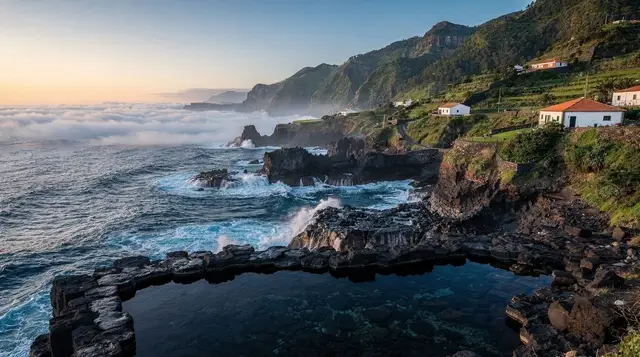
Once you are on the north coast, São Vicente sits naturally between two other stops most visitors combine it with. A short drive west brings you to Porto Moniz, known for its own natural lava pools – a different and separately worthwhile attraction covered on its own page, not repeated here.
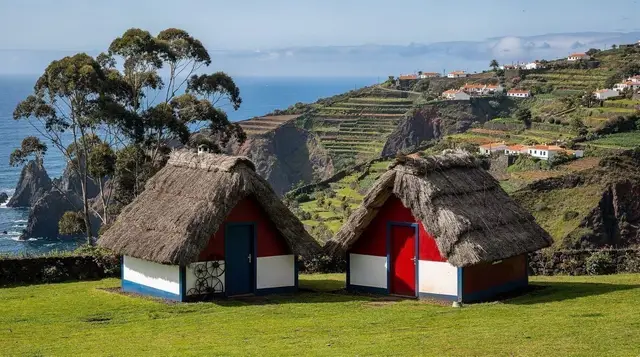
East and slightly inland, the road leads towards Seixal and its own black-sand beach and pools, then on towards Santana with its traditional thatched houses (see Santana Thatched Houses), and further still to São Jorge, Arco de São Jorge, Boaventura and Faial.
Heading the other direction inland, the road up through Encumeada connects the north coast to Paul da Serra, the island’s one high plateau, and from there to Fanal – whose famous mist-wrapped til trees are covered properly in Fanal Forest Guide, including the honest point that without fog the place is unremarkable.
For a full sense of how a north coast day typically strings these stops together, North Madeira Day Trip lays out a sensible route; if you would rather not drive it yourself, jeep tours covering this stretch are common and usually include São Vicente or its immediate area as a stop – see below.
Building São Vicente into a north coast day
Because the caves take under an hour, São Vicente works best as one anchor of a longer loop rather than a destination in its own right. A typical version of that day leaves Funchal early, tunnels north to São Vicente for the caves and volcanism centre, continues west to Porto Moniz for lunch and the pools, then either loops back over Paul da Serra and Fanal or returns along the coast, depending on how the light and weather are behaving.
Travellers who would rather not navigate the mountain roads themselves can join a 4WD jeep tour covering Porto Moniz and Fanal forest, which typically threads past São Vicente on the same north coast run, or a dedicated north coast 4x4 tour from Porto Moniz that covers this stretch in more detail with a local driver-guide doing the tunnel driving for you.
Travellers extending the day further east sometimes pair São Vicente with a stop in Santana for a wine tasting and harvest lunch at Santana, turning the north coast loop into a full day out that mixes geology, coastline and a proper sit-down meal rather than snacking between stops. However you build the day, São Vicente earns its slot early – the caves are least crowded in the first tour groups of the morning, and doing them before Porto Moniz means you are not rushing the pools to make a return drive before dark.
When to go
There genuinely is no bad season for the caves themselves, which is unusual on an island where the weather dictates so much of the daily plan. What changes by season is everything around them: winter brings shorter daylight and a higher chance of the coastal drizzle that defines this side of the island, which if anything makes an indoor stop like São Vicente a better use of a grey morning than a levada walk would be.
Summer brings more traffic on the tunnel road and busier ticket desks, so arriving before mid-morning is worth the earlier start. Whatever the forecast, the north coast tends to run wetter and greyer than the south on any given day – for the fuller picture of how that split plays out across the island, North versus South Madeira is worth a read before you fix a date.
São Vicente caves: your questions answered
What are the São Vicente caves, exactly?
They are a network of lava tubes – hollow channels left behind when the outer skin of a lava flow cooled and solidified while molten rock kept draining out beneath it. The tubes formed during eruptions around 890,000 years ago, and today visitors walk roughly 700 metres of the accessible section on a lit, levelled path.
Are the São Vicente caves suitable for children?
Yes, in general. The walkway is levelled and there are handrails at the tighter points, though the tubes are naturally low-ceilinged and cool, and some sections require ducking. It is not a soft-play attraction – it is a real cave system with genuine geology, so very young children may find parts of it more interesting once explained rather than simply walked through.
How long does a visit take?
Budget 45 to 60 minutes for the caves and the attached Centro do Vulcanismo together. The cave walk itself takes about 20 to 30 minutes at an unhurried pace; the volcanism centre adds another 20 to 30 minutes if you read the exhibits.
Is São Vicente the same place as the Porto Moniz natural pools?
No – they are neighbouring but separate stops on the same stretch of north coast road. São Vicente’s attraction is its lava caves and volcanism centre; Porto Moniz, a short drive further west, has the natural lava pools. Most visitors combine both in a single day.
Do I need to book tickets in advance?
It is not usually necessary outside the busiest summer weeks, but arriving earlier in the day avoids any queue at the ticket desk and gives you first pick of a guided slot if timed entries are running that day.
Is São Vicente worth visiting if I’ve already seen Fanal or the levadas?
Yes, because it shows a different side of the island. Fanal and the levadas are about vegetation and water engineering; São Vicente is the only easily accessible place on Madeira where the raw volcanic rock that built the whole island is explained and walked through directly.
Can I visit São Vicente without a car?
It is difficult. Public buses reach São Vicente but services are infrequent and not built around tourist opening hours, so most independent visitors either self-drive or join a north coast jeep or minibus tour that includes the village as a stop.