Madeira vs the Canary Islands: What's Actually Different
Is Madeira one of the Canary Islands?
No. Madeira is an autonomous region of Portugal, roughly 900km southwest of Lisbon, while the Canary Islands belong to Spain, further south off the coast of Morocco. The two archipelagos are separate countries, separate landscapes and separate travel experiences that only look similar on a map.
Two archipelagos that keep getting mixed up
Type “Madeira” into a search bar and the Canary Islands turn up somewhere on the same page, usually in an ad for a package holiday that treats the two as interchangeable. They aren’t. Madeira is an autonomous region of Portugal, sitting on its own in the North Atlantic about 900km southwest of Lisbon and roughly 600km west of Morocco. The Canary Islands are Spanish, further south, closer to the Moroccan coast, and made up of seven main islands rather than one dominant one. Confusing the two isn’t a minor slip — it means booking the wrong kind of holiday, because the two archipelagos deliver genuinely different weeks away, even though both are volcanic, both sit in the Atlantic, and both get marketed as year-round mild-weather destinations.
This page isn’t a practical guide to Madeira on its own — for that, best time to visit Madeira and Madeira on a budget cover the detail. What follows is the comparison: country, terrain, beaches, activities and the kind of week each destination actually gives you, so you can work out which one matches what you’re after.
Different countries, different everything downstream
The country distinction is the root of most of the practical differences travellers notice once they land. Madeira has been Portuguese since its uninhabited discovery by Portuguese sailors in the fifteenth century — see history of Madeira for the full story of Zarco, Vaz Teixeira and the settlement of Funchal and Machico.
The Canary Islands, by contrast, were absorbed into the Crown of Castile around the same broad era and have been Spanish ever since. Both now use the euro and sit inside the EU, so the currency confusion that used to matter has faded, but the language, the food culture, the public holidays and the general rhythm of daily life are Portuguese on one side and Spanish on the other, right down to what’s on the menu and what time dinner starts.
| Madeira | Canary Islands | |
|---|---|---|
| Country | Portugal (autonomous region) | Spain (autonomous community) |
| Number of main inhabited islands | 2 (Madeira, Porto Santo) | 7 |
| Distance from mainland | ~900km from Lisbon | ~100km from Morocco at the nearest point |
| Capital / main hub | Funchal | Las Palmas / Santa Cruz de Tenerife (shared capital) |
| Population, main island | ~250,000 (Madeira region) | Varies widely by island |
| Language | Portuguese | Spanish |
The single-island-plus-a-satellite structure matters too. Madeira is effectively one trip: you base yourself in or near Funchal and radiate out. The Canary Islands are a choice between seven quite different islands — Tenerife, Gran Canaria, Lanzarote, Fuerteventura, La Palma, La Gomera and El Hierro — each with its own character, so “the Canaries” as a single holiday doesn’t really exist the way “Madeira” does.
Vertical versus flat: the terrain is the real story
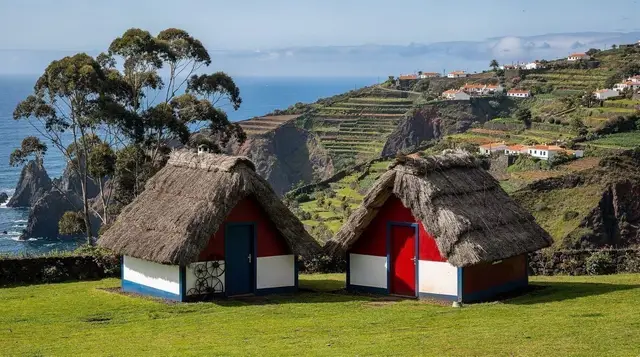
This is the difference that shapes an actual holiday more than the flag on the airport does. Madeira is a mountain that happens to have a coastline. The island covers only about 741 square kilometres but rises to 1,862m at Pico Ruivo, the highest point on the island and reachable only on foot, with Pico do Arieiro at 1,818m being the one summit a road actually reaches. That’s an extraordinary amount of vertical relief packed into a small footprint, and it’s why Madeira reads less like a beach island and more like a green, cloud-wrapped mountain range that happens to sit in the sea.
The Canary Islands have their own volcanic drama — Tenerife’s Mount Teide is Spain’s highest peak — but the islands as a group include vast stretches of flat or gently rolling terrain, sweeping sand dunes on Fuerteventura and Gran Canaria, and long, wide beaches that simply don’t exist in Madeira’s geography. Madeira’s slopes drop steeply to the Atlantic almost everywhere, which is exactly why its historic irrigation channels, the levadas, had to be carved along the cliffs in the first place rather than dug across open ground — see levada walks explained for how that engineering became the island’s best-known activity.
Practically, this terrain difference means Madeira’s roads are narrower, steeper and more tunnel-heavy, and driving here is a different skill from island-hopping around flatter Canarian terrain — driving in Madeira and car rental in Madeira go into what that actually involves.
Beaches: the difference nobody warns you about
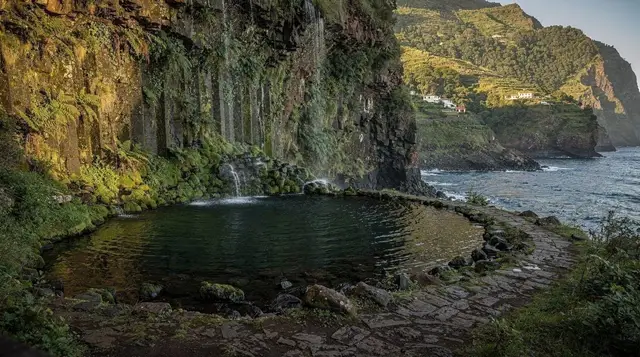
If a long sandy beach is the point of the holiday, Madeira is the wrong island, and it’s worth saying plainly rather than dressing it up. Most of Madeira’s coastline is basalt cliff and volcanic rock. Where the island offers sea swimming, it’s usually in natural lava pools carved by the Atlantic — Porto Moniz natural pools and Seixal being the best known — rather than in stretches of sand you can lay a towel on. The two spots that do offer sand, Machico beach and Calheta beach, have imported golden sand trucked in and topped up, not a natural formation.
The one genuine sandy beach in the whole Madeira archipelago is on Porto Santo, Madeira’s small sister island a ferry or short flight away, which has around nine kilometres of continuous golden sand along its south coast — see beaches of Madeira and natural lava pools guide for the full rundown, and Porto Santo versus Madeira if a beach day is non-negotiable.
The Canary Islands are built around exactly what Madeira lacks: kilometres of sand, in some cases entire dune systems, across Fuerteventura, Gran Canaria, Lanzarote and Tenerife’s south coast resort strips. If the holiday in your head involves a sun lounger, a long swim off soft sand and a beach bar within walking distance, that’s a Canarian holiday, not a Madeiran one — Madeira’s version of a coastal day out is a natural pool, a boat trip, or a short black-sand cove rather than a resort beach.
What you’ll actually spend your days doing
The activity mix is where the two archipelagos diverge most sharply, and it follows directly from the terrain and beach differences above. Madeira’s tourism board and its whole visitor economy are built around walking, and specifically around the levadas — the centuries-old irrigation channels whose maintenance paths now double as the island’s main hiking network, covering more than 2,000km.
Routes like Levada das 25 Fontes and Levada do Caldeirão Verde are the reason a large share of visitors come at all, alongside the sunrise hike from Pico do Arieiro to Pico Ruivo that’s become the island’s signature outing. Since 2021 the official trails carry a small daily fee, which is covered properly in hiking permits and trail fees — worth reading before you plan a walking-heavy week, since it changes the budget for a hiking trip.
The Canary Islands can absolutely deliver hiking too — Tenerife’s Teide National Park and La Palma’s Caldera de Taburiente are genuinely excellent — but the islands as a group are built primarily around beach time, watersports and resort life, with hiking as one option among many rather than the headline activity. Where Madeira’s evening plan is often a wine tasting or a walk through Funchal’s Old Town and painted doors, a typical Canarian evening is more likely to be built around a beachfront strip.
A wine tasting with a sommelier, guided through the island’s own fortified wine, gives a good sense of how Funchal fills that early-evening slot — this Madeira wine tasting with a sommelier in Funchal covers the Sercial-to-Malmsey range that doesn’t really have an equivalent on the Canarian side.
Boat trips exist on both archipelagos, but the content differs too. Madeira’s are built around whale and dolphin watching in deep Atlantic water close to shore, and around the protected Desertas Islands just off Madeira’s southeast coast — a full-day outing such as this ten-hour luxury boat tour to the Desertas Islands reaches a nature reserve that has no real Canarian parallel, since the Desertas are a strictly protected refuge for the Mediterranean monk seal rather than a beach-hopping stop.
Getting there and getting around
Both archipelagos are reachable on direct flights from most of the UK and Northern Europe, and neither requires a long-haul commitment. Madeira’s Cristiano Ronaldo Airport in Funchal has one runway, famously extended on a platform of nearly 180 pillars above the sea, and has a reputation for tricky crosswind landings — see Madeira Airport guide for what that means for nervous flyers. The Canary Islands have several airports spread across the seven islands, generally with more capacity and more route options, since the destination as a whole handles far higher visitor volumes.
Once on the ground, Madeira is compact enough to get a real sense of it from a single base — where to stay in Madeira and getting around without a car cover the options — while the Canary Islands, spread across seven islands, usually mean picking one island per trip rather than seeing “the Canaries” in one visit. A first-timer’s week on Madeira, for comparison, is mapped out in one week in Madeira.
Weather: milder but less predictable on Madeira
Both archipelagos get pitched as year-round mild-weather escapes, and both broadly deliver on that promise, but the detail differs. The Canary Islands, further south and flatter, run warmer and drier on average, with the desert-influenced islands like Fuerteventura and Lanzarote seeing very little rain most of the year.
Madeira’s weather is more layered: the south coast around Funchal is sunny and comparatively dry, the north coast is greener and wetter, and the mountains sit in their own climate above the cloud line — sometimes near freezing at dawn on Pico do Arieiro while it’s a mild 18°C down in Funchal the same morning. That variability is part of what makes the island dramatic, but it also means Madeira is a worse bet than the Canaries for anyone who wants one guaranteed sunny beach day, every day, without checking a forecast.
A quick side-by-side
| Madeira | Canary Islands | |
|---|---|---|
| Best for | Hiking, mountains, food and wine, a compact single-base trip | Beaches, sunshine, resort holidays, island-hopping |
| Terrain | Steep, mountainous, forested | Mostly flat to rolling, volcanic desert on some islands |
| Beaches | Mostly natural pools and small imported-sand beaches; one real sandy beach on Porto Santo | Long natural sand beaches across several islands |
| Signature activity | Levada walking and mountain hiking | Beach time, watersports, resort life |
| Typical trip length | 5–7 days, one base | 1–2 weeks, often one island per trip |
| Weather pattern | Sunny south, wet north, cold peaks — same day | Generally warm and dry, especially the southern islands |
So which one should you actually book
If the appeal is dramatic scenery, a genuine walking holiday, and a food-and-wine-led evening routine within a small and easily explored island, Madeira wins clearly — and it’s worth reading first time in Madeira and Madeira travel mistakes to avoid before you go, since the trail fees, the driving and the layered weather all catch first-timers who expected something closer to a standard beach island. If the appeal is long beaches, dependable heat and a wider spread of resort-style options, the Canary Islands are the better match, and Madeira will likely disappoint anyone chasing that specific brief.
What the two share is real too: both are volcanic, both are subtropical-leaning Atlantic islands with excellent seafood, and both make a genuinely good winter-sun option when mainland Europe is grey — the new year fireworks in Funchal turn Madeira’s own December into one of its busiest and most distinctive weeks. They just deliver on that promise in almost opposite ways, one vertical and green, the other flat and golden, and knowing which is which before you book is the whole point of this page.
A short private tour on arrival is a good way to get your bearings on Madeira’s terrain fast, without committing to a full hiking day straight off the plane — this private tuk-tuk tour of Funchal city covers the steep streets and viewpoints in a couple of hours, and cruise passengers with a single day ashore have a similar option built for a tight window in this Funchal highlights tour for cruise guests.
Popular Madeira experiences on GetYourGuide
Verified deep-linked GetYourGuide tours. Book through these links and we earn a small commission at no cost to you.
GetYourGuide does not provide a product photo for this activity — the image shows the meeting point, photographed by us.