Beaches of Madeira: Imported Sand, Black Sand and Where to Actually Swim
Does Madeira have natural sandy beaches?
Almost none. Madeira is a volcanic island with mostly pebble and black-sand shoreline, so its two best-known golden beaches, Calheta and Machico, are imported sand brought in from Morocco. The nearby island of Porto Santo has the archipelago's one genuine natural sand beach, a nine-kilometre stretch along its south coast.
Why Madeira Doesn’t Look Like a Beach Postcard
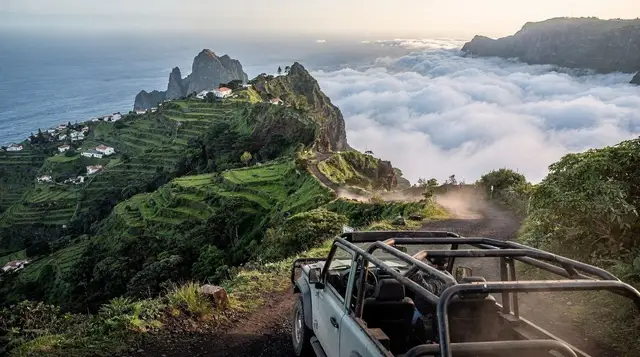
Madeira is a volcanic island barely five million years old, and it shows in the coastline. Cliffs meet the Atlantic almost everywhere, and where the land does flatten out, the shore is pebble, shingle or black volcanic sand rather than the fine golden sand people picture when they hear “island holiday.” That’s not a flaw in the island; it’s geology.
If you arrive expecting a string of Caribbean-style beaches, you’ll be disappointed. If you arrive knowing the truth, Madeira’s coast is genuinely interesting: two beaches with imported sand that work very well for a relaxed day, a handful of natural black-sand and pebble coves that feel more like the island’s real character, and one proper natural sand beach on Porto Santo, a short hop away.
This guide sorts out which is which, because guidebooks and listings routinely blur the two. Knowing whether a beach is natural or imported changes what you should expect from the sand, the water and the crowd.
The Imported Sand Beaches
Two beaches on Madeira get described as classic golden-sand beaches, and both of them earned that look artificially. Neither is dishonest about it if you ask locally, but neither volunteers the information either, and it genuinely changes what you’re getting.
Calheta
Calheta, on the southwest coast, has Madeira’s best-known sand beach. The sand was imported, and a breakwater holds it in place against the swell that would otherwise wash it away within a season or two. It works: the water inside the breakwater is calm, warm by Madeiran standards, and shallow enough near the shore for families. There are showers, loungers, beach bars and a marina alongside. It is the closest thing on the island to a conventional resort beach, and for a lot of visitors, especially with children, it’s exactly what they came for.
What it is not is a natural Madeiran beach. The sand had to be brought in because the coastline here, like almost everywhere else on the island, doesn’t produce it on its own. Calheta is popular precisely because it manufactures the beach experience most visitors expect, and there’s nothing wrong with choosing it for that reason. Just don’t mistake it for something the island grew on its own.
The wider Calheta beach area sits at the western end of the south coast road, easily combined with a run further west toward Ponta do Pargo, and it’s the beach most tours pair with a scenic west-coast drive.
an afternoon tour along the southwest coast that builds in beach time at CalhetaMachico
Machico, on the east coast, is where the Portuguese first landed on Madeira in 1419, and its bay has been a working harbour and fishing town for centuries. Its golden sand beach, though, dates only to 2008, when the town imported sand to cover what had been a narrower stretch of pebble and shingle. The result is popular with locals as much as tourists — it’s the easiest sand beach to reach from the airport and from the east-coast towns — with a similar calm, sheltered feel to Calheta, since a breakwater does the same job here too.
Step outside the imported section, though, and the beach reverts to the pebble and shingle that lines most of the rest of the bay. That contrast is worth seeing for what it tells you about the coast: the golden strip is the exception, engineered in, and the stony shore either side of it is what Machico looked like before 2008 and what most of Madeira’s coastline still looks like today.
Machico beach is a straightforward stop if you’re near the airport or exploring Canical and the whaling museum nearby, and it works well as a first or last swim of a trip given how close it sits to arrivals and departures.
The Natural Beaches: Pebble and Black Sand
If you want to see what Madeira’s coastline actually does on its own, skip the imported sand and head for the natural shore. It’s rockier and less comfortable underfoot, but it’s the real island.
Seixal
On the north coast, Seixal has one of the few genuinely natural black-sand beaches on Madeira, formed from the volcanic rock the island is made of rather than trucked in from elsewhere. It sits below cliffs with waterfalls that spill onto the coast road after rain, and the village itself is one of the most photographed viewpoints in the north. The Atlantic here is more exposed than at Calheta or Machico, so swimming conditions depend heavily on the day’s swell; check before you get in, and don’t expect the flat, sheltered water of the south coast breakwaters.
Seixal also has natural lava pools alongside the black-sand beach, which is a separate swimming option covered in full in the natural lava pools guide rather than here — worth reading before you go, since the pools and the beach have different access points and different conditions.
Prainha
Near Canical in the east, close to Ponta de Sao Lourenco, Prainha is a small natural black-sand beach and one of the few on the island formed from local material rather than imported. Its name literally means “little beach,” and it is exactly that: a modest cove, sheltered enough for reasonably calm swimming on a normal day, popular with locals, and prone to filling up fast on hot weekends since there isn’t much sand to go around. It pairs naturally with a day exploring the arid, treeless peninsula further east.
Canico de Baixo
Canico de Baixo, on the south coast near Garajau, doesn’t have much beach at all in the conventional sense — it’s mostly rocky shoreline and concrete platforms with ladders into the water — but it’s included here because it’s one of the main entry points for swimming and diving on this stretch of coast, and it illustrates the same point as everywhere else on the island: natural coastal access on Madeira usually means rock, not sand.
Porto Santo: The Archipelago’s Real Sand Beach
If a proper natural golden-sand beach is what you actually want, the honest answer is to leave Madeira and go to Porto Santo. Around 43 kilometres northeast of Madeira, reachable by a roughly 2 hour 15 minute ferry (which is cancelled by heavy swell fairly often in winter, so don’t cut it fine) or a 15-minute flight, Porto Santo has close to nine kilometres of continuous natural golden sand along its entire south coast. This is the one beach in the archipelago that didn’t need any help: the island’s shallower profile and different geology produced fine sand the way Madeira’s steep volcanic coast never has.
The sand is locally promoted for supposed therapeutic properties, and whether or not you buy that claim, it’s genuinely a different kind of beach experience from anything on Madeira itself — wide, flat, uncrowded away from Vila Baleira, and warm. If a “real” beach holiday matters to your trip, a day trip or overnight to Porto Santo beach is worth the crossing, and it’s covered in full in the Porto Santo day trip guide.
Natural Lava Pools: The Alternative to Sand
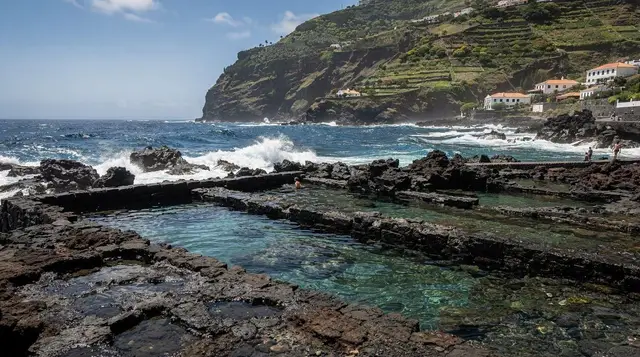
Because Madeira’s coastline is mostly volcanic rock, the island’s best swimming spots are often not beaches at all but natural lava pools — seawater trapped and filtered through volcanic rock formations, most famously at Porto Moniz and at Seixal itself. These are a genuinely distinct experience from a sand beach: clearer, cooler water, a rockier setting, and a strong dependence on swell, since heavy waves close them regularly.
This guide won’t redevelop that subject here, since it deserves its own space — see the natural lava pools guide for the full picture of which pools are free, which are paid and staffed, and how conditions change through the year. The short version for beach planning purposes: don’t treat a lava pool as a beach substitute, and don’t treat a beach day as covering what the pools offer. They’re complementary, not interchangeable, and a well-planned west-coast day often combines both.
a west-coast tour that combines Porto Moniz’s natural pools with the cliffs further along the coastBeach Comparison Table
| Beach | Sand type | Natural or imported | Best for |
|---|---|---|---|
| Calheta | Golden sand | Imported, breakwater-protected | Families, calm swimming |
| Machico | Golden sand (central strip) | Imported (2008), pebble either side | Convenience near the airport |
| Seixal | Black sand | Natural | Scenery, character, exposed swimming |
| Prainha | Black sand | Natural | Small, local, can get crowded |
| Canico de Baixo | Rock platforms | Natural | Diving and snorkelling access |
| Porto Santo | Golden sand | Natural | The real sand-beach experience |
Getting to the Southwest and West Coast Beaches
Calheta sits at the end of the VR1 motorway on the south coast, an easy drive from Funchal that takes under an hour. Continuing west from Calheta toward Ponta do Pargo and up to Porto Moniz on the north coast makes for a full day combining beach, cliffs and natural pools, and it’s a popular route for both self-drivers and organised tours.
a full west-coast route linking Porto Moniz, Calheta and Ponta do Pargo in one dayIf Calheta is your main stop, there are also shorter, more focused options that stay on the southwest coastline rather than covering the whole west of the island, including a van tour that spends more time in and around Calheta itself, or something as low-key as a stand-up paddle or yoga session on the water there.
a van tour that stays focused on the southwest coastline around CalhetaPractical Tips for Swimming in Madeira
Sea temperature runs roughly 18 to 23°C depending on the season, cooler than most Mediterranean beach destinations but comfortable enough for a swim most of the year at the sheltered spots. The south coast, where Calheta and Machico sit, is calmer and more sheltered than the north; the north coast, including Seixal, faces the open Atlantic and can have significant swell even on an otherwise fine day.
None of Madeira’s beaches, imported or natural, tend to have the persistent lifeguard coverage you might expect at a major resort destination, so treat posted flags and local advice seriously rather than assuming a beach is automatically safe because it’s popular. Shoes with a decent sole are worth packing for the pebble and shingle beaches, since bare feet on Madeiran shingle is an unpleasant lesson learned only once. For a fuller rundown of currents, flags and where the water genuinely isn’t safe to swim, see the swimming safety in the Atlantic guide.
Parking at Calheta is straightforward and largely free near the marina; Machico has more limited beachfront parking and gets busy on weekends with locals as well as visitors. Neither beach charges for basic access, though sunbeds and umbrellas are typically a paid extra at both.
Madeira Beaches: Your Questions Answered
Is Calheta beach natural sand?
No. Calheta’s golden beach is imported sand, trucked and shipped in and topped up periodically, held in place by a breakwater. The sand itself is fine and the water is calm, but it is not a natural Madeiran beach.
Is Machico beach natural?
No. Machico’s beach was covered with imported golden sand in 2008. Before that it was a narrower pebble and shingle shore, which is still what you find along most of the rest of the bay outside the imported section.
Which Madeira beaches have natural sand?
None on Madeira itself have natural golden sand. Seixal has a genuine natural black-sand beach on the north coast. Porto Santo, a 15-minute flight or roughly 2 hours 15 minutes by ferry from Funchal, has the archipelago’s only natural golden-sand beach, running about nine kilometres along its south coast.
Why doesn’t Madeira have natural sandy beaches?
Madeira is a young volcanic island with steep cliffs meeting the Atlantic almost everywhere, so wave action produces pebbles, shingle and black volcanic sand rather than the fine golden sand that forms on shallower, older coastlines like Porto Santo’s.
What is Prainha beach like?
Prainha, near Canical in the east, is a small natural black-sand beach, one of the few on Madeira formed from local volcanic material rather than imported sand. It is sheltered but modest in size and can get crowded on a hot weekend.
Is swimming safe at Madeira’s beaches?
Conditions vary a lot by coast and season. The sheltered, breakwater-protected beaches such as Calheta are the calmest choices for families; open shoreline, and the natural lava pools on the north coast in particular, can have strong swell and should be checked before you get in.
Should I visit a beach or a natural lava pool in Madeira?
They are different experiences rather than substitutes. Sandy beaches at Calheta and Machico suit lounging and calm swimming; the natural lava pools at Porto Moniz and Seixal are a distinct volcanic-rock swimming experience worth doing separately, not instead of, a beach day.
tours.beaches-natural-pools
Verified deep-linked GetYourGuide tours. Book through these links and we earn a small commission at no cost to you.
GetYourGuide does not provide a product photo for this activity — the image shows the meeting point, photographed by us.