A capital that doesn’t act like one
Vila Baleira is the only proper town on Porto Santo, and it barely behaves like a capital at all. Low white houses, a single grid of streets you can cross on foot in ten minutes, a handful of cafés with tables spilling onto the pavement, and, at the southern edge, sand. No traffic jams, no high-rises, nothing that asks to be photographed from a distance. That modesty is the point. Porto Santo is not a smaller, quieter version of Madeira tacked onto the same trip — it is a different island altogether, and Vila Baleira is where that difference is easiest to feel.
Where Madeira is green, steep and often wet, Porto Santo is flat, dry and pale gold for most of the year. There are no laurel forests here, no levadas, no mountain roads folding back on themselves. The island’s high point, Pico do Facho, barely tops 500 metres, and most of the interior rolls gently rather than climbing. Rain falls rarely enough that the island has a long-standing reputation for dry heat even when Madeira, less than an hour away by air, is under cloud. If you arrive expecting Funchal in miniature, the flat light and open horizon of Vila Baleira will correct you within the first afternoon.
This page covers the town itself: the Casa Colombo, the streets around it, and the start of the beach that runs along the whole southern coast. It does not cover how to get here — the ferry and flight options, timings and the swell that regularly cancels crossings are their own subject, covered in full on the dedicated crossing guide. Treat this as what to do once you’ve arrived, not how to arrive.
The Casa Colombo
The single fact most visitors already know about Porto Santo is that Christopher Columbus lived here, and the house associated with that stay sits a short walk from the town’s main square. Columbus is believed to have settled in Vila Baleira around 1479, after marrying Filipa Moniz Perestrelo, daughter of Bartolomeu Perestrelo, the island’s first captain-donatary. The marriage gave Columbus a foothold in the Portuguese Atlantic world years before his voyages west, and local tradition holds that time spent here, reading his father-in-law’s charts and hearing sailors’ talk of debris washed up from unknown shores, shaped the conviction that a westward route to Asia was possible.
The house is now the Casa Colombo–Porto Santo Museum, a modest two-storey building organised around a small courtyard. Inside, the rooms hold period furniture, maps charting the Portuguese age of discovery, ceramics, and documents relating to the Columbus family and the early settlement of the archipelago. It is not a large museum and does not need a large block of time — most visits run 30 to 45 minutes — but it earns its place as the one fixed historical anchor on an island that otherwise offers very little in the way of monuments. Come with modest expectations of scale and it delivers; come expecting a grand house on the order of a European stately home and you’ll be disappointed. This is a captain-donatary’s era dwelling, not a palace.
The museum sits close to the Vila Baleira parish church and the main square, so it slots naturally into a walk rather than requiring a special trip. Opening hours shift with the season and the museum closes on Mondays, so check current times locally before planning your day around it.
Walking the town centre
Vila Baleira rewards an unhurried lap far more than a checklist. The centre is arranged around a pedestrianised main street and a small square, both lined with the low, whitewashed buildings and cobbled paving typical of Portuguese island towns. The parish church anchors one end; cafés, a scattering of small shops selling local ceramics and the island’s own melon liqueur, and a produce market fill the rest.
None of it is dressed up for tourists in the way parts of Funchal’s old town are — there is no equivalent of the painted-door project here, no evening crowd of restaurant touts. What you get instead is a working town going about an ordinary day, which is a large part of Porto Santo’s appeal for visitors who have already done the busier circuits on Madeira.
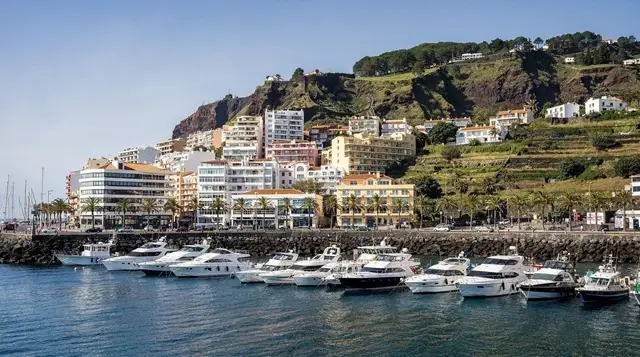
A short walk brings you to the seafront promenade, which runs along the top of the beach and is where most of the town’s evening life happens — an ice cream, a slow walk, families out after the day’s heat has broken. The marina sits at the western end of town, handling the ferry arrivals along with a modest fleet of local fishing and pleasure boats. If you want to see the island from the water rather than just beside it, small-boat trips run from here along the coast; a rigid inflatable option is one of the more direct ways to do this.
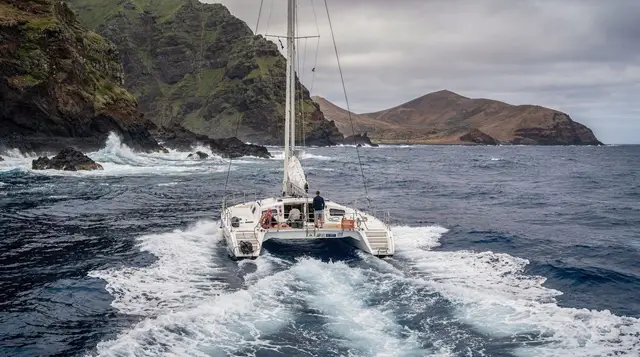
a rigid inflatable boat ride along the Porto Santo coastline gets you views of the island’s cliffs and inlets that the beach and town simply don’t offer, and it runs to a fixed, short duration rather than a full-day charter, which suits a day visit well.
For a longer look at the island’s interior and its status as a UNESCO biosphere reserve — granted for the dune systems, native flora and the surrounding marine environment — a guided option covers ground you won’t reach on foot from town in the time most visitors have.
a guided walk through Porto Santo’s Unesco Biosphere Reserve is the more structured way to see beyond the town and beach in a single outing, with a guide explaining what’s easy to miss on your own — the dune vegetation, the reserve’s boundaries, and the island’s slower, drier ecology.
The beach: nine kilometres of gold
Porto Santo’s defining feature begins at the southern edge of Vila Baleira and does not stop for nine kilometres. It’s the only continuous stretch of sand in the whole archipelago — Madeira’s coastline is mostly cliff, pebble and imported sand in small pockets — and it runs unbroken along almost the entire southern shore of the island. The sand itself is a pale gold rather than Madeira’s volcanic black, fine and soft underfoot, and the water is shallow enough close to shore that swimming here feels notably gentler and warmer than the more exposed spots around Madeira.
The sand has its own local reputation beyond swimming: it’s often described as “areia terapêutica,” therapeutic sand, and some visitors bury their feet or legs in it, following a long-standing island tradition around its mineral content. Treat the claim as local colour rather than medical fact, but it’s a genuine and harmless part of how residents and repeat visitors use the beach, and worth knowing about before you see people doing it and wonder why.
Because the beach runs the full length of the southern coast, the stretch directly below Vila Baleira is the easiest to reach and the most used, with sunbeds, a handful of beach bars and easy access from the promenade. Walk twenty minutes in either direction and the crowd thins fast — this is a nine-kilometre beach serving an island of around 5,500 people, so solitude is never far from the town centre. For a fuller comparison of what Porto Santo’s sand offers against Madeira’s black-sand and natural-pool coastline, the beaches guide covers both islands side by side.
Eating and staying in town
Vila Baleira’s food scene is small and unpretentious, built around fresh fish, simple grilled meat and the kind of café culture where the same few dishes appear on most menus. Fresh fish is the safest and most rewarding order most evenings — Porto Santo’s waters support a working fishing fleet, and what lands at the marina tends to end up on plates the same day. Restaurants cluster around the main square and the promenade, with prices generally a notch below equivalent spots in central Funchal, reflecting the island’s slower pace rather than any lower quality.
Accommodation in town runs from small guesthouses to a few larger resort-style hotels along the beachfront, with options thinning out considerably compared to Madeira’s much larger hospitality sector. Most visitors treat Porto Santo as a day trip from Madeira, but staying even one night changes the experience meaningfully: the beach empties out after the last afternoon boats and flights leave, and the town’s evening rhythm — quiet streets, an unhurried dinner, no rush to catch a return crossing — is a different island again from the daytime version most people see.
If you’re weighing a day visit against an overnight stay, the day-trip guide and the direct island comparison both lay out the trade-offs in more detail than fits here.
Beyond the town
Vila Baleira is compact enough to explore fully on foot, but a hire car or scooter opens up the rest of the island within a very short drive — this isn’t Madeira’s mountain road network, and distances are genuinely small. Pico do Facho, the island’s highest point, gives a panoramic view back over the town, the beach and, on clear days, across the water to Madeira itself. The interior beyond it is dry, scrubby and sparsely populated, closer in feel to parts of the Canary Islands or coastal North Africa than to anything on Madeira.
For visitors combining both islands, whale and dolphin watching is one of the more natural additions either side of a Porto Santo trip, since sightings happen across the wider archipelago rather than being tied to one coastline.
a dolphin and whale watching catamaran trip from Funchal is worth timing around your crossing days rather than treating as a separate outing, since it departs from Madeira rather than Porto Santo itself.
Similarly, if your trip includes time along Madeira’s own southern coastline before or after Porto Santo, a boat trip there rounds out the contrast between the two islands’ coasts.
a cruise along Madeira’s southern coast shows the cliffs and volcanic coastline that make Madeira’s shore so different from Porto Santo’s long open beach — seeing both back to back is one of the more effective ways to understand why residents insist the two islands aren’t interchangeable.
Getting a fuller picture
None of this page tries to settle whether Porto Santo deserves a day, an overnight, or a longer stay — that depends on what kind of trip you’re having on Madeira and how much you value flat horizons and sand over levadas and cloud forest. What Vila Baleira does settle is that Porto Santo isn’t an overflow beach for Madeira’s crowds. It has its own history, tied specifically to this town through the Casa Colombo, its own geography — flat, dry, sun-baked in a way no part of Madeira really is — and its own pace, set by a town small enough to walk end to end before the heat of the day builds.
For the practicalities of getting here, the ferry guide has the detail this page deliberately leaves out; for planning how much of your trip to give the island, the day-trip guide and the wider best-time-to-visit guide are the next stops.
Frequently asked questions about Vila Baleira and Porto Santo
Did Christopher Columbus really live in Vila Baleira?
Local tradition and historical record place Columbus in Vila Baleira from around 1479, following his marriage to Filipa Moniz Perestrelo, daughter of the island’s first captain-donatary. The Casa Colombo museum occupies the house associated with that period and displays maps, documents and period items relating to his stay and to the wider Portuguese age of discovery.
How long do you need in Vila Baleira?
Half a day covers the Casa Colombo museum and a walk around the town centre comfortably. Add a few hours at the beach and a full day is more realistic, especially if you also want time on the water or a look at the island’s interior from a viewpoint like Pico do Facho.
Is Porto Santo just a smaller version of Madeira?
No. Porto Santo is flatter, drier and considerably less green than Madeira, with a single continuous sandy beach rather than Madeira’s cliffs and volcanic pools. The pace, landscape and even the typical weather differ enough that the two islands are best treated as separate, contrasting destinations rather than one place with two parts.
Is the beach in Vila Baleira good for swimming?
Yes. The water along Porto Santo’s southern coast is generally shallow and calm close to shore, making it gentler for swimming than many of Madeira’s more exposed coastal spots. Conditions still vary with wind and season, so check locally if you’re visiting outside the main summer months.
Can you visit Vila Baleira without a car?
The town itself is entirely walkable, and the Casa Colombo, main square, marina and beachfront are all within a few minutes of each other on foot. A car or scooter only becomes useful if you want to explore beyond the town, such as reaching Pico do Facho or other points around the island.
What is the “therapeutic sand” people mention on Porto Santo?
It’s a long-standing local tradition around the island’s pale, fine sand, which some visitors and residents believe has beneficial mineral properties, sometimes burying feet or legs in it. It’s best understood as local colour and custom rather than a medically verified treatment, but it’s a genuine and widely known part of beach culture here.
Is one day enough to see Vila Baleira and the beach?
For most visitors, yes — a day allows time for the museum, a walk around the centre, and a proper stretch on the beach. Staying overnight changes the experience rather than adding more sights, since the town and beach empty out considerably once the day’s arrivals from Madeira have left.