A History of the Madeira Archipelago
When was Madeira discovered and by whom?
Portuguese navigators João Gonçalves Zarco and Tristão Vaz Teixeira reached Porto Santo in 1418 and Madeira itself in 1419, claiming both for the Portuguese crown. Madeira has been Portuguese territory ever since, and has never belonged to Spain or the Canary Islands.
An Empty Volcanic Island, Waiting to Be Found
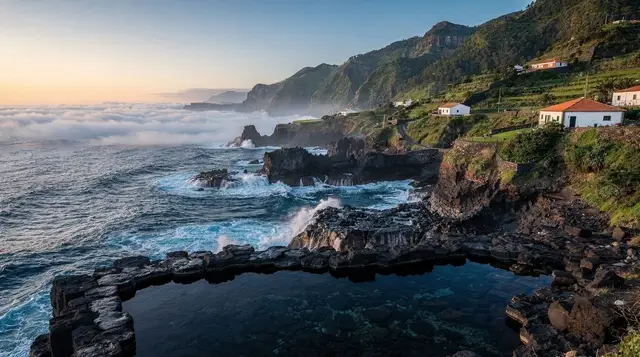
For most of its existence, Madeira had no human history at all. The island rose from the Atlantic floor as a volcano roughly five million years ago, and by the time anyone set foot on it, that volcanic activity had long since stopped, leaving behind steep peaks, deep ravines and a dense forest that covered the land from shore to summit. There were no people here, no towns, no roads — nothing but seabirds, laurel trees and the sound of water running off the mountains toward the sea.
The same was true of neighbouring Porto Santo and the wilder, smaller Desertas Islands further offshore. Unlike the Canary Islands to the south, which had a resident Guanche population before Europeans arrived, Madeira’s archipelago was empty land, waiting on the edge of a mostly unmapped ocean.
That emptiness matters, because it shapes everything that follows. There is no pre-colonial history to recover here, no earlier civilisation whose story runs alongside the Portuguese one. Madeira’s human history begins, cleanly, in the early 15th century, with a handful of ships and a prince back in Portugal who was obsessed with pushing further into the Atlantic than anyone had gone before.
1418 and 1419: Zarco, Teixeira and the Discovery
The discovery of Madeira was not an accident so much as a by-product of a bigger project. Prince Henry the Navigator, a son of the Portuguese king, was sponsoring voyages down the African coast in search of new routes and new territory, and in 1418 two of his captains, João Gonçalves Zarco and Tristão Vaz Teixeira, were blown off course — or deliberately explored further out, depending on which account you read — and sighted a small island.
They named it Porto Santo, “holy port,” grateful to have found safe anchorage. From Porto Santo, the crews could see a dark shape on the horizon to the southwest: a larger landmass, thickly wooded. The following year, 1419, Zarco and Teixeira returned and landed on it. They called it Ilha da Madeira — the island of wood — for the forest that covered it almost entirely.
A third captain, Bartolomeu Perestrelo, was given the smaller task of settling Porto Santo, which he governed as its first captain-donatary. Both islands were formally claimed for the Portuguese crown, and colonisation began almost immediately under the system of capitânias, hereditary captaincies granted by the king to the men who had found the land. This is the detail worth holding onto if you take nothing else from this page: Madeira has been Portuguese territory continuously since 1419.
It has never been Spanish, and it has never had any administrative connection to the Canary Islands, even though the two archipelagos sit within a few hundred kilometres of each other and are sometimes confused by visitors booking a trip. If you want the fuller comparison, our Madeira versus the Canary Islands guide sets out how differently the two island groups actually developed.
Machico: The First Settlement
Tradition places the first landing, and the island’s first settlement, at Machico, on the sheltered east coast. The bay offered fresh water and reasonably flat land close to the shore, which made it a practical place to establish a base before the harder work of clearing the interior began. Machico became the seat of Tristão Vaz Teixeira’s captaincy, and for a period it rivalled Funchal as the island’s most important settlement, though Funchal’s better anchorage and more central position eventually won out.
Machico today still carries physical traces of that early period, alongside a striking modern touch: its long stretch of golden sand was imported in 2008 and is not a natural beach, a detail worth knowing if you visit expecting the volcanic black-sand coastline typical of the rest of the island. For the fuller local history of the town, including the story behind its founding legend, see our dedicated page on Machico — this guide sticks to the archipelago-wide story and won’t repeat what’s covered there.
Funchal: A City Named for Fennel
Funchal, which grew to become the island’s capital and today is home to roughly 105,000 of the archipelago’s 250,000 residents, gets its name from something almost comically unglamorous: funcho, the Portuguese word for wild fennel. Early settlers arriving by boat found the herb growing thickly around the bay, and the name stuck. It is a small detail, but it says something about how these early Portuguese place names worked — descriptive, practical, tied to what people actually saw when they stepped ashore, rather than to grand historical claims.
Funchal’s natural harbour, sheltered from the prevailing winds, made it a far more useful base than Machico as ship traffic increased, and it became the administrative and commercial centre of the island within a few decades of settlement. The layout of its old quarter, the Zona Velha, still reflects those early centuries, even if most of what you’ll see walking through Rua de Santa Maria today — including its famous painted doors — is a much more recent addition to the streetscape.
Clearing the Forest: Fire, Sugar and a Difficult Legend
The island the Portuguese found was covered almost entirely in dense laurel forest, and turning it into productive farmland meant clearing large parts of that cover. A well-known story, repeated in many guidebooks, holds that early settlers set fire to the forest and that it burned for years before the land was usable — some tellings even suggest this is where the name “Madeira” itself originates, though the more straightforward explanation is simply that early sailors were struck by how densely wooded the island was and named it accordingly.
Historians treat the fire story with some scepticism; there is little solid documentary evidence for a years-long blaze, and it may be a later embellishment. What is certain is that large areas of lowland forest were cleared for agriculture in the 15th and 16th centuries, while the steep, less accessible north-facing slopes were left largely untouched. That surviving forest is the Laurissilva, a UNESCO World Heritage site since 1999 and the largest remaining example of this once-widespread Atlantic forest type anywhere on Earth — a direct, living link back to the landscape Zarco and Teixeira first saw.
Once cleared, the fertile volcanic soil and mild climate made the island well suited to sugar cane, which the Portuguese introduced from Sicily via Prince Henry’s wider Atlantic project. Madeira became one of Europe’s major sugar producers through the 15th century, worked in significant part by enslaved labour brought from West Africa — an uncomfortable but essential part of the island’s early economic history, and one that predates the larger, better-documented slave economies that would later develop in Portuguese Brazil. Sugar wealth built much of early Funchal, including its cathedral, and for a time made the island genuinely important to the Portuguese crown’s finances.
From Sugar to Wine
Madeira’s dominance in sugar didn’t last. Through the late 15th and 16th centuries, larger and cheaper sugar-producing colonies in Brazil and later the Caribbean undercut the island’s exports, and Madeira’s growers gradually shifted toward a crop better suited to smaller plots and a mountainous landscape: grapevines. What began as a local product grown for the island’s own use developed, almost by accident of geography, into something far more famous.
Ships travelling the Atlantic trade routes between Europe and the Americas routinely stopped at Funchal to take on water and provisions, and the wine they loaded alongside those supplies had an unusual quality: it seemed to improve rather than spoil after weeks or months rolling around in a ship’s hold in tropical heat. That accidental discovery is essentially how the modern practice of heating and ageing Madeira wine began, and it’s a subject substantial enough that it deserves its own page rather than a summary here — this guide is about the island’s broader history, not its cellars.
The British Connection
No history of Madeira is complete without acknowledging just how deeply British trade, and later British tourism, shaped the island over the following centuries. English and Scottish merchant families settled in Funchal from the 17th century onward to trade in wine, and their names — many still attached to wine lodges and shipping firms today — became woven into the island’s commercial life.
That relationship deepened in the 19th and 20th centuries as Madeira turned into a fashionable winter destination for wealthy Britons, a shift symbolised most visibly by Reid’s Palace hotel, which opened its doors in 1891 and is still trading on that same reputation today. Winston Churchill painted at Câmara de Lobos in 1950, and the resulting association is one every visitor to that fishing village still hears about. It’s a strand of the island’s story worth knowing, though its full detail belongs with the towns and hotels it touches rather than in this general history.
Emigration, Autonomy and the Modern Era
Like much of Atlantic Portugal, Madeira went through long periods of hardship and emigration, particularly in the 19th and 20th centuries, as islanders left in large numbers for South Africa, Venezuela and elsewhere in search of work that the island’s limited farmland couldn’t provide. The 20th century also brought Madeira an unlikely footnote in European royal history: the last Habsburg emperor, Charles I of Austria, died in exile on the island in 1922 and is buried at the Church of Nossa Senhora do Monte, above Funchal.
Following the 1974 Carnation Revolution in mainland Portugal, Madeira was granted the status of an autonomous region in 1976, with its own regional government and assembly based in Funchal, while remaining fully part of the Portuguese Republic and, since 1986, the European Union. That status is worth stating plainly, because the confusion is common enough to be worth repeating: Madeira is not Spanish, has never been administered from the Canary Islands, and its political ties run entirely through Lisbon.
Where the History Is Still Visible Today
Much of Madeira’s early history has to be pieced together from documents and place names rather than surviving buildings, since the island’s damp climate and repeated redevelopment haven’t been kind to the oldest structures. That said, a handful of places do let you stand close to it.
Funchal’s old town still follows its original street pattern down toward the harbour, and the nearby Mercado dos Lavradores, while a 1940s building rather than a colonial one, carries on trading traditions that go back centuries. On Porto Santo, the Columbus House museum marks where Christopher Columbus is believed to have lived for a period in the 1480s, one generation after the island’s discovery.
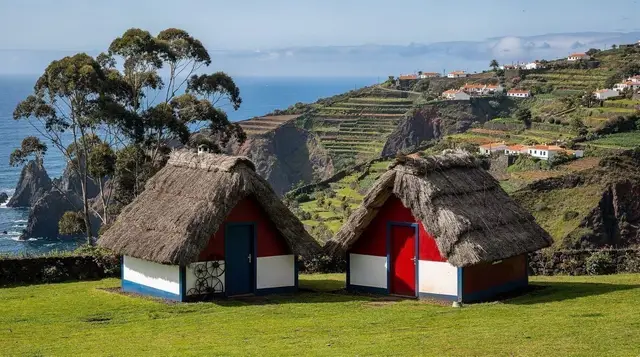
For the two chapters of this story that deserve fuller treatment than a general history can give them, we’ve written them up separately: the story of Santana’s thatched houses, and the island’s more recent whaling past at the Museum of the Whale in Canical. Both are genuinely local histories, tied to specific villages on the north and east coasts, and neither would fit comfortably folded into the broader archipelago-wide account above.
If you’d rather see the island’s volcanic origins explained on the ground than read about them, a guided geology tour tracing the island’s volcanic formation covers the deep-time story that predates everything in this guide.
For the human history of the east coast specifically, where this island’s story begins, a full-day East Coast tour that pairs the Machico area with the Santana cable car links several of the places named above in a single day out, and a 4x4 safari through the East Wonders route reaches some of the same ground with a guide on hand to fill in local detail as you go.
A Portuguese Island, Then and Now
It’s worth ending where this guide began: everything about Madeira’s history, from Zarco’s landing in 1419 through sugar, wine, British merchants and 20th-century autonomy, has taken place under the Portuguese crown and, later, the Portuguese Republic. There is no Spanish chapter to this story and no administrative link to the Canary Islands, however close the two archipelagos sit on a map of the Atlantic.
What you’re visiting is a genuinely Portuguese island — remote, autonomous, and shaped over six centuries by decisions made first in Lisbon’s royal court and later in Funchal’s own regional government. Keeping that straight will save you more than one awkward conversation with a local, and it’s the single fact this whole history keeps circling back to.
If you’re building out a trip around some of this, our one week in Madeira itinerary and first-time visitor guide are good next stops, and the Funchal and Câmara de Lobos pages fill in more of the everyday texture behind the history covered here.
Madeira’s History, Answered
Was Madeira inhabited before the Portuguese arrived?
No. Madeira, Porto Santo and the Desertas were uninhabited when Portuguese sailors landed in 1418 and 1419. Unlike the Canary Islands to the south, there is no record of an indigenous population here.
Who discovered Madeira?
João Gonçalves Zarco and Tristão Vaz Teixeira, sailing under Prince Henry the Navigator, sighted Porto Santo in 1418 and landed on Madeira in 1419. A third captain, Bartolomeu Perestrelo, later governed Porto Santo.
What was the first town founded on Madeira?
Machico, on the east coast, is traditionally regarded as the island’s first settlement, founded shortly after the 1419 landing and named as the captaincy of Tristão Vaz Teixeira.
Why is Funchal called Funchal?
Funchal takes its name from funcho, the Portuguese word for fennel, which early settlers found growing wild and in abundance around the bay where the city now stands.
Is Madeira part of Spain or the Canary Islands?
No. Madeira is an autonomous region of Portugal and always has been since its discovery in 1419. The Canary Islands, roughly 450 kilometres to the south, belong to Spain; the two archipelagos are separate countries.
Did settlers really set fire to the island’s forest?
A persistent legend claims early colonists burned the island’s dense forest for years to clear land, which is where some say the name Madeira, meaning wood or timber, comes from. Historians treat the story with caution, but the name itself reliably refers to the forest that once covered the island.
How did Madeira become known for wine?
Sugar cane was the island’s first major export, but as sugar production shifted to Brazil and the Caribbean in the 16th and 17th centuries, Madeira’s economy turned increasingly toward wine, helped by ships calling at Funchal on Atlantic trade routes.
History and heritage tours on GetYourGuide
Verified deep-linked GetYourGuide tours. Book through these links and we earn a small commission at no cost to you.
GetYourGuide does not provide a product photo for this activity — the image shows the meeting point, photographed by us.