Vila Baleira is a small town, and its most-discussed building is a modest one: a narrow house on a quiet street, given over since the 1990s to the story of the man who is said to have lived there before he ever thought of sailing west. Casa Colombo — the Columbus House — is not a grand museum, and it does not need to be. What it holds is a single, well-anchored claim in the island’s history, and a chance to see where it played out.
What the Columbus House actually claims
The house museum’s premise rests on a specific, documented episode rather than a folk legend. Christopher Columbus is believed to have lived on Porto Santo for a period in the late 1470s, connected to the island through his marriage to Filipa Moniz, daughter of Bartolomeu Perestrelo, the first captain-donatary appointed to govern Porto Santo after its 1418 discovery. The marriage is generally dated to around 1479. Columbus would have been in his late twenties, working at the time as a chart-maker and trader between Genoa, Lisbon, and the Portuguese Atlantic islands — a career that put him precisely where the era’s maritime knowledge was concentrated.
That connection to the Perestrelo household matters more than the house itself. Bartolomeu Perestrelo had access to charts, sailing logs, and the accumulated experience of a family running one of Portugal’s newest Atlantic possessions. Whatever time Columbus spent in this house, married into this family, sits at the edge of the story historians tell about how he built the geographical convictions that eventually took him across the Atlantic on behalf of Spain rather than Portugal. None of that is dramatised inside — the museum presents it plainly, through period maps, reproductions, and explanatory panels, and lets the visitor draw the line themselves.
The one fact this page will not blur
Guidebooks and even some local signage have, over the years, drifted into calling this “the house where Columbus was born.” It is worth being direct about why that framing is wrong. There is no verified evidence that Columbus was born on Porto Santo — the accepted historical record places his birth in Genoa, around 1451, well before any documented connection to the island. What the house represents, and what the museum is careful to present, is a period of residence and a marriage, not a birthplace. If you read the claim as a birth house anywhere else before visiting, correct it now: you’ll get more out of the rooms if you’re not looking for a nursery that was never here.
Inside the museum
The building itself is a restored 17th-century town house, rebuilt after storm damage and fire over the centuries — so what you walk through is not the original 15th-century structure Columbus would have known, but a later house on the same plot, furnished and arranged to evoke the period. The rooms are organised loosely by theme rather than strict chronology:
- Period maps and navigational instruments — reproductions of the kind of charts and tools a late-15th-century pilot would have used, giving a sense of how imprecise and speculative Atlantic geography still was before 1492.
- Portraits and documents relating to Columbus — engravings and printed material gathered from later centuries, since no contemporary portrait of Columbus is considered reliably authentic; the museum is honest about this uncertainty rather than presenting any single image as definitive.
- A room dedicated to Porto Santo’s own settlement history — covering the 1418 discovery by João Gonçalves Zarco and Bartolomeu Perestrelo’s arrival as captain-donatary, which is the context that makes the Columbus connection make sense in the first place.
- Furnished period rooms — giving a sense of domestic life on a small, remote Atlantic outpost in the late 15th century, when Porto Santo was still a fledgling settlement rather than the sleepy resort island it is today.
It is a small museum, and visitors typically move through it in under an hour. That is not a criticism — it means the Columbus House fits neatly into a Porto Santo day without dominating it.
Finding it in Vila Baleira
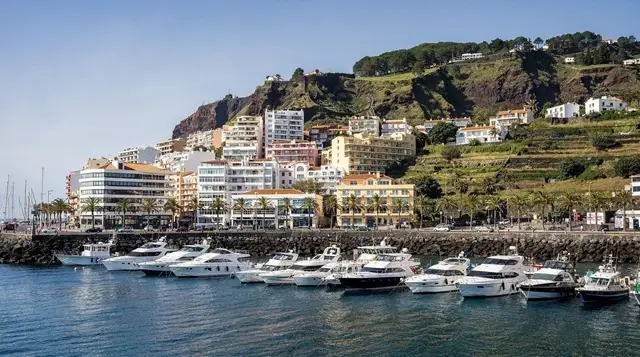
The museum sits on Rua Cristóvão Colombo, in the historic centre of Vila Baleira, Porto Santo’s small capital. The town itself is compact enough to cross on foot in fifteen minutes, so the house is never more than a short walk from wherever you’re staying, from the main square, or from the seafront. There’s no need to drive or arrange transport specifically for this — it’s a stop you fold into a wider walk around the old town, alongside the parish church and the streets radiating from the square.
Vila Baleira beyond the museum
The Columbus House sits inside a wider historic centre worth a slower look, particularly if you’ve timed your visit for the cooler part of the day rather than midday beach hours. Vila Baleira’s streets are low, white-walled, and quiet compared with Funchal — a genuinely small-town Atlantic capital rather than a scaled-down city. Cafés around the main square make an easy stop before or after the museum, and the walk down to the seafront promenade takes only a few minutes from the historic centre.
For travellers arriving by boat, several operators run guided walking routes through Porto Santo’s protected landscapes that pair naturally with a morning in town — a guided walk through Porto Santo’s Unesco biosphere reserve covers the island’s wilder terrain in a way an afternoon in Vila Baleira doesn’t reach. If the coastline itself is more the draw, a rigid inflatable boat ride around Porto Santo gets you off the sand and along the cliffs in an hour or two, and works well bookended by a morning at the museum.
Getting to Porto Santo — and what this page doesn’t cover
This page deliberately stays narrow: it’s about the house, the museum, and the history behind it. It does not cover the practicalities of reaching Porto Santo, the nine-kilometre beach that draws most visitors here in the first place, or how to structure an overnight stay versus a rushed day trip. For the ferry schedule, flight times, and how the crossing can be affected by winter swell, along with a full rundown of the beach and where to base yourself, see the dedicated Porto Santo guide and the Porto Santo ferry guide — both are the right starting point before you plan a visit that includes the museum.
If you’re weighing whether a full day on Porto Santo is worth the crossing at all, the Porto Santo day trip guide lays out a realistic itinerary, and Porto Santo versus Madeira is useful if you’re still deciding how to split your time across the two islands.
Pairing the museum with the rest of Porto Santo
Most visitors treat the Columbus House as one stop among several rather than a destination in its own right, and that’s the right instinct — it rewards 45 minutes, not half a day. A sensible loop through Vila Baleira might run: a coffee near the main square, the museum itself, a walk down to the seafront, then onward to the beach or the Pico do Facho viewpoint if you have a car or taxi for the afternoon.
History travellers who enjoyed the Columbus House often also make time for the whaling museum in Canical back on Madeira proper, which covers a very different but equally specific chapter of the archipelago’s past — the island’s whaling industry rather than its role in the Age of Discovery. Together, the two museums cover more of the archipelago’s real history than either does alone, and neither takes more than an hour.
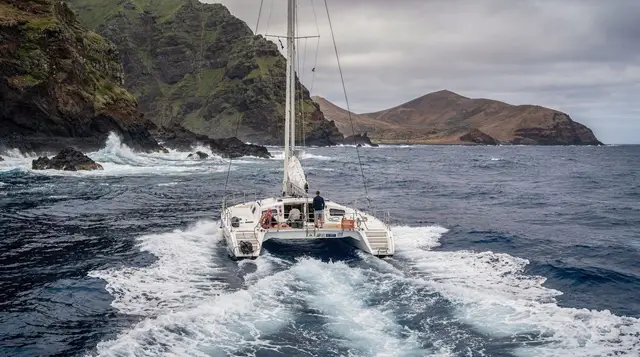
For those staying on Porto Santo rather than day-tripping, the island’s protected waters make it a genuine base for time on the water — beyond the walking tour and boat ride already mentioned, sailing trips run along stretches of coastline that are otherwise hard to reach on foot, including options departing from the wider archipelago such as a sailing trip along Madeira’s east coast to a hidden cove or a private sailing charter at Madeira’s eastern tip — both easiest to arrange if you’re basing part of your trip around Porto Santo and the eastern end of the archipelago rather than Funchal alone.
Practical notes for visiting
Opening hours follow a fairly standard museum pattern — mornings and afternoons on weekdays, with reduced hours or closure on Sundays and public holidays, so it’s worth checking the current schedule before making a special trip, particularly if you’re on a tight cruise-call window. Entry is inexpensive, typically a few euros, and some museums on Porto Santo waive the fee on certain Sunday mornings as a local access initiative — worth asking about at the door rather than assuming.
Photography is generally permitted inside, though flash may be restricted in rooms with older documents and reproductions. The museum is small enough that it rarely feels crowded, even in the busier summer months when Porto Santo’s beach draws the bulk of day-trip traffic away from the town centre.
Why the house still matters
Porto Santo is, first and foremost, a beach island — nine kilometres of golden sand is the reason most visitors make the crossing at all. But Vila Baleira’s Columbus House is a reminder that this small, quiet outpost sat at the edge of one of the most consequential periods in European history, decades before Columbus’s 1492 voyage made him a household name. The house doesn’t overstate its case, and neither should you: it’s not the place he was born, and it’s not a shrine.
It’s a modest, well-kept record of a marriage, a period of residence, and a family connection that placed a future navigator inside a household with charts, ships, and Atlantic ambition. Forty-five minutes here adds real depth to a day that would otherwise be all sand and sun — and that combination, beach and history within walking distance of each other, is precisely what makes Vila Baleira worth the short walk inland.