First Time in Madeira: A Complete Introduction
Is Madeira in Spain or the Canary Islands?
No. Madeira is an autonomous region of Portugal, around 900km southwest of Lisbon and 600km west of Morocco. It is a separate archipelago from Spain's Canary Islands, even though the two lie only a short flight or ferry apart.
If you’ve landed here after seeing photos of a green mountain rising out of the Atlantic, laced with narrow water channels and framed by cloud, you’re already looking at Madeira correctly. What trips people up is the geography around it. Madeira is not part of Spain, and it is not one of the Canary Islands — it’s a separate, older, Portuguese archipelago that happens to sit within a few hours of them by air or sea. Get that straight before you book anything, because it changes what currency you’re using, what language is on the menus, and — more practically — what kind of island you’re actually flying to.
This guide is the starting point, not the deep dive. Each section below points to a dedicated page for the details — budget, where to stay, what to pack, the mistakes to dodge — so treat this as the map of the map.
Where Madeira Actually Is
Madeira is an autonomous region of Portugal, roughly 900km southwest of Lisbon and about 600km west of the Moroccan coast — closer to Africa’s latitude than to mainland Europe’s. The archipelago has four parts: Madeira itself, the inhabited Porto Santo, and the uninhabited, protected Desertas and Selvagens island groups.
Madeira island covers about 741km², stretching 57km east to west and just 22km north to south, and it’s volcanic in origin, having emerged from the seabed around five million years ago. That volcanic history is why the terrain is so vertical: the interior peaks at Pico Ruivo (1,862m), reachable only on foot, with Pico do Arieiro (1,818m) as the highest point a road actually reaches.
Around 250,000 people live in the region, roughly 105,000 of them in Funchal, the capital and the island’s only real city. Porto Santo, the sandy sister island 43km to the northeast, has about 5,500 residents. Portuguese navigators Zarco and Vaz Teixeira reached Porto Santo in 1418 and Madeira in 1419; Funchal takes its name from funcho, the wild fennel that once covered the bay. None of this is trivia for its own sake — it’s the context that makes the island’s Portuguese food, wine and place names make sense once you’re there.
For a side-by-side of what separates the two archipelagos people most often confuse, see Madeira versus the Canary Islands.
How Long to Stay
A week is the working answer for a first visit, and it’s the length this whole site is built around — see One Week in Madeira for a full day-by-day layout, or the more forgiving Madeira First-Timers’ Week if you’d rather pace things gently. Five days is workable if you’re organised and don’t try to fit in Porto Santo. Anything shorter than four days means choosing one region — Funchal and the south coast, most likely — and accepting you’ll see the rest another time.
The reason Madeira rewards a full week rather than a long weekend is that its highlights aren’t clustered. Funchal’s sights are a day or two on their own; the mountains and north coast are a separate world reached by tunnel roads; Porto Santo is a boat or plane ride away. Trying to compress all three into three days means a lot of driving and very little actually standing still.
What Not to Miss on a First Visit
Funchal is where almost every itinerary starts and ends, and it earns the time. The old town and its painted doors, the flower-and-fish stalls of the Mercado dos Lavradores, and the cable car up to Monte are the three fixtures most first-time visitors build a day around — the cable car ride alone gives you a view of the city and bay that’s worth the trip regardless of what else you do that day.
The levadas — Madeira’s centuries-old irrigation channels — are the reason hikers put this island on their list. They are not casual strolls: since August 2021 the official waymarked trails require a paid, pre-booked permit, and the paths themselves are often narrow, exposed or tunnelled. Read Levada Walks Explained and Hiking Permits and Trail Fees before you commit to a specific trail — this page won’t repeat what those cover.
The mountains deserve at least one clear-weather morning. A sunrise at Pico do Arieiro, above the cloud line with the temperature near freezing while Funchal sits 18°C warmer below, is the single most-repeated recommendation from visitors who’ve done it — and the most regretted skip from those who didn’t make the early alarm.
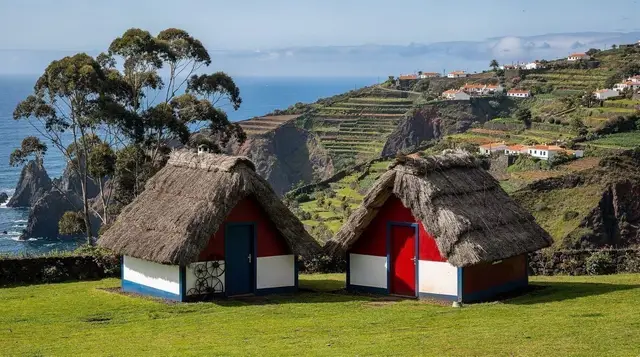
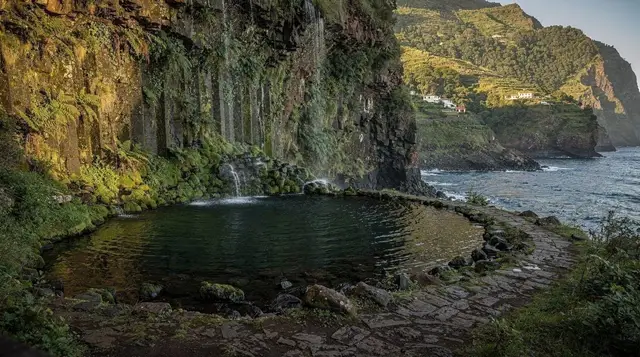
The north coast — Porto Moniz’s lava pools, the black sand at Seixal, the thatched houses of Santana — is a different island from the sunny south, wetter and greener, and it’s most efficiently seen as a full-day loop by car rather than a series of separate trips.
Porto Santo, if your schedule allows it, is the counterpoint to all of the above: nine kilometres of continuous golden sand and almost nothing to climb. It’s worth a day if you have a week to spend; it’s not worth restructuring a five-day trip around, because the ferry crossing depends on the swell and gets cancelled in poor weather. See Porto Santo Day Trip for how to plan around that risk.
For a broader first look at the capital before you build a day plan, Funchal in One Day walks through the sequencing.
A Gentle Way to Start
Before tackling levadas or mountain roads, most first-time visitors find their footing with something low-effort in and around Funchal — a short tuk-tuk loop through the steep old-town streets, or an afternoon on the water. Both give you a feel for the island’s layout without committing a full day.
renting a kayak along Funchal’s waterfront is a relaxed way to see the marina and coastline from the sea on your first afternoon, while a tuk-tuk tour through Funchal’s steep old-town lanes covers ground that would otherwise mean a lot of uphill walking.
If you’d rather go further afield without driving yet, a half-day trip up into the eastern highlands gives you a preview of the mountain scenery before you decide whether to hire a car for it yourself. And for an evening once you’ve settled in, a guided Madeira wine tasting with a sommelier is a good, unhurried introduction to the island’s best-known export.
Getting Around
Madeira’s main road, the VR1, tunnels along the south coast and makes Funchal-to-Machico or Funchal-to-Ribeira Brava fast. Away from it, roads narrow quickly and climb steeply — this is not an island where a large hire car is an advantage. If your plan includes the north coast, the mountains, or any levada trailhead, a car is close to essential; the bus network (several regional operators, split by direction) serves the main towns but rarely reaches where a trail actually starts. Car Rental in Madeira covers hire specifics, and Getting Around Without a Car is the honest alternative if you’d rather not drive.
Money, Weather and Packing
Three things catch first-timers out, and each has its own dedicated page rather than a paragraph here. Madeira is generally cheaper than the Canary Islands and mainland Portugal’s resort coasts on food and accommodation, but car hire and organised excursions in peak season change that calculation — see Madeira on a Budget for real numbers.
Weather is the island’s defining quirk: the south is sunny and dry, the north is green and wet, and the summits sit above the clouds entirely — often on the same day. Best Time to Visit Madeira breaks that down by month. And because a coastal town at 20°C and a mountain summit near freezing can both be on your itinerary the same morning, packing needs more thought than a standard island trip — see What to Pack for Madeira.
Where you base yourself matters too. Funchal is the practical choice for a first visit — central, well-connected, close to the airport transfer routes — though it isn’t the only option. Where to Stay in Madeira covers the alternatives, from the old town to the quieter Lido promenade.
Mistakes First-Timers Make
The single most common one, worth repeating here because it shapes everything else: treating Madeira as a beach holiday. There is very little natural sand on the main island — Machico and Calheta’s beaches are imported — and visitors who arrive expecting Canary Islands–style resort beaches are consistently the most let down. The fix is simple: come for the mountains, the levadas and the gardens, and treat any beach time as a bonus rather than the plan. A longer list of the errors that trip up first visits — from underestimating trail difficulty to booking too small a hire car — is collected in Madeira Travel Mistakes to Avoid.
Suggested First Itineraries
If a week feels like a lot to plan from scratch, the One Week in Madeira itinerary lays out a full day-by-day route balancing Funchal, the north coast and the mountains. Travelling with children changes the pacing considerably — see the Madeira with Kids Itinerary for a version built around shorter days and easier walks. And if five days is genuinely all you have, the Five Days in Madeira plan drops Porto Santo and one of the longer hikes to keep things realistic.
Frequently Asked Questions About a First Trip to Madeira
Is Madeira part of Spain or the Canary Islands?
No. Madeira is Portuguese territory, an autonomous region of Portugal in the North Atlantic. It sits roughly 450km north of the Canary Islands, which belong to Spain — close neighbours, but two different countries.
How many days do you need for a first visit to Madeira?
A week is the sweet spot for a first trip: enough time for Funchal, one or two levada walks, the north coast and a sunrise at Pico do Arieiro without rushing. Five days works if you’re focused; anything under four means picking one region only.
Is Madeira good for a first-time visitor with no hiking experience?
Yes, with care. Madeira has plenty to see by car, cable car and short walks around Funchal, but its signature levada trails involve narrow paths, drops and sometimes unlit tunnels, so match the trail to your comfort level rather than assuming “levada” means easy.
Do you need to hire a car in Madeira?
For a first visit that includes the north coast and mountains, yes — buses reach the main towns but not most trailheads. If you’re staying in Funchal and sticking to organised tours, you can manage without one.
What’s the biggest mistake first-time visitors make?
Assuming Madeira is a beach island like the Canaries. It’s a mountain island with dramatic scenery and very little natural sand; visitors expecting sun loungers by the sea are usually the most disappointed.
Is Madeira expensive?
It sits below the Canary Islands and mainland Portugal’s coastal resorts on food and accommodation, but car hire and organised tours can push a trip’s cost up in the July–August and New Year peaks.
When is the best time for a first trip to Madeira?
Spring (April–June) and early autumn (September–October) give the most reliable trail conditions and flower displays. Winter is mild but wetter in the north; the New Year period is spectacular but the busiest and priciest week of the year.
Should Porto Santo be part of a first visit?
Only if you have a week or more. It’s a worthwhile day or overnight trip for its long sandy beach, but the ferry crossing depends on the weather and can be cancelled, so don’t build a tight itinerary around it.
Trip-planning essentials on GetYourGuide
Verified deep-linked GetYourGuide tours. Book through these links and we earn a small commission at no cost to you.
GetYourGuide does not provide a product photo for this activity — the image shows the meeting point, photographed by us.