A First-Timer's Week in Madeira: The Gentle Route
Who this week is for
This is the itinerary for a first visit to Madeira that doesn’t lean on cliff-edge paths, unlit tunnels or a 4 a.m. alarm for a summit walk. It uses a hire car to reach the island’s signature views and villages, keeps each day to a manageable amount of driving, and swaps every “technical” walk for its easy, drive-up equivalent.
If you want the full levada network and the PR1 traverse from Pico do Arieiro to Pico Ruivo, see our hiking week itinerary instead — this route deliberately sacrifices that in favour of comfort. Porto Santo is left out too, on the basis that seven days is tight enough on the main island alone; see Porto Santo versus Madeira if you’re weighing whether to add it.
You’ll want a hire car for the whole week — a small one, not a large one, given how narrow and steep some of the coast roads get. Base yourself in Funchal throughout; nothing on this route needs a change of hotel.
Day 1: Settle into Funchal
Arrive, collect the car, and do as little as possible on day one — Madeira rewards a slow start. Walk the old town, the Zona Velha, where dozens of front doors along Rua de Santa Maria have been repainted by local and visiting artists since 2010. Have dinner in the old town rather than the marina strip; it’s where the evening actually happens.
If you arrive with energy left, the Mercado dos Lavradores is worth a look even outside market hours for its 1940s Art Deco shell. If you go when it’s open, be wary of the fruit stallholders who offer a free taste and then weigh and charge for what you sampled — a well-known trick, not a bargain.
Day 2: Funchal in full — Monte and the gardens
Spend day two entirely in the Funchal area, no car needed. Ride the cable car from the old town up to Monte — about fifteen minutes and 560 metres of climb, with the harbour dropping away behind you. At the top, visit the church of Nossa Senhora do Monte, where the last Austro-Hungarian emperor, Charles I, who died in exile on Madeira in 1922, is buried, and wander the Monte Palace Tropical Garden.
Down the hill, the wicker toboggan is the ride everyone photographs: two carreiros in white and straw boaters push a basket sledge on wooden runners about two kilometres down to Livramento, a tradition that dates to 1850. Do note before you queue that this is not a way of getting back to Funchal — the run stops halfway, and you’ll need a taxi or bus from there, not a lift home. Read the details in our Monte cable car and toboggan guide before you go.
In the afternoon, choose between the Botanical Garden and Quinta do Palheiro Ferreiro — they’re two separate gardens, often confused, and both are easy half-day visits without a car.
Day 3: The south coast and Cabo Girão
Today is a short, spectacular drive rather than a long one. Head west along the coast to Câmara de Lobos, the fishing village Winston Churchill painted in 1950, then on to Cabo Girão: a cliff of roughly 580 metres, among the highest sea cliffs in Europe, with a free glass-floored skywalk that opened in 2012. Give yourself a clear morning to visit before the coach groups arrive.
For a taste of the island’s famous irrigation channels without any exposure, book a gentle, guided version rather than a solo trail walk. This half-day option threads a level, easy stretch of levada near the cliffs with a guide doing the route-finding — a private guided levada walk around Cabo Girão and Ribeira Brava — and it’s a far softer introduction than tackling an official PR trail alone. Round off the day in Ribeira Brava, a working town rather than a resort, good for a late lunch.
Day 4: Pico do Arieiro by car — the viewpoint, not the hike
This is the day it matters most to be precise about what you’re doing. A paved road climbs all the way to the car park at Pico do Arieiro, 1,818 metres up — Madeira’s third-highest peak and the only one a road actually reaches. From the car park, a short paved viewing area gives you a huge panorama, often above a layer of cloud, for essentially no effort.
That is a completely different undertaking from the PR1 trail that continues from the same car park to Pico Ruivo: roughly seven kilometres one way, three unlit tunnels, stone stairways cut into the basalt, and three to four hours of exposed, narrow path each way. The trailhead sign is metres from where you’ll park the car, and every year visitors who came for the view end up drawn onto the path in trainers, without water or a torch. Stay at the viewpoint. If a mountain day like that appeals on a future trip, our PR1 Arieiro to Pico Ruivo guide sets out what it actually demands.
Bring a layer regardless — it’s routinely close to freezing at the summit car park in the early morning even when Funchal is a mild 18–19°C below. On the way back down, stop at Ribeiro Frio: the short, flat walk out to the Balcões viewpoint is one of the very few levada-side paths that’s genuinely easy, wide and short enough to count as a stroll, and it delivers one of the best views of the central massif for almost no walking.
If you’d rather have a guide handle a longer, well-shaded valley walk on a separate day, the guided hike through Funchal’s Ecological Park is a gentler, forested alternative near the same road up to the peaks.
Day 5: Santana and the north coast villages
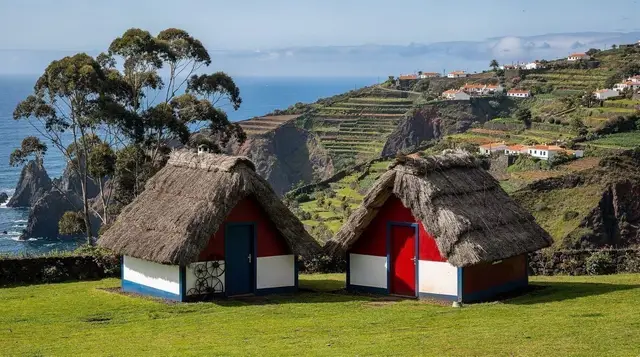
Drive north to Santana to see the casas de colmo — small, triangular, thatched houses painted in red, white and blue. Three in the village centre are open to visit; they’re maintained reconstructions rather than lived-in homes, which is worth knowing before you go looking for a whole hamlet of them. Our Santana thatched houses guide covers which ones to visit and how long to allow.
Nearby, the Queimadas park and its thatched cottages make an easy, short stop — worth the detour for the setting alone, without continuing onto the long levada walk that starts there (that one runs to the Caldeirão Verde waterfall and is a serious half-day hike, not part of this itinerary). Loop back toward Funchal via Faial and Porto da Cruz on the coast road for a change of scenery from the day’s mountain villages.
Day 6: Porto Moniz and the wild west coast
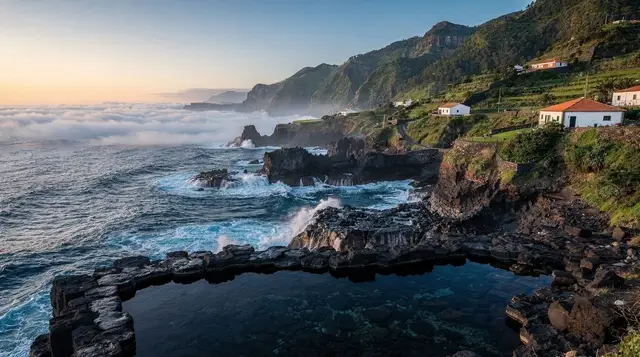
This is the longest drive of the week, so make an early start. On the way to Porto Moniz, stop wherever the road allows on Madeira’s northern flank — it’s the green, damp side of the island, a real contrast with the sun of Funchal. At Porto Moniz itself, the natural volcanic pools are the draw: seawater held in lava rock, refreshed by the tide, split between a maintained paid section with changing rooms and a wilder free section. Swell from the north closes them fairly often, so check conditions before you count on swimming.
Rather than drive the whole west coast loop yourself on a day when you’re already tired, a guided 4x4 covers it in comfort: a north coast 4x4 tour that takes in Porto Moniz handles the driving on the tightest stretches of road.
If you’d rather see more of the west in one outing — the black-sand village of Seixal and the mist-wrapped ancient forest at Fanal — a west-coast 4x4 tour linking Porto Moniz, Seixal and Fanal is the easier way to fit all three into a single day. Worth knowing before you go: Fanal’s famous, gnarled til trees are only atmospheric when the cloud rolls in — on a clear day it’s a fairly ordinary highland pasture.
Day 7: Curral das Freiras and a slow finish
Save the easiest day for last, especially if you’re flying out. A short drive inland brings you to the Eira do Serrado viewpoint, looking straight down into the volcanic bowl that holds Curral das Freiras, the “Nuns’ Valley” — worth the detour for the view alone, with a coffee and a taste of the valley’s chestnut specialities if you have time to go down.
Back in Funchal, spend what’s left of the day at an easy pace: a wine tasting at Blandy’s Wine Lodge in the centre of town is a fitting way to close the week, and the marina area is a calm spot for a final dinner. If your flight is from the Cristiano Ronaldo airport at Santa Cruz, allow more time to reach it than the distance suggests — the approach is notoriously exposed to wind, and delays and diversions to Porto Santo or Las Palmas do happen, mostly in winter.
Planning notes for this route
| Day | Focus | Driving |
|---|---|---|
| 1 | Funchal old town, arrival | None |
| 2 | Monte, cable car, gardens | None |
| 3 | Câmara de Lobos, Cabo Girão, Ribeira Brava | Short |
| 4 | Pico do Arieiro viewpoint, Ribeiro Frio | Moderate |
| 5 | Santana, Queimadas, north coast | Moderate |
| 6 | Porto Moniz, west coast | Long |
| 7 | Curral das Freiras, Funchal | Short |
A single small hire car for the week, a couple of guided half-days, and modest hotel or apartment in Funchal keep this route around the island’s usual mid-range daily budget rather than pushing into the cost of a hiking-focused trip with permits and gear. See Madeira on a budget for a fuller breakdown, and mountain weather and what to wear before day four, since the summit car park runs far colder than the coast.
FAQ: planning a gentle first week in Madeira
Is a week enough time to see Madeira for the first time?
Yes, for a first visit built around driving rather than hiking. A week gives one relaxed day per major area — Funchal, the south coast, the peaks by road, the north, and the west — without the long, tiring drives that a shorter trip forces.
Do I need a car for this itinerary?
For most of it, yes. Days 1 and 2 work entirely on foot and by cable car in Funchal, but Cabo Girão, Pico do Arieiro, Santana and Porto Moniz all sit well outside the city and are impractical to link by bus in a single day each.
Is the Pico do Arieiro viewpoint the same as the hike to Pico Ruivo?
No, and this is the most common mix-up on the island. The viewpoint at the car park is a short, paved, effortless stop reached entirely by road. The PR1 trail that starts at the same car park and continues to Pico Ruivo is a demanding, exposed, three-to-four-hour hike through unlit tunnels — a different undertaking entirely, not an extension of the view.
Is the Cabo Girão skywalk free?
Yes. The glass-floored viewing platform at Cabo Girão has no entry charge, unlike Madeira’s official PR hiking trails, which have required a paid, pre-booked permit since August 2021.
Can I do this itinerary without any levada walking?
Almost entirely. The only levada-adjacent stop is the short, flat path to the Balcões viewpoint from Ribeiro Frio, which is about as easy as these paths get. Everything else on this route is reached by road or cable car.
What’s the best time of year for this easy itinerary?
Madeira works for this kind of trip most of the year, since none of the days depend on trail conditions. Winter brings cooler, wetter weather on the north coast and a colder Pico do Arieiro car park; see Madeira in winter and best time to visit Madeira for the seasonal detail.
Should I add Porto Santo to this trip?
Not on this schedule. Reaching Porto Santo needs a ferry crossing of around two hours fifteen minutes, or a short flight, and a worthwhile visit needs at least a full day either way — better added as an eighth day than squeezed out of this route.
What should I not skip on this route even if time runs short?
Cabo Girão and the Pico do Arieiro viewpoint are the two stops that most define Madeira in a single frame — the sea cliff and the summit road — so if a day has to be cut, trim Curral das Freiras or the second half of the west coast loop first.
tours.7 days
Verified deep-linked GetYourGuide tours. Book through these links and we earn a small commission at no cost to you.
GetYourGuide does not provide a product photo for this activity — the image shows the meeting point, photographed by us.