A fishing village at the end of the easy road
Porto da Cruz sits where Madeira’s north coast makes one of its most dramatic gestures: a bay closed in on both sides by near-vertical cliffs, with a village of low houses, a small harbour and a scatter of banana terraces squeezed onto the flat ground between them. Coming from Funchal, it is the last settlement of any size before the coast road stops being straightforward.
Beyond Porto da Cruz, the terrain toward Porto da Cruz’s eastern neighbours and on to São Jorge and the far north grows narrower, steeper and more exposed, and the driving changes character accordingly. That sense of having reached a hinge point — the road easing off just as the cliffs close in — is what defines the village more than any single sight.
This is not the postcard Madeira of manicured gardens or café terraces overlooking Funchal’s marina. Porto da Cruz is a working place. Fishing boats still put out from the small harbour, agricultural terraces climb the valley behind the houses, and the pace on a weekday afternoon is unhurried in a way that has nothing to do with tourism. That is precisely its appeal to anyone who has already done Funchal and the west coast and wants to see a corner of the island that has not been smoothed into a resort.
It is worth being clear about what Porto da Cruz is not. It is not Arco de São Jorge, the terraced, agricultural village further west along the same stretch of coast, known for its vine-covered slopes and its role in Madeira wine production. The two villages are sometimes confused because they share a coastline and a certain rural character, but Porto da Cruz’s identity is maritime and cliff-bound — a bay, a harbour, a wall of rock — while Arco de São Jorge’s is inland and agricultural, spread across gentler terraced land. Treat them as separate stops on a north-coast itinerary rather than as one blurred destination.
The bay and the cliffs
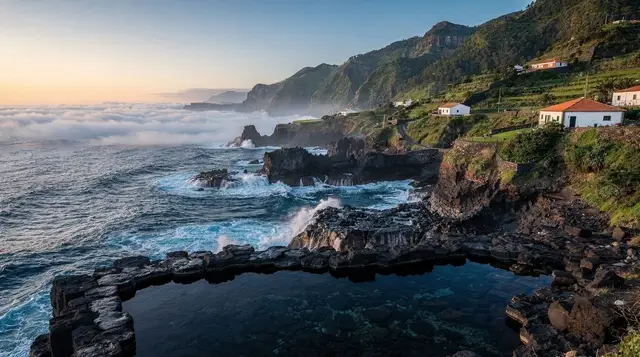
The geography is the reason to come. Porto da Cruz occupies a narrow coastal shelf hemmed in by two headlands, and the cliffs rising directly behind and beside the village are some of the most striking on the island’s north side — dark volcanic rock, often streaked where water runs down after rain, with the Atlantic working steadily against the base. The beach itself is a stretch of dark volcanic sand and pebble, more suited to watching the sea than lounging beside it; the swell here can be significant, and this is one of the north coast’s known surf spots rather than a sheltered swimming bay.
Because the cliffs box the village in so tightly, the light changes fast through the day — flat and grey under cloud, then suddenly gold when the sun drops toward the headland in late afternoon. Photographers who time a visit for this window tend to come away with the strongest images of the trip. The small harbour, with its handful of working boats pulled up or moored close to shore, adds the human element that a bare cliff shot lacks.
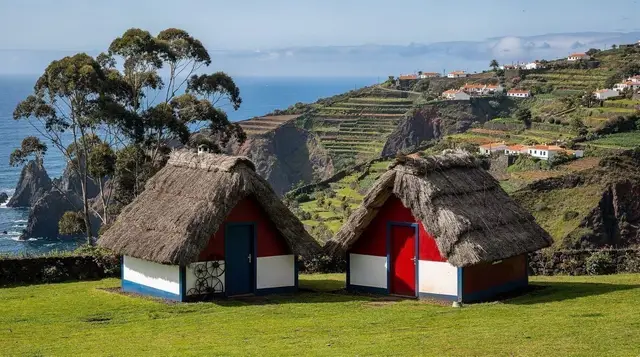
Behind the village, the valley opens slightly and climbs toward vineyards and banana plantations, a reminder that Porto da Cruz has always earned its living from both the sea and the land. The wine grown on these east-coast slopes feeds into Madeira’s wider wine industry, though the famous producers and lodges are concentrated in Funchal rather than here.
Walking and getting oriented
Porto da Cruz is small enough to see on foot in under an hour: the harbour, the seafront promenade, the church, and the short streets of low houses behind. There is no need for a car once parked, and parking near the centre is generally straightforward outside peak summer weeks.
One point worth stating plainly, because guides to this stretch of coast are not always careful about it: Porto da Cruz is not the trailhead for one of Madeira’s numbered official levada walks. The village’s connection to the island’s hiking network is as a coastal waypoint on guided cliff and valley routes that link it to neighbouring villages, not as the starting point of a PR-numbered levada path in its own right.
If a levada walk is the goal for the day, look instead to routes properly anchored elsewhere on the island, such as those detailed in the guide to Madeira’s best levada walks — and always check current trail status before setting out, since access and conditions on the north coast change quickly after rain.
What does start near here, and is worth knowing about, are guided coastal hiking routes that connect Porto da Cruz to Machico and Caniçal to the east. These are organised walks along cliff paths and old tracks rather than levada routes, offering the kind of sea-and-cliff scenery that draws people to this coast in the first place, without the misleading label of an official levada trail.
Reaching Porto da Cruz
The drive from Funchal takes roughly 45 to 55 minutes via the VR1 expressway and the connecting roads down to the coast, making it a comfortable half-day trip rather than a major expedition. The approach itself is part of the experience: the road descends in tight turns from the high ground around Portela toward the coast, and the first view of the bay opening below the cliffs is one of the better unplanned viewpoints on the island.
| Starting point | Approx. drive time | Route character |
|---|---|---|
| Funchal | 45–55 minutes | VR1 expressway, then descent via Portela |
| Machico | 15–20 minutes | Coastal and hill road, winding |
| Santana | 20–25 minutes | Interior road via São Jorge direction |
| Ribeiro Frio | 20–25 minutes | Mountain descent, tight bends |
A rental car is the practical way to reach the village independently; bus services along this stretch of the north coast run on limited schedules and are built around local needs rather than day-trip timings. For anyone without a car, a guided tour or private transfer that includes Porto da Cruz as a stop is the more reliable option — several of the operators covering this coast build the village into wider east-coast or north-coast itineraries.
For a broader sense of how a car changes what is realistically possible on this side of the island, see the guide to driving in Madeira and the wider car rental guide before booking.
Off-road and active ways to see the coast
Because much of the terrain around Porto da Cruz is steep valley and cliff rather than open road, several operators run off-road and guided walking trips through the area rather than relying on self-drive alone. A guided buggy route along the north coast takes in the cliffs and valleys around the village from tracks a standard rental car cannot reach, while a buggy tour through the Funduras and Portela hills above the village covers the high ground travellers see from the descent road but rarely explore on foot.
For those who want the coastline on foot, a guided hike along the cliffs from Caniçal to Porto da Cruz is one of the more direct ways to arrive in the village with the sea on one side the whole way, and a guided cliff walk from Machico via the Larano route to Porto da Cruz covers similar ground from a different starting point. Both are led routes along genuine coastal paths rather than the island’s official numbered levada network, and both end in the village described above rather than starting from it.
The beach’s exposure to Atlantic swell also makes it one of the north coast’s recognised surf spots; a surf lesson at Porto da Cruz or nearby Machico is a reasonable way to get in the water here on a day when conditions allow, run by instructors who know which of the two beaches is working on a given day.
Nearby villages worth pairing with a visit
Porto da Cruz works best as one stop on a loop through Madeira’s eastern hills and north coast rather than a destination in isolation. Faial, a short drive further along the coast, offers a wider bay and the distinctive Penha de Águia rock. Inland and up, Ribeiro Frio sits in the laurel forest at the top of the descent road and makes a natural combination with a Porto da Cruz afternoon — cool mountain forest followed by warm coastal light. Machico, the island’s first Portuguese settlement, lies a short drive to the south-east and pairs naturally with the guided cliff walks that connect the two villages.
Anyone building a full day around this side of the island should also weigh in Santo da Serra and the high plateau route through Camacha, both of which connect back toward Funchal without retracing the coast road. For a structured plan covering this whole quarter of the island in one outing, the north Madeira day trip guide lays out a sensible order of stops.
Eating in Porto da Cruz
The village has a handful of unpretentious restaurants around the harbour and seafront, serving grilled fish caught locally and the standard Madeiran staples: espetada skewered on laurel wood, bolo do caco with garlic butter, and limpets when they are in season. Prices tend to run lower than the equivalent meal in central Funchal, reflecting the village’s working character rather than any tourist premium. For context on what to expect and order across the island generally, see the Madeira food guide.
There are no large supermarkets in the village; anyone self-catering or stocking up for a day of driving should do so in Machico or before leaving Funchal.
Practical notes
Porto da Cruz has no significant accommodation cluster of its own — most visitors come as a day stop from Funchal, Machico or Santana rather than basing themselves here overnight, and hotel options in the immediate area are limited compared with the south coast or Funchal itself. Mobile coverage is generally reliable in the village centre but can drop out on the descent roads through the hills above.
The cliffs that make the setting so photogenic also mean the village can feel enclosed and shadowed earlier in the afternoon than the open south coast, particularly in winter when the sun sits lower. Layering up slightly more than the Funchal forecast suggests is sensible, especially near the water where the wind off the Atlantic has nothing to slow it down.
A typical half-day budget covering fuel, a harbourside lunch and coffee runs somewhere between €40 and €80 per person depending on appetite, well below what the same afternoon would cost on the south coast’s more tourist-oriented stretches.
Frequently asked questions about Porto da Cruz
Is Porto da Cruz worth visiting on a Madeira trip?
Yes, particularly for travellers who want to see a genuine working fishing village rather than a resort town. The combination of a cliff-locked bay, a small working harbour and banana-terrace farmland behind it makes it one of the more distinctive stops on the north coast, best suited to a half-day or full-day visit rather than a base for the whole trip.
How do I get to Porto da Cruz from Funchal?
The drive takes roughly 45 to 55 minutes via the VR1 expressway and the descent road through Portela. A rental car is the most practical option; bus services exist but run on limited schedules built for local needs rather than day-trip timing, so a guided tour or private transfer is a more reliable choice without a car.
Can you swim at Porto da Cruz beach?
The beach is dark volcanic sand and pebble, and the Atlantic swell here can be significant, making it more of a surf spot than a swimming beach. It is one of the recognised surf locations on Madeira’s north coast, and lessons are available; check local conditions before swimming, as the sea can be rougher than on the sheltered south coast.
Does a levada walk start in Porto da Cruz?
No. Porto da Cruz is not the trailhead of one of Madeira’s official numbered PR levada walks. It does feature as a coastal waypoint on guided cliff and valley hiking routes linking it to Machico and Caniçal, but these are distinct from the island’s levada network, and no official levada path should be assumed to begin here.
What is the difference between Porto da Cruz and Arco de São Jorge?
The two are separate villages on the same general stretch of Madeira’s north coast, easily confused but quite different in character. Porto da Cruz is a maritime village centred on a cliff-bound bay and a fishing harbour. Arco de São Jorge, further west, is an inland, agricultural village known for terraced vineyards and its role in Madeira’s wine country.
Is there anywhere to stay overnight in Porto da Cruz?
Accommodation options in the village itself are limited compared with Funchal or the south coast. Most visitors treat it as a day stop from a base elsewhere on the island rather than staying overnight, though a small number of local guesthouses do operate for those who want to base themselves on the quieter north coast.
What can you do near Porto da Cruz without a car?
Guided options are the most practical route without self-driving: coastal hiking tours connect the village to Machico and Caniçal on foot, and off-road buggy tours cover the surrounding hills and valleys from bases that include pickup. Independent bus travel is possible but limited, and taxis between nearby villages are a workable if pricier alternative.
What is the best time of year to visit Porto da Cruz?
Late spring through early autumn brings calmer seas and clearer light for photographing the cliffs, along with generally drier conditions for the drive down from Portela. Winter visits are possible and quieter, but the village’s exposed, cliff-shadowed position means it can feel cooler and greyer than the south coast at that time of year.