A Cool-Air Village on the Road East
Most visitors to Madeira meet Camacha by accident, from the window of a car climbing out of Funchal on the way to Santo da Serra or the east coast. That is, in a sense, exactly what Camacha is for. It is not a headline sight with a ticket booth and a queue. It is a working highland village on the plateau above the capital, where the terraced fields, the cooler air, and the unhurried pace tell you more about everyday Madeira than any museum could.
The village sits at altitude on the high ground that separates Funchal’s sheltered south coast from the wetter, greener terrain further north and east. That position is the whole story of Camacha: it is a crossroads settlement, a place where roads from the capital, from Monte, and from the plateau villages further along meet before dropping again toward Machico and the coast. If you are driving the east of the island rather than flying past it on a coach tour, you will almost certainly pass through, and it is worth slowing down when you do.
Terraces, Market Gardens, and the Rhythm of the Plateau
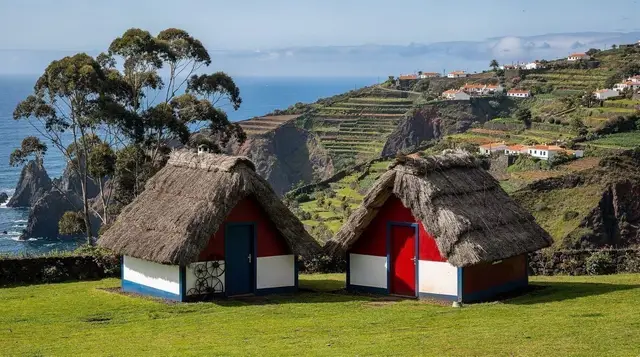
What defines Camacha visually is not a monument but a landscape: stepped terraces cut into the hillsides, small plots of vegetables and flowers, and patches of woodland climbing toward the higher ground. This is Madeira’s market-garden country, the kind of steep, intensively worked land that has fed Funchal for generations. The terracing here follows the same logic as everywhere on the island — flat ground is scarce, so every usable slope is cut into steps and held in place by stone walls, then planted right up to the edge.
Because Camacha sits higher than the coast, the growing conditions are different from the banana terraces and vineyards you find nearer sea level. Expect cooler-climate produce and pasture rather than the sub-tropical fruit gardens of Funchal’s outskirts, and a generally greener, mistier feel even on days when the coast is dry and sunny.
This is the same north-south, high-low split that shapes weather across the whole island: the south is sheltered and sunny, the interior and higher ground catch the cloud, and the two can feel like different climates on the same afternoon. If you are planning a day that moves between coast and plateau, our guide to mountain weather and what to wear is worth reading before you leave the hotel, because a warm morning in Funchal says nothing about conditions a few hundred metres higher up.
There is no ceremony to visiting this side of Camacha. The reward is simply walking a lane between two terraced plots, watching cloud drift across the hillside, and getting a sense of the island’s working landscape rather than its resort face. Bring a camera for the light rather than for any single landmark — the interplay of terrace walls, crop rows, and cloud is the actual subject here, and it changes by the hour.
A Crossroads, Not a Terminus
Camacha’s real function in most itineraries is as a link rather than a destination. Roads converge here from several directions: down toward Funchal and Monte on one side, out toward Santo da Serra and its plateau views on another, and onward toward Ribeiro Frio and the levada country of the north-central mountains. Further along the same general corridor, the road continues down to Machico, Madeira’s first Portuguese settlement, and on to Canical and the wild, treeless tip of Ponta de Sao Lourenco at the island’s easternmost point.
That crossroads position is precisely why several guided tours use Camacha as a start or end point rather than a headline stop. A self-guided e-bike route, for instance, runs from Camacha down toward Monte with lunch included, letting you cover the descent toward the capital at your own pace while someone else handles the logistics — worth considering if the idea of freewheeling through plateau air and cooler terraces sounds more appealing than another hour behind the wheel: a self-guided e-bike ride from Camacha down to Monte, with lunch built in.
For a wider view of the same corridor, jeep tours that cover the villages and viewpoints of the east typically thread through or near Camacha on their way between the plateau and the coast. If you would rather sit back and let a driver-guide handle the mountain roads while narrating the landscape, a route like this jeep tour through Santana and the Pico do Arieiro side of the east covers much of the same high ground in a single day.
| Nearby stop | How it connects to Camacha | Why go |
|---|---|---|
| Monte | Same road corridor, downhill toward Funchal | Cable car, gardens, toboggan run |
| Santo da Serra | Continues along the plateau road | Golf course, wide plateau views |
| Ribeiro Frio | Further along the mountain road | Trout hatchery, levada walks nearby |
| Machico | Descends toward the east coast | First Portuguese landing site, beach |
| Canical | Continues past Machico | Whale museum, old whaling port |
Getting There and Around
A hire car is by far the most practical way to see Camacha and treat it as the crossroads it is, rather than a single bus stop on a fixed schedule. The drive up from Funchal takes roughly 20 to 30 minutes depending on traffic and the exact road chosen, and the roads on this side of the island are typical Madeira mountain roads: narrow in places, with tight bends and real gradient, but generally well surfaced. Our guides to car rental in Madeira and driving in Madeira cover what to expect before you book, including why a smaller car is almost always the better choice up here than anything oversized.
Local buses do reach Camacha, but services are built around residents’ schedules rather than tourist timetables, and the real appeal of this area — stringing together the plateau, Monte, and the villages further east in one loop — depends on having your own wheels or a guide who does.
If self-driving does not appeal, a private guided option that takes in the wider east of the island, including a stop at a rum distillery on the way, removes the need to plan the route yourself: a private guided day through east Madeira with a rum distillery stop. For a broader look at how to structure a day that covers this side of the island without doubling back on yourself, see our east Madeira day trip guide.
If you would rather combine the plateau with an activity than simply drive through it, a jeep-and-levada combination pairs a short guided walk with off-road driving through terrain like this, which is a reasonable way to get out of the car for an hour without committing to a full day’s hike: a combined jeep safari and levada walk through the east.
Where Camacha Fits in a Wider Day
Because Camacha is a stop rather than a destination, the honest way to plan around it is to decide what else you want to see on the same day and let Camacha be the pause in between. A morning that starts in Funchal, climbs through Camacha, continues to Santo da Serra or Ribeiro Frio, and drops down toward Machico or Canical by afternoon covers a genuine cross-section of the island’s interior and east coast without retracing the same road twice. For a structured version of that kind of route, our three-day itinerary sketches out how to combine plateau villages, coastal towns, and at least one proper viewpoint without over-scheduling the day.
Speaking of viewpoints: Camacha itself is not built around a single dramatic outlook the way some plateau villages are, but the wider high ground it sits on offers some of the more rewarding panoramas on this side of the island. Our roundup of Madeira’s best viewpoints and miradouros is worth checking before you set off, so you know which stops along the way are genuinely worth pulling over for, and which are better admired from the car window.
A Note on What Camacha Isn’t
It is worth being direct about this: Camacha does not have a single confirmed headline craft, monument, or must-see attraction that belongs in a rushed itinerary. What it offers instead is atmosphere — terraced farmland, cooler air, and a sense of the island’s working interior — and a genuinely useful position on the road network. Treat it that way and it earns its place in an east Madeira day. Treat it as a box to tick with a specific “thing to see” and you will likely be disappointed, because that is not what this stretch of the plateau is selling.
If your priority is the coast rather than the plateau, you are better served by the diving and swimming spots around Canico or the beaches further east, both covered elsewhere on this site — Camacha’s value is precisely the opposite of that: altitude, cultivation, and quiet, rather than sea and sand.
Practicalities at a Glance
Pack a light layer even on a day that starts warm in Funchal, since the temperature drop with altitude is real and can catch out visitors who only checked the coastal forecast. Fuel up and use the bathroom before you leave the capital or the coast, since Camacha’s facilities are modest compared with the resort towns. And if you are combining the plateau with a proper hiking day elsewhere on the island, remember that Madeira’s official waymarked trails have required a paid, pre-booked permit since August 2021 — that applies to the levada network further along this same road corridor, not to walking through Camacha’s own lanes, but it is worth knowing before you commit to a bigger hiking day in the same trip.
For anyone planning to explore this stretch of the island by bike rather than by car, our guide to e-bike tours in Madeira explains how routes like the Camacha-to-Monte ride work in practice, including what kind of fitness and experience they actually require.