Madeira's Best Viewpoints and Miradouros
What are the best viewpoints in Madeira besides Cabo Girão?
Eira do Serrado above Curral das Freiras, Seixal on the north coast, and Balcões near Ribeiro Frio all rank among Madeira's best miradouros, alongside the high mountain viewpoints at Pico do Arieiro and Pico Ruivo. Most are reached by a short paved path from a car park rather than a doorstep view.
Madeira has more than one great view
Cabo Girão gets the headlines, and fairly so — a near-vertical drop to the sea with a glass-floored platform is hard to beat for a single photograph. But it’s one stop on an island that rewards a proper look-around. Madeira’s terrain was built for viewpoints: a volcanic spine that climbs to nearly 1,900 metres in nine kilometres from the coast, and a road network that clings to cliffs almost everywhere it goes.
This guide sets Cabo Girão alongside the miradouros most itineraries skip past, and is honest about which ones you can drive right up to and which ones ask for a short walk first. For the skywalk’s opening hours, ticket cost and how to combine it with Câmara de Lobos, see the dedicated Cabo Girão skywalk guide — this page won’t repeat that detail.
Eira do Serrado, above Curral das Freiras
If you only add one viewpoint to a Cabo Girão day, make it this one. Eira do Serrado sits at around 1,000 metres and looks straight down into the natural amphitheatre that holds Curral das Freiras — the “Valley of the Nuns,” where a scatter of red rooftops sits on the valley floor, ringed by peaks on every side. The car park is a short, level walk from the platform, and there’s a second, slightly higher lookout a few minutes further along a signed path if the main one is crowded.
The drive up from Funchal takes about 30–40 minutes through tunnels and switchbacks, and it pairs naturally with Cabo Girão on the same loop: Câmara de Lobos, up to Eira do Serrado, down into Curral das Freiras for chestnut liqueur or a coffee, and back. Go in the morning if you can — cloud tends to build over the valley by early afternoon, and it can erase the view entirely by 2 or 3pm in summer.
| Viewpoint | Walk from car park | Best time |
|---|---|---|
| Cabo Girão skywalk | Steps only | Any time, avoid midday sun for photos |
| Eira do Serrado | 2–5 minutes, paved | Morning, before valley cloud builds |
| Seixal viewpoints | Roadside, minimal | Morning light, after rain for waterfalls |
| Balcões | 20–30 minutes, easy path | Morning, clearest air |
| Pico do Arieiro | Steps to main platform | Sunrise, or late afternoon |
| Pico Ruivo summit | 1–2 hours from either trailhead | Clear, calm days only |
| Fanal | None, but needs fog to be worthwhile | Mid-morning, when cloud sits low |
The north coast: greener, wilder, and often overlooked
Where the south coast is dry and terraced, the north is the wet, green side of the island, and its viewpoints look different as a result. Seixal is the standout: a headland above a black-sand cove, with waterfalls that drop straight onto the coast road after rain. It’s one of the most photographed spots on Madeira, and unlike Cabo Girão, the light works best in the morning before the sun swings round behind the cliffs.
Further west, Porto Moniz offers a different kind of viewpoint — not a clifftop but a look down over the natural lava pools where the Atlantic meets the rock. It’s worth the stop even if you don’t plan to swim. Between the two, the old coast road that the newer tunnels have bypassed gives a string of pull-offs with sea views that most visitors now miss entirely, simply because the fast route saves 20 minutes.
The trade-off with the north coast is weather: it’s the wetter, cloudier side of the island on a normal day, so a north-coast viewpoint run works best on a forecast that favours the north, which local weather sites (and hotel staff) can usually tell you a day ahead.
a full-day guided run that links Cabo Girão, Fanal and Porto Moniz is a practical way to cover both coasts without driving the mountain roads yourself.
The high mountains: Pico do Arieiro, Pico Ruivo, Balcões
Madeira’s highest viewpoints aren’t roadside stops — they sit on marked trails, and how much walking they demand varies a lot.
Pico do Arieiro is the exception: it’s the one major peak the road actually reaches, at 1,818 metres, so the main platform needs only a few steps from the car park. It’s Madeira’s best-known sunrise spot, often looking out over a sea of cloud below the summit — see the Pico do Arieiro sunrise guide for timing and what to wear, since it can sit close to 0°C at dawn while Funchal is at 18°C.
Pico Ruivo, the island’s true summit at 1,862 metres, is a genuine walk from either direction — roughly 3 hours one-way if you start from Arieiro on the PR1, or a shorter 2.8km climb from Achada do Teixeira if you want the view without the full traverse. Neither route is a viewpoint you drive to.
Balcões, near Ribeiro Frio, is the best-value option for effort spent: a level, easy path along a levada of around 20–30 minutes each way, ending on a rock ledge with one of the clearest views of the central peaks on the island. It suits anyone who wants a mountain panorama without a mountain walk. Full directions and timing are in the Balcões levada guide.
Fanal: a viewpoint that needs the weather to cooperate
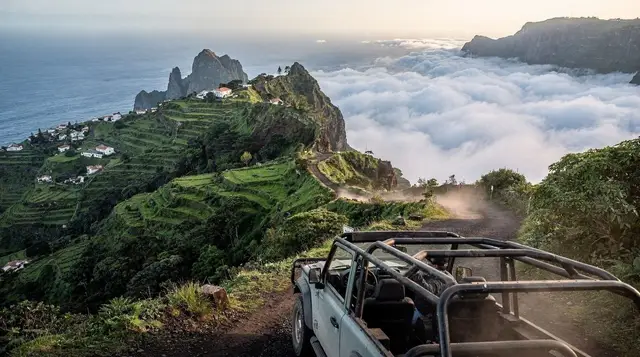
Fanal, on the northern edge of the Paul da Serra plateau, isn’t a formal miradouro at all — there’s no platform, no railing, no single spot marked on a map. What draws people is a stand of centuries-old til trees, twisted into strange shapes, that becomes Madeira’s most photographed scene when low cloud drifts through them. Without that fog, it’s an open, windswept pasture and nothing more. Check the forecast for low cloud on the plateau before building a day around it, and treat it as a bonus stop on a west-coast route rather than a destination in its own right. The Fanal forest guide has more on when the fog typically rolls in.
What a miradouro actually is
The word is Portuguese for “viewpoint”, and on Madeira it covers everything from a railed terrace with a car park and a kiosk to a bend in the road where someone once poured a small concrete platform. Signs with a little binocular symbol appear all over the island, and some of the best views are at the unsigned ones. Treat the official list as a starting point rather than a ranking.
Two things shape almost every view here. The first is the geology: Madeira is volcanic, with sea cliffs, deep valleys and a central ridge that rises to the 1,862 metres of Pico Ruivo within a short distance of the coast. The second is the cloud. The island makes its own weather, so the same viewpoint can be crystal clear at nine in the morning and white by noon. If you are tempted to spend a whole afternoon on a mountain miradouro, the mountain weather guide is worth five minutes first.
Reading the weather before you go
Madeira is subtropical and has no dead season, so there is never a month when you can ignore the sky. The coast and the mountains often disagree: Funchal can be sunny while the summits sit inside cloud. A few habits help.
- Look at the mountains from your hotel window in the morning. If the ridge behind Funchal is clear, the high viewpoints are likely to be too.
- Check more than one forecast, and look for the one that treats the south coast, the north coast and the peaks separately.
- Keep the plan flexible. If the north is grey, swap to the south coast and do the north another day.
- Start early. Clouds build as the day warms, and morning light is also kinder for photographs.
For more on seasons, see the best time to visit Madeira and the winter guide, since the New Year period is the real high season and the views are often at their sharpest in settled winter weather.
Sunrise, sunset and the light
Light changes what a viewpoint is worth. Pico do Arieiro is the sunrise viewpoint, and the sunrise and sunset guide covers where else the island rewards an early or late start. The south coast faces the evening light, which makes places like Cabo Girão and the coast around Funchal natural choices at the end of the day. The north coast is the opposite: Seixal and Porto Moniz tend to look their best earlier, before the sun moves behind the cliffs.
If photography is the point of your trip, the photography spots guide and the photography itinerary organise the island by light rather than by distance. For something to do at dusk without a mountain drive, a sunset catamaran from Funchal gives you the coastline from the water instead.
Viewpoints close to Funchal
You do not need a car or an early start to see something good. The capital sits on a steep amphitheatre of hillside, so many of its streets are viewpoints in themselves. The Funchal old town and the harbour front reward a slow walk, and the marina and the Lido promenade give you the bay and the cruise ships from sea level.
Higher up, Monte looks back down on the city and the bay. You can reach it on the Monte cable car, which is itself a moving viewpoint, and the cable cars of Madeira guide compares the options. Monte Palace Gardens adds terraces with views over the valley. If you are on a cruise stopover, the one-day cruise itinerary shows how to fit a view or two around the ship’s schedule.
West of Funchal beyond Cabo Girão
The coast west of the capital has a run of smaller views that a Cabo Girão day can include. Câmara de Lobos is a fishing harbour that sits under the cliff, and its own viewpoint looks down on the boats. Further along, Ponta do Sol, Calheta and Jardim do Mar all have stretches of road with sea views, and Ponta do Pargo has its lighthouse at the far western tip. The west Madeira day trip strings several of these together, and the Cabo Girão skywalk guide remains the place for the skywalk itself.
On the way to the north you cross the central plateau. Paul da Serra is open moorland with big skies, and the Encumeada pass looks down both sides of the island at once. Both are quick stops that add a lot to a drive.
Viewpoints with children, or with limited mobility
Most of the stops on this page are short, but not all are easy. The places with a car park close to the platform, such as Cabo Girão and Eira do Serrado, suit a pushchair or a slower walker far better than the mountain trails. Balcões is level but narrow beside a drop in places, so keep a hand on small children. Pico Ruivo and anything on the PR1 need proper shoes and some stamina.
If you are travelling as a family, the Madeira with kids guide and the family-friendly walks page pick out what works, and the Madeira with kids itinerary shows how to space the stops. Railings are not always continuous, so in any case treat cliff edges with respect.
Safety, fences and common sense
A viewpoint can sit directly above a long drop. Stay behind barriers, keep off wet rock, and do not step back for a photograph without looking behind you. Wind can pick up suddenly on exposed ridges, and fog can cut visibility to a few metres. If you plan to walk to a viewpoint along a levada, the levada safety guide explains tunnels, torches and exposure, and the hiking permits and trail fees page lists which trails now charge. Drivers should also remember that the roads to many miradouros are narrow, with few places to pass.
Building a viewpoint-focused day
A few miradouros most days actually deliver more than a checklist of ten. A reasonable south-coast loop from Funchal takes in Cabo Girão, Eira do Serrado and Curral das Freiras in half a day; a north-coast loop pairs Seixal and Porto Moniz with a stop at São Vicente. Combining a mountain sunrise with either is a stretch — Arieiro is worth its own early start rather than being bolted onto an afternoon plan.
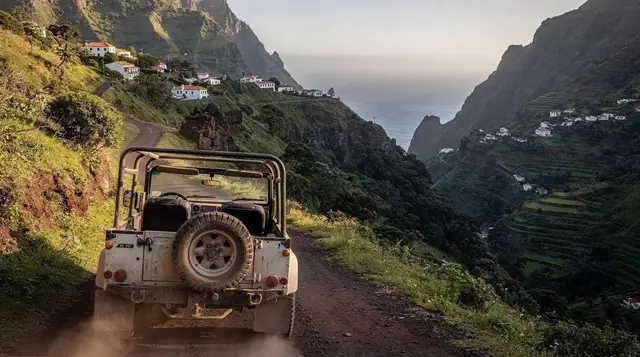
A tuk-tuk tour from Câmara de Lobos to the Cabo Girão skywalk is a good option if you’d rather not drive the cliff road yourself, and it drops you closer to the platform than the main car park. For a broader sweep in one outing, a 3.5-hour 4x4 excursion through Câmara de Lobos and Cabo Girão covers more ground than most people manage solo in the same time, including a few of the roadside pull-offs that are easy to miss when self-driving.
Getting there without your own car
Public buses reach some of these viewpoints, but infrequently and rarely on a schedule that suits a viewpoint-hopping day — see buses and public transport for what’s realistic. A small hire car gives the most flexibility, particularly for the north coast, but Madeira’s roads are narrow, steep and unfamiliar to most visitors; read driving in Madeira before you book one.
For a single well-organised day, a guided tuk-tuk or 4x4 route removes the driving question entirely — a guided tuk-tuk tour of Funchal’s best viewpoints is built specifically around that idea, staying close to the city rather than the far coasts.
Seeing the island from the water
Some of the best views of the cliffs are from below. A boat gives you the full height of the coast, and the boat trips from Funchal guide compares the options. Whale and dolphin trips add a chance of wildlife, and responsible whale watching explains how to pick an operator. This will not replace a clifftop, but it complements one well.
Which viewpoints for which itinerary
If you have one day and no car, stick close to Funchal and take a guided tuk-tuk route. If you have a car and a full day, the Cabo Girão–Eira do Serrado–Curral das Freiras loop is the single best return on driving time. If you have two days, split them by coast: south and central peaks on one, the greener north — Seixal, Porto Moniz, and Fanal if the cloud cooperates — on the other. However you split it, treat “viewpoint” as a spectrum from steps-from-the-car to a proper hike, not a single category, and plan footwear and timing accordingly rather than assuming every miradouro on the map is a two-minute stop.
Miradouros, cable cars and skywalks on GetYourGuide
Verified deep-linked GetYourGuide tours. Book through these links and we earn a small commission at no cost to you.
GetYourGuide does not provide a product photo for this activity — the image shows the meeting point, photographed by us.