Responsible Whale Watching in Madeira: How to Choose a Boat
How do I know a Madeira whale watching operator is responsible?
Look for a permit-holding operator that follows the official approach code: no more than two or three boats near an animal at once, engines idled or cut on approach, a maximum viewing time of around 10 to 15 minutes, and no chasing or head-on approaches. Certified operators display this openly; if a crew boasts about getting close or circling an animal, book elsewhere.
Not every boat out of Funchal follows the same rules
Madeira’s waters hold one of the most consistent year-round cetacean populations in the Atlantic, and the island has built a genuine tourism industry around watching them. What gets said less often is that the boats doing the watching are not all held to the same standard. A permit and a printed code of conduct exist, but nobody stands on the quay checking that every skipper follows them. The difference between a trip that respects the animals and one that harasses them for a better photo comes down to which operator you book, not luck.
This matters more in Canical than almost anywhere else in the archipelago, because of what the town used to do for a living.
From whaling station to sanctuary
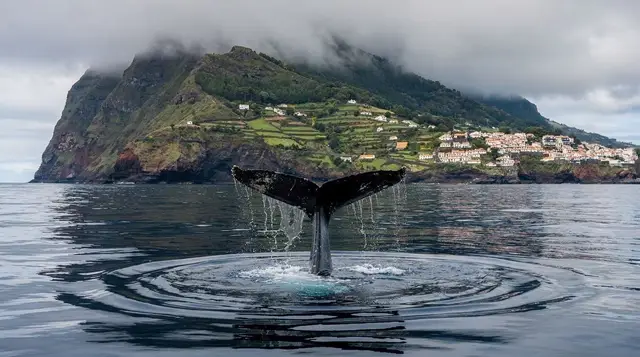
Canical was Madeira’s whaling port. Sperm whales were hunted from open boats launched from this coast into the 1980s, with the last commercial catch recorded in 1981. The Whaling Museum sits on the site of the old factory where the catch was processed, and it does not soften what happened there. Within a few years of the hunt ending, the same waters were reclassified, and the animals that had been pursued for oil and meat became the reason tourists now fly in.
That reversal is real, but it is also recent enough that the habits of the old industry have not fully disappeared. Some of today’s boat operators are descended from families that fished or whaled this coast for generations, and their seamanship is often excellent. Skill on the water, though, is not the same thing as restraint around a wild animal, and a crew that grew up chasing things down with a boat can carry that instinct into a watching trip without meaning any harm by it. The point of an approach code is to remove that instinct from the equation.
What the approach code actually says
Madeira’s regional authorities regulate commercial whale and dolphin watching through licensing and a set of approach rules. The detail varies slightly by permit, but the core standard that responsible operators work to is consistent:
| Rule | What it means in practice |
|---|---|
| Boat limit | No more than two or three vessels within the close approach zone of one animal group at a time |
| Approach angle | Boats approach from the side or slightly behind, never head-on or cutting across the direction of travel |
| Engine behaviour | Engines slowed well before arrival, often idled or cut once close, never gunned to keep pace with a moving pod |
| Maximum time | Roughly 10 to 15 minutes with any one group before moving off to let other boats queue in, or leaving the animals alone entirely |
| No chasing | If a group is travelling away from the boat, the trip does not follow; the animals choose the encounter, not the skipper |
None of this is exotic. It is the same logic behind whale watching codes worldwide: an animal that is repeatedly surrounded, followed, or cut off by boat traffic changes its behaviour, and a mother with a calf is particularly vulnerable to that pressure. What is specific to Madeira is the queuing system for boat numbers, a direct response to how busy the waters off Funchal and Canical get in peak season, when several operators can be working the same stretch of coast within sight of each other.
Why “we saw whales” is not the same as “it was a good trip”
It is easy to judge a whale watching trip purely on whether something surfaced. That is the wrong measure, and it is the measure that lets poor operators get away with poor practice, because a chased, crowded, or harassed animal still counts as a sighting on a review site. A trip where three boats box in a pod of pilot whales for twenty minutes so every passenger gets a close photo will generate five-star reviews from people who do not know what they watched happen.
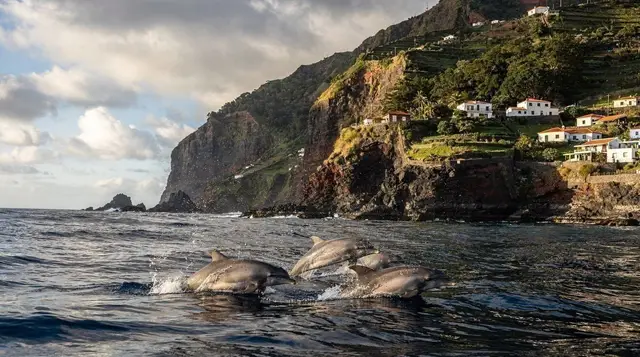
The better question is what the boat did when the animals were found, not just whether they were found. A responsible skipper who arrives at a group already circled by two other boats will hold back and wait rather than pushing in for a third position. A responsible skipper travelling with a pod that turns and swims off will let it go rather than opening the throttle to keep up. Passengers on a well-run trip sometimes come away having watched from a distance for most of the encounter, with no dramatic close pass at all, and that is what the code working looks like, not a failure of the trip.
Signs of a serious operator
A few practical things to look for before you hand over money, most of which you can check from an operator’s own listing or by asking directly:
- A stated licence or permit. Commercial whale watching in Madeira requires authorisation. An operator confident in their standing will say so plainly rather than being vague about it.
- A trained guide or biologist aboard, not just a skipper. This is not a legal requirement everywhere, but its presence correlates strongly with disciplined approach behaviour, because someone on board has a professional reason to prioritise the animals over the itinerary.
- A clear statement that sightings are not guaranteed. Operators who promise whales, or who imply every trip finds something dramatic, are telling you something about how they might behave once they are actually alongside a pod trying to make that promise come true.
- Willingness to explain the approach rules unprompted. Ask how many boats they allow near one group and how long they stay. A crew that answers specifically, with numbers, is one that thinks about this. A crew that shrugs is not.
- Smaller boats, smaller groups. This is not an absolute rule, but a rigid semi-rigid inflatable with eight passengers has more room to manoeuvre gently than a large catamaran with ninety, and tends to attract operators who built their business around watching rather than volume.
What to watch for once you are on the water
Even with a good operator booked, it helps to know what bad practice looks like, because a busy day can put several boats in the same stretch of sea regardless of who booked whom.
Watch for boats converging tightly around a single animal or group rather than spacing out and taking turns. Watch for a skipper who accelerates to keep pace with a pod that is clearly moving away, rather than letting the encounter end. Watch for approaches that cut directly across an animal’s path instead of coming in from an angle. None of these are always deliberate, sea conditions and other boat traffic complicate every approach, but a pattern of them over the length of a trip is a fair reason to mention it afterwards, whether to the operator, to a booking platform, or to the regional tourism authority.
Reporting matters more in Madeira than the size of the industry suggests. Regulation here works less through active patrol and more through operators knowing that passengers, other boats, and eventually the licensing body will notice a pattern of disregard. A code with no one watching how it is followed is not much of a code.
Combining a responsible trip with the rest of the coast
A whale watching outing is often bundled with, or booked alongside, other time on Canical’s stretch of coast. A guided fishing trip out of Canical runs from the same harbour and gives a sense of how local skippers read these waters day to day, which is a useful comparison when judging a watching operator’s seamanship. For an evening on the water without the early start a watching trip usually demands, a sunset boat tour with snorkelling along the coast covers similar ground at a gentler pace.
Further along the coast towards the island’s easternmost point, a sailing trip along the east coast to a quieter cove passes through some of the same waters where cetacean groups are regularly sighted, without being marketed as a dedicated watching trip, which some travellers prefer precisely because there is no pressure on the skipper to deliver a sighting.
Travellers heading to the peninsula itself for the walk out to Ponta de Sao Lourenco sometimes pair it with a snorkelling trip off the peninsula’s sheltered coves on the same day, giving a full look at this end of the island from both land and water.
Where this fits with the rest of the coast
Canical rewards a slower visit than most first-time itineraries allow it. The Whaling Museum is the place to understand what changed in 1981 and why, before or after a trip on the water gives that history some context. For the wider picture of species, seasons, and where trips depart from across the island, the general whale and dolphin watching guide covers that ground.
Divers curious about the marine life from underwater rather than from a boat deck should look at the Garajau marine reserve, Madeira’s other major marine protection area along this same eastern coast. And for a broader sense of how to pick a boat operator on this coast in general, not just for whale watching, the boat trips from Funchal guide runs through the options departing the capital.
None of this requires expertise to navigate as a visitor. It requires asking two or three direct questions before booking, and paying attention to what the boat actually does once something surfaces. On a coast that spent over a century hunting these animals and has spent less than half a century watching them instead, that attention is the least a visitor can bring.
tours.whale-watching
Verified deep-linked GetYourGuide tours. Book through these links and we earn a small commission at no cost to you.
GetYourGuide does not provide a product photo for this activity — the image shows the meeting point, photographed by us.