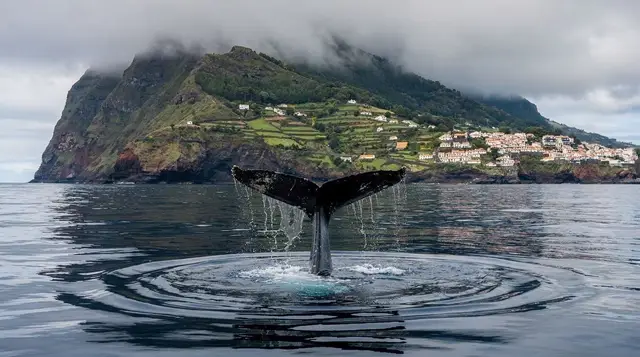
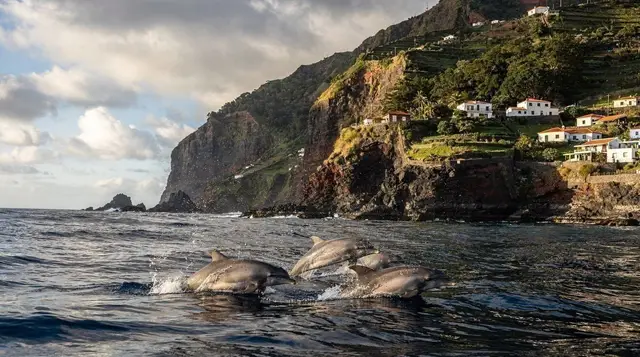
Whale and Dolphin Watching in Madeira
Can you see whales and dolphins in Madeira?
Yes. Around twenty cetacean species have been recorded in the waters off Madeira, including Atlantic spotted dolphins, common bottlenose dolphins, sperm whales and Bryde's whales. Boat trips run year-round from Funchal, Calheta and Canical, typically lasting two to three and a half hours.
An ocean crossroads: what lives off Madeira’s coast
Madeira has a geographical accident going for it that most whale watching destinations would envy: the seabed drops away steeply close to shore, so deep water — and the deep-diving animals that use it — is often only a few kilometres from the marina, rather than a half-day crossing away. The archipelago also sits on a north-south migratory corridor used by cetaceans moving between feeding grounds and warmer breeding waters, which is part of why sightings happen in every month of the year rather than in one short season.
Around twenty species of whales and dolphins have been recorded in Madeiran waters over the years, from small, sociable dolphins that ride a boat’s bow wave to sperm whales that can dive for the best part of an hour. Not all twenty show up on a given afternoon, and this guide deliberately does not promise any of them individually — the honest version of this activity is that you go out with good odds of dolphins and a real but unpredictable chance of something larger.
The species you’re most likely to see
Two dolphin species do most of the everyday work. The Atlantic spotted dolphin travels in lively, often large pods and is one of the most frequently reported animals on trips out of Funchal. The common bottlenose dolphin is the other regular, recognisable by its size and the classic curved dorsal fin, and it is often seen closer to the coast than the spotted dolphin.
Beyond the two dolphins, sightings become less certain but still meaningfully common. The sperm whale — Madeira’s most-searched-for whale, and the animal the historic whaling industry was built around — passes through the deep water off the south coast in most months of the year, though never on demand. The Bryde’s whale, a baleen whale that feeds on small fish, is the other whale most associated with these waters, generally reported more often in spring and early summer than in winter, though patterns shift from year to year. Short-finned pilot whales and the common dolphin (a different, smaller species from the bottlenose) round out the list of animals you have a realistic chance of encountering.
| Species | Type | How often seen |
|---|---|---|
| Atlantic spotted dolphin | Dolphin | Very common, most months |
| Common bottlenose dolphin | Dolphin | Very common, most months |
| Sperm whale | Toothed whale | Regular but not guaranteed |
| Short-finned pilot whale | Toothed whale | Occasional |
| Bryde’s whale | Baleen whale | Occasional, more spring/summer |
| Common dolphin | Dolphin | Occasional |
No boat trip in Madeira, and no honest operator, will tell you which of these you will see before you leave the harbour. That uncertainty is the trade-off for watching wild animals in open water rather than a marine park.
Where trips depart from: Funchal, Calheta and Canical
Funchal is where the vast majority of whale and dolphin watching happens. The fast RIB boats that leave from the marina several times a day give the widest choice of departure times, and Funchal’s large fleet means you can pick between small rigid inflatables, mid-sized catamarans and sailing boats depending on how much comfort — or how much speed — you want. The Funchal marina is the natural base for this activity, within easy walking distance of the old town and most hotels along the Lido promenade.
Calheta, on the sunnier, drier west coast, has its own small marina and its own operators, useful if you are based in Calheta itself, in Jardim do Mar or along that stretch of coast and would rather not drive back into Funchal for an evening trip. Trips from here reach broadly the same deep water as Funchal boats, just from a different angle.
Canical, at the island’s eastern tip near Ponta de Sao Lourenco, is the smallest of the three departure points and the most historically loaded — this was Madeira’s last working whaling port before hunting stopped in 1981. It is a useful base if you are staying in Machico or the east, and it pairs naturally with a visit to the whaling museum, covered in its own guide rather than here.
What a typical trip looks like
Trips generally fall into two shapes. A RIB trip is fast, low to the water, and carries a smaller group — often a dozen or fewer passengers — which means more manoeuvrability if dolphins are spotted, at the cost of more bouncing and spray on the way out. A catamaran or larger boat is slower, more stable, and carries more passengers, which suits families, anyone prone to seasickness, or people who would rather sit and watch the horizon with a drink than hang onto a grab handle.
Most trips out of Funchal run two to three and a half hours, including the run out to open water and back — the dolphins and whales are not right at the harbour mouth, so transit time is built into every trip regardless of boat type. A skipper or marine guide on board usually explains what has been seen recently and what to look for, and better operators carry a hydrophone so passengers can listen to dolphin clicks and whistles, or occasionally a distant whale, underwater.
For a first trip with no particular preference, a standard shared boat trip from the marina covers the basics well. If a small group or a specific departure time matters more, a private charter just for your own group removes the scheduling constraints of a shared trip, at a higher price.
And for anyone who wants the light rather than the wildlife to be the main event, a sunset speedboat trip combines the chance of dolphins with the far more reliable payoff of watching the sun go down over the Atlantic from open water.
Prices and what they include
| Trip type | Typical duration | Typical price (per adult) | Boat type |
|---|---|---|---|
| Shared RIB trip | 1.5–2.5 hours | €45–€60 | Small rigid inflatable |
| Shared catamaran/boat trip | 2–3.5 hours | €50–€75 | Larger, more stable boat |
| Sunset trip | 1.5–2.5 hours | €55–€75 | RIB or speedboat |
| Private charter | 2–4 hours | From several hundred euros for the boat | Varies |
Prices generally include life jackets, a safety briefing, and the boat crew or guide’s commentary; some catamaran trips add a drink or light snack. Wetsuits and snorkelling gear, where swimming is offered, are sometimes included and sometimes an add-on — worth checking before booking rather than assuming. None of these prices buy a guaranteed sighting of any particular species; some operators offer a free return trip if nothing at all is seen, which is worth looking for as a fair-use policy rather than a promise of what you will find.
Swimming with dolphins and whales
A handful of trips are marketed around the idea of swimming with dolphins or whales, and it is worth being clear about how that actually works in practice. Nobody puts snorkellers in the water on a fixed schedule; it depends on finding a pod that is calm, slow-moving and comfortable with people nearby on the day, which is far from every trip. When conditions and the animals cooperate, it can be one of the most memorable things on offer in Madeira. When they don’t, the trip is still a boat trip with a good chance of dolphins from the deck. Book this kind of trip in the spirit of “possible, not promised,” and you won’t be disappointed by ordinary weather or a shy pod.
Best time of year for this activity
Unlike whale watching in colder, more seasonal waters, Madeira runs trips every month of the year, and dolphins are seen with roughly similar frequency across the seasons. The main seasonal difference is sea state rather than wildlife: winter can bring rougher water and a higher chance of a trip being cancelled or postponed for safety, particularly on the more exposed north coast departures, while late spring through early autumn generally offers calmer conditions and a smoother ride. If Bryde’s whales are a specific hope rather than a bonus, spring and early summer have historically produced more reports, though this is a pattern, not a rule.
Combining a boat trip with the rest of the coast
A whale and dolphin trip pairs naturally with other things on and around Madeira’s water. Divers and snorkellers exploring the Garajau marine reserve are in the same general waters where dolphins are often seen from the shore path above. Anyone drawn to the idea of open, empty ocean rather than a busy harbour can extend the idea with a trip out towards the Desertas Islands, the uninhabited reserve south-east of Madeira that is also a refuge for the Mediterranean monk seal. And for a lower-key evening on the water without committing to a full wildlife trip, a sunset catamaran out of the Funchal marina covers similar ground at a gentler pace.
It is also worth remembering that not every operator on the marina treats the animals, or the other passengers, the same way — the difference between a considerate approach at a respectful distance and a boat that chases a pod for a better photo is real, and it is covered in full in the dedicated guide to choosing a responsible whale watching operator rather than repeated here.
Whale and dolphin watching FAQ
What species of whales and dolphins can you see off Madeira?
Around twenty cetacean species have been logged in Madeiran waters. The regulars are the Atlantic spotted dolphin and the common bottlenose dolphin, both seen close to shore for much of the year. Sperm whales pass through in most months, and Bryde’s whales, short-finned pilot whales and common dolphins are also recorded, though less predictably than the dolphins.
Is whale watching in Madeira guaranteed?
No operator can guarantee a specific species, and no honest one will promise one. Dolphins are seen on the large majority of trips, but whales are wild animals on an open ocean, not a scheduled show, and a small number of trips end with no cetacean sighting at all.
What time of year is best for whale watching in Madeira?
Trips run all year, which is unusual for Atlantic whale watching. Dolphins are seen in every season. Sperm whale sightings are reported across most months, while Bryde’s whales tend to be more associated with spring and early summer, though this varies year to year.
How long do whale watching trips from Funchal last?
Most standard trips last two to three and a half hours, including transit time to open water and back. RIB trips tend to be shorter and faster; catamaran and sailing trips run longer and more slowly, with more time and comfort on board.
How much does a whale watching trip in Madeira cost?
Expect roughly 45 to 75 euros per adult for a shared trip of two to three hours, with RIBs usually at the lower end and larger catamarans and sunset trips at the higher end. Private charters cost considerably more, generally starting from several hundred euros for the boat.
Do trips leave from anywhere other than Funchal?
Funchal marina has by far the largest fleet and the widest choice of times, but Calheta on the west coast and Canical on the east coast both run their own whale and dolphin watching trips, useful if you are staying away from Funchal or want a smaller operation.
Can you swim with dolphins in Madeira?
A few operators market swimming with dolphins or whales, but it depends entirely on finding a pod that is calm and approachable on the day, and it never happens on every trip. Treat it as a possibility a good operator will offer if conditions allow, not a booked activity.
Is whale watching in Madeira safe for children?
Most standard catamaran and larger boat trips are suitable for children, with life jackets provided and a briefing before departure. Fast RIB trips involve more bouncing over waves and spray, which some younger children find uncomfortable or frightening, so a slower boat is usually the safer first choice for families.
tours.whale-watching
Verified deep-linked GetYourGuide tours. Book through these links and we earn a small commission at no cost to you.
GetYourGuide does not provide a product photo for this activity — the image shows the meeting point, photographed by us.