A gold-sand pause on Madeira’s wilder coast
Calheta is the town on Madeira’s west coast that gives you a genuine, sit-down-and-swim beach without a ninety-minute detour to Porto Santo. It sits roughly where the tamer south coast starts giving way to the steeper, greener, more exposed villages further west, and it works as either a half-day stop or a proper base for two or three nights. The bay is sheltered by a breakwater, the marina is modern and easy to like, and the promenade behind it has enough cafes and restaurants to make an evening here feel like a small holiday rather than a pit stop.
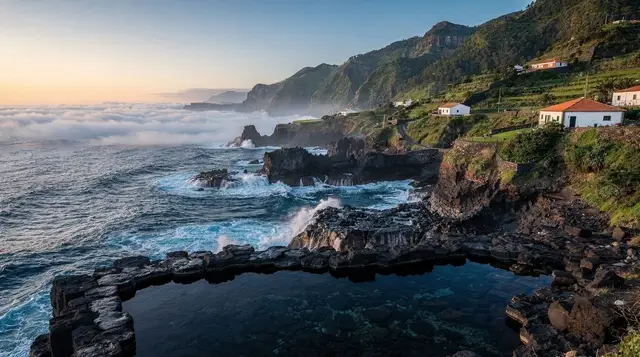
What makes Calheta worth a dedicated page, rather than a paragraph in a wider west-coast guide, is the sand. It is genuinely gold, genuinely soft, and genuinely not what most of Madeira’s coastline produces on its own. The island is volcanic from top to bottom, and its natural beaches are black sand, dark pebbles, or bare rock with a natural pool cut into the lava, as you find further north at Porto Moniz and Seixal. Calheta’s beach, like the one at Machico on the other side of the island, was built by importing sand. That is not a criticism of the place, it is simply the fact most guides leave out, and knowing it in advance means you arrive with the right expectations instead of a mild sense of having been misled.
The beach and the marina
The beach itself is a crescent of imported gold sand tucked behind the Calheta marina, calm enough for children and confident swimmers alike thanks to the breakwater that blunts the Atlantic swell before it reaches the sand. Sunbeds and umbrellas are available to rent in season, there are showers and changing facilities close to the sand, and a lifeguard is on duty through the main summer months. It is one of the few beaches on the island where you can reasonably plan a full afternoon around swimming rather than treating the sea as a bonus to a walk.
Behind the beach, the marina at Calheta is the town’s other centre of gravity. It holds berths for private yachts and the boats that run fishing and sightseeing trips along this stretch of coast, and the promenade around it is lined with restaurants that lean toward fresh fish, unsurprisingly. Evenings here are unhurried: locals and visitors mix over long dinners, and the lighting along the water makes it one of the more photogenic small harbours on the island after dark. If you are staying nearby, this is where you will end up most nights by default, and there are worse defaults.
A short walk or drive from the marina, the Calheta beach area also has a small church and a scattering of banana plantations on the slopes above town, a reminder that this coast has always made its living from agriculture as much as from the sea. Banana terraces climb the hillsides on the road out toward Estreito da Calheta, and if you are driving through in spring you will see them in flower.
Boats and the sea from Calheta
Because Calheta has a working marina rather than just a beach, it is also a sensible departure point for getting onto the water rather than just beside it. Several operators run out of the harbour, from short scenic cruises to full private charters, and the west coast here has a different character to the boat trips that leave from Funchal: fewer other boats, closer cliffs, and a good chance of picking up dolphins on the way out to open water.
For a relaxed few hours on the water, a wooden boat trip along the west coast covers sea caves and quiet coves that are invisible from any road, with swimming stops built in when conditions allow. If you would rather have the boat to yourselves, the private charter departing from Calheta marina is the more comfortable version of the same idea, suited to a small group or a couple wanting an unhurried afternoon without a shared schedule.
Neither of these needs to be booked from Funchal. Basing yourself in Calheta for a night or two and walking to the marina in the morning removes the drive entirely, which matters more here than it sounds: the coast road west of Ribeira Brava is scenic but slow, and not something you want to do twice in one day if you can avoid it.
Day trips into the mountains from Calheta
Calheta’s other advantage is proximity. The Rabacal car park, gateway to the 25 Fontes and Levada do Risco walks, sits up in the hills not far above town, reached by a winding but manageable drive. These are two of Madeira’s best-known levada walks, and doing them from Calheta rather than from Funchal saves a substantial amount of driving time each way, leaving more daylight for the walk itself.
A guided option removes the logistics entirely. The guided walk to 25 Fontes and Risco waterfall starts from Calheta and handles transport up to Rabacal, where the road to the trailhead is closed to private cars and a shuttle is compulsory in any case.
If you would rather cover more ground with less walking, a west-coast jeep tour taking in Fanal and the Seixal natural pools uses Calheta’s position to reach places that would otherwise mean a long day from Funchal, and a guide who knows the unmarked forest tracks around Fanal is worth having, since the mist that makes the place photogenic also makes it easy to lose your bearings.
For something gentler and further inland, a private guided walk on the Levada do Prazeres stays close to Calheta’s own hills, above the villages of Prazeres and Estreito da Calheta, with none of the tunnels or exposed drops that make some of Madeira’s higher-mountain levadas unsuitable for nervous walkers. See our guide to the 25 Fontes walk for what to expect on the trail itself, including the trail-fee system that applies to every official route on the island.
Using Calheta as a base for the far west
This is where Calheta earns its keep beyond the beach. West of town, the coast road climbs and narrows as it passes through Jardim do Mar, a former surf village stacked on a hillside above the sea, before reaching Paul do Mar itself, a wilder fishing village with a black-pebble beach and Madeira’s best-known surf break. Paul do Mar has its own character and its own page on this site; from Calheta it is a short, dramatic drive rather than a destination you would attempt on foot, since there is no coastal walking path linking the two and the road between them switches back sharply down the cliff face.
Further on again, the road runs out at Ponta do Pargo, the westernmost point of Madeira, marked by a lighthouse on a headland with nothing between it and the open Atlantic. It is one of the best places on the island to watch a sunset, precisely because there is so little in the way of the horizon.
Closer to Calheta itself, Madalena do Mar and Canhas sit along the same stretch of coast toward Ponta do Sol, both worth a stop if you are driving slowly rather than aiming straight for the beach. A full loop, from Calheta out to Ponta do Pargo and back via the inland road through Prazeres, is a comfortable half-day with a hire car and covers most of what makes the west coast worth the drive. Our west coast day trip guide lays out a version of this route in more detail, and the driving in Madeira guide is worth reading first if this will be your first time on the island’s mountain roads.
Nearby villages and drive times
| Destination | Approx. distance from Calheta | Drive time |
|---|---|---|
| Paul do Mar | 8 km | 15–20 minutes |
| Jardim do Mar | 7 km | 15 minutes |
| Ponta do Pargo | 20 km | 30–35 minutes |
| Prazeres | 6 km | 15 minutes |
| Ribeira Brava | 15 km | 20–25 minutes |
| Funchal | 40 km | 50–60 minutes |
Beach practicalities at a glance
| Detail | |
|---|---|
| Sand type | Imported gold sand, not natural to Madeira |
| Water | Sheltered by a breakwater; generally calm |
| Lifeguard season | Summer months, roughly June to September |
| Facilities | Sunbed and umbrella rental, showers, changing rooms |
| Parking | Paid car parks near the marina, fills up in peak season |
Where to eat and stay
The marina promenade is the obvious place to eat, with fish restaurants overlooking the boats and a handful of more casual cafes for lunch on the beach. Prices are noticeably lower than the equivalent view in Funchal, since Calheta sees far fewer cruise-ship day-trippers. If you want to try Madeira’s own fortified wine or a proper poncha away from the tourist bars of Camara de Lobos, several of the marina restaurants keep a reasonable list, and the town sits within the wider wine-growing area celebrated at the Madeira Wine Festival each autumn; our poncha guide explains what you are actually drinking before you order one.
Accommodation in Calheta ranges from beachfront resort hotels to smaller guesthouses up in the hills toward Estreito da Calheta, and prices generally undercut Funchal for a comparable standard, particularly outside the July and August peak. Booking a hire car is close to essential if you are staying here rather than in Funchal, since bus connections along this stretch of coast are infrequent; see our car rental guide before you arrive. For what else the beach can offer beyond swimming, our broader guide to Madeira’s beaches puts Calheta in context alongside the island’s natural lava pools, covered separately in our natural pools guide.
Calheta FAQ: sand, tides and getting there
Is Calheta beach natural sand?
No. The gold sand was brought in, in the same way Machico’s beach was, because Madeira’s own coastline is volcanic and produces dark sand and pebbles, not pale sand. Calheta is the honest exception, and it is worth knowing before you arrive expecting a black-sand cove.
How do I get to Calheta from Funchal?
The fastest route is the VE1 expressway west to Ribeira Brava, then the VR1 tunnel road, which puts Calheta about 50 to 60 minutes from Funchal by car. There is a bus connection via Rodoeste, but it runs far less often and takes considerably longer, so a hire car is the practical choice.
Is Calheta a good base for exploring the west coast?
Yes. Calheta sits between Ribeira Brava and the wilder villages of Jardim do Mar, Paul do Mar and Ponta do Pargo, so it works well as an overnight base for a west-coast loop without the driving fatigue of a single long day trip from Funchal.
Can I walk to Paul do Mar from Calheta?
Not comfortably. Paul do Mar lies further west along a winding, steep coast road, and there is no flat coastal path connecting the two. Drive or take a local bus between them rather than planning to walk it.
Is the sea safe for swimming at Calheta?
Calheta’s bay is one of the more sheltered spots on this coast, with a breakwater that cuts the swell, and the beach is lifeguard-supervised in the summer season. Conditions still change with the weather, so check the flag before swimming outside those months.
What’s the best time of year to visit Calheta?
May to September gives the calmest sea, the warmest water and the longest lifeguard cover. Outside that window the beach is still pleasant to walk, but swimming is less comfortable and some marina-side facilities scale back.
Is there a marina at Calheta?
Yes, Calheta has a modern marina with berths for yachts and smaller boats, a promenade of cafes and restaurants around it, and it is one of the departure points used for boat trips and fishing charters along the west coast.