A working plateau, not a postcard
Most visitors reach Prazeres by accident, on the road linking Estreito da Calheta to the steep descent toward Paul do Mar and Jardim do Mar. That accident is the honest way to see it.
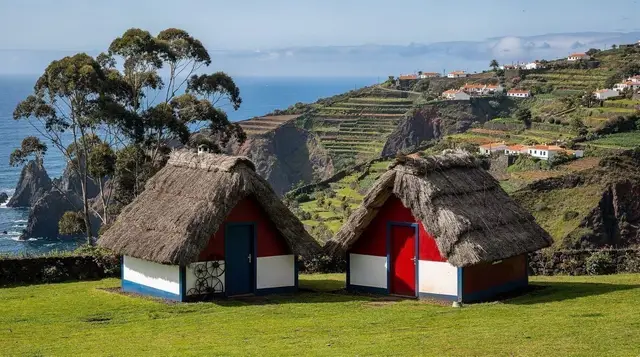
Prazeres sits on the high plateau above Madeira’s west coast cliffs, a scatter of farmhouses, dairy sheds and apple orchards laid out on gently rolling ground that feels almost nothing like the volcanic drama a few kilometres either side of it. There is no single attraction here, no ticket office, no queue. What there is, is agricultural land worked for generations, hedgerows heavy with hydrangeas in early summer, and a silence that is rare anywhere else on the island.
That is also the trap for anyone writing about the place: the temptation to invent a headline sight where none exists. Prazeres does not have a waterfall, a skywalk or a museum. Its value is the landscape itself and the fact that almost nobody stops for longer than it takes to photograph a field of cows against the Atlantic horizon. If you are chasing a single “must-see” moment, this is not it. If you want twenty unhurried minutes on a working Madeiran plateau, it is exactly right.
Where it sits on the map
Prazeres belongs administratively to the west, in the stretch of hillside villages between Ponta do Sol and Calheta, set well above Camara de Lobos and the coastal road that most itineraries follow. The village occupies a broad shoulder of the plateau, at an altitude that keeps it noticeably cooler and damper than the sun-baked coast below. Cloud drifts across the fields on many afternoons, even when Funchal is cloudless, which is part of why the grass stays green enough for dairy cattle year-round.
Two better-known landmarks bookend the wider area and are worth naming for context, even though neither is the subject of this page. Cabo Girao, one of Europe’s highest sea cliffs with its glass-floored skywalk, lies to the east along the same coastal shelf. Achadas da Cruz, with its small service cable car dropping to a cultivated fajã by the sea, sits further north. Both draw coach parties and rental cars in numbers Prazeres never sees, and both have their own detailed guides. Treat them as orientation points on the map rather than reasons to detour into the village itself.
What the landscape actually looks like
The defining feature of Prazeres is pasture. Dairy farming has shaped this plateau for well over a century, and the fields are still fenced, grazed and cut for hay in a pattern that predates any tourism on the island. Holstein and mixed-breed cattle graze in small paddocks divided by hydrangea hedges and stone walls, a scene that would not look out of place in parts of rural England or Brittany, which is disorienting in a good way given how volcanic and vertical most of Madeira is.
Alongside the pasture, apple orchards are a genuine local speciality. Prazeres apples are grown at altitude, in a cooler and wetter microclimate than the coastal citrus and banana groves further down, and the fruit has a longer local reputation than most visitors realise. There is no formal orchard tour or tasting room to point you to here, and inventing one would be dishonest; the orchards are working smallholdings, not an attraction, and the correct way to experience them is simply by driving or walking the lanes between the fields, ideally in late summer or early autumn when the trees are heavy with fruit.
The overall effect is of a landscape that rewards slow movement rather than a checklist. Walk a lane rather than drive it if you have the time. The quiet is not incidental; it is the actual point of stopping here.
Getting to Prazeres and moving on
A hire car is close to essential. Prazeres is not served meaningfully by island bus routes with any useful frequency, and the connecting roads through the west are narrow, steep in places and better suited to a small car than a large one. From Funchal, the drive takes 50 to 60 minutes via the VR1 west and then the climb up through Ribeira Brava or Campanario onto the plateau; from Calheta it is closer to 15 minutes.
The village’s most useful role in a west-coast itinerary is as a link, not a destination in its own right. The road down from Prazeres toward Paul do Mar is one of the steeper descents on this side of the island, dropping from plateau farmland to sea level in a short, winding stretch with tight hairpins. It is entirely manageable in a small hire car driven carefully, but it deserves full attention rather than being treated as a minor connector; wet or foggy conditions on the plateau make the upper section considerably less forgiving. If you are combining a west-coast loop in one day, Prazeres is naturally the point where you leave the high ground and start down toward the coastal villages.
| Route segment | Approx. time | Notes |
|---|---|---|
| Funchal to Prazeres | 50–60 min | Via VR1 west, then plateau roads |
| Calheta to Prazeres | 15 min | Short climb onto the plateau |
| Prazeres to Paul do Mar | 15–20 min | Steep, narrow descent; drive with care |
| Prazeres to Cabo Girao | 25–30 min | Along the plateau shelf toward the coast |
When to visit
May to September gives the most reliable weather for appreciating the open fields and orchards, with the plateau’s cloud cover burning off more often than in winter. That said, Prazeres is arguably at its most characteristic in the shoulder seasons, when mist sits low over the pastures in the early morning and the cattle are the only thing moving. Winter brings more persistent cloud and rain at this altitude than the sun-drenched coast below suggests, so pack accordingly if you are heading up here between November and March; do not assume Funchal’s mild winter temperatures apply on the plateau, because they do not.
There is no fee, permit or booking system attached to visiting Prazeres itself. Unlike Madeira’s official waymarked levada trails, which have required a paid permit since August 2021, simply driving or walking through the village and its lanes costs nothing.
Nearby activities worth pairing with a stop
Because Prazeres has no organised activity of its own, the sensible approach is to treat it as a stop within a larger west-coast day rather than a standalone outing. A private guided levada walk through the Prazeres area is one of the few ways to get onto the plateau’s irrigation channels away from the busier eastern trails, and it is the most direct way to actually spend time in this landscape rather than just driving through it.
a private guided levada walk through the Prazeres countryside gives structure to an otherwise unstructured visit, with a local guide explaining the irrigation system and farming history as you go.
For those who want a levada walk with a more dramatic backdrop nearby, a scenic levada walk from Serra de Agua covers similarly quiet terrain a short drive to the east, through the valley below Encumeada.
If you would rather see the west coast from below after descending from the plateau, a sunset jeep tour around Paul do Mar picks up the coastal side of the same region, timed for the evening light along the cliffs.
For a fuller loop that takes in the plateau villages alongside the coastal landmarks, a full-day private 4x4 tour is the option most likely to include Prazeres as one stop among several, rather than requiring you to plan the connections yourself.
Practicalities: eating, staying and budgeting
Prazeres has a handful of small local cafes and a bakery or two serving the village itself, useful for a coffee and a pastry rather than a destination meal; most visitors eat in Calheta or Paul do Mar, both a short drive away and considerably better supplied. Accommodation follows the same pattern: a few rural guesthouses and farm stays exist on the plateau for travellers who specifically want the quiet, but the bulk of west-coast lodging is concentrated closer to the coast.
Because there is nothing to buy a ticket for, a stop in Prazeres itself costs nothing beyond fuel and, if you stop for refreshments, the price of a coffee. Budgeted as part of a wider day exploring the west, allow €25 to €45 per person once car hire, fuel and a meal elsewhere are factored in.
Prazeres in context: what to see nearby
Treat Prazeres as one stop on a loop rather than a day trip in itself. To the east along the coastal shelf, Cabo Girao offers the region’s genuine headline attraction, its skywalk suspended nearly 580 metres above the sea. To the north, Achadas da Cruz and its small cable car down to a working fajã make a similarly short, focused stop.
Downhill and to the west, Jardim do Mar and Paul do Mar give you the coastal fishing-village counterpoint to the plateau’s farmland, while Ribeira Brava anchors the route back toward Funchal. None of these substitutes for Prazeres, and Prazeres does not substitute for any of them; the point of the plateau stop is precisely that it is different from all of it.
Frequently asked questions about visiting Prazeres
Is Prazeres worth visiting on a Madeira trip?
It is worth a short stop if you are already driving the west coast loop and want to see the island’s working farmland rather than only its cliffs and viewpoints. It is not worth a dedicated trip on its own, since there is no single sight to justify the drive.
What is Prazeres known for?
Prazeres is known locally for dairy farming and apple orchards on Madeira’s high western plateau, and among visitors for its quiet, uncrowded rural landscape rather than any specific attraction.
Do I need a car to visit Prazeres?
Yes, effectively. Public bus routes do not serve the village with useful frequency, and the surrounding roads, while manageable, are narrow and steep, making a small hire car the practical option.
Is Prazeres the same area as Cabo Girao?
No. Cabo Girao is a separate, more famous clifftop viewpoint and skywalk further east along the same coastal region. Prazeres is a farming village on the plateau above; the two are commonly visited on the same day but are distinct places.
How long should I spend in Prazeres?
Twenty minutes to an hour is typical, enough time to drive or walk a lane or two through the fields and orchards. Longer stays suit travellers specifically seeking rural quiet rather than sightseeing.
Are there hiking trails around Prazeres?
There are levada and farm-lane walks in the surrounding countryside, though Prazeres is not on one of Madeira’s headline official PR trail numbers the way areas further east are. A guided levada walk is the most reliable way to explore the terrain properly.
What is the weather like in Prazeres compared to Funchal?
Prazeres sits at a higher altitude on the plateau and sees noticeably more cloud, mist and rain than sun-drenched Funchal on the coast, even on days when the capital is clear. Pack a layer even in summer.
Can I buy Prazeres apples or local dairy products in the village?
Small local shops occasionally sell farm produce, but there is no formal market or tasting facility geared toward visitors. Treat any purchase as a pleasant chance encounter rather than a planned stop.