A working village, not a resort
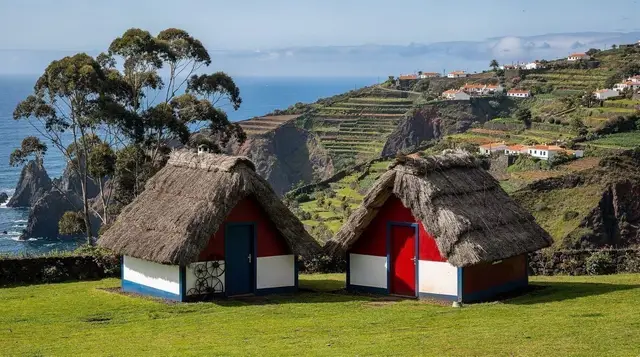
Estreito da Calheta sits in the hills directly above Calheta, on Madeira’s south-west coast, and the two places could hardly feel more different. Down at sea level, Calheta has a marina, cafés and a beach of sand imported from Morocco in 2008. Up here, at around 300–400 metres, the land is still worked: steep terraces of bananas, vines and vegetables climb the slopes in tight green steps, held up by dry-stone walls that in places are centuries old.
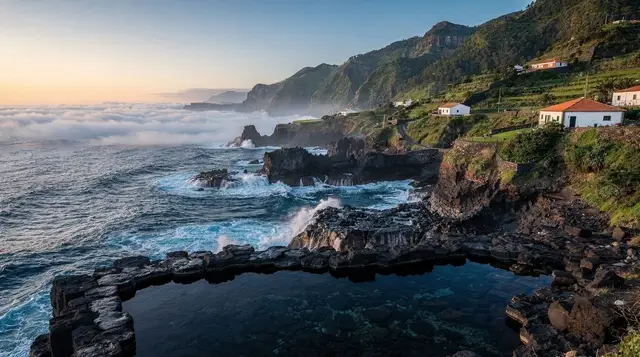
There is no seafront, no promenade and no natural beach — if a photo or a listing implies otherwise, it is not describing this parish. What Estreito da Calheta offers instead is a slower, more agricultural side of the island, the kind of place you pass through on the way to a levada trailhead and then find yourself lingering in.
The name itself gives it away. “Estreito” means narrow or strait, and it refers to the tight ravine the village sits astride, squeezed between the Ribeira da Calheta and steep terraced hillsides on both flanks. The parish belongs to the municipality of Calheta, which stretches from this rural interior down to the coastal town and its beach — worth keeping in mind if a map or booking confuses the two, since driving directions to “Calheta” can mean either.
Terraces, poios and how the land is farmed
The defining feature of Estreito da Calheta is its poios — the small, hand-built terraces that turn near-vertical hillside into farmable ground. Madeira’s volcanic soil is rich but its slopes are unforgiving, and communities across the island spent generations levelling narrow strips behind dry-stone retaining walls, then irrigating them by hand-dug channel. Around Estreito da Calheta the terraces carry bananas on the lower, warmer ground and vines higher up, with vegetable plots and the odd chestnut or fruit tree filling in between. Many of these smallholdings are still worked by families rather than agribusiness, which is part of why the parish feels lived-in rather than curated for visitors.
Water for all of this comes from the same levada network that defines hiking on the rest of the island — see how the levadas actually work for the full picture. Around Estreito da Calheta and neighbouring Prazeres, older, unnumbered irrigation channels still feed the terraces directly, distinct from the numbered PR trails that walkers follow further up the mountain. Don’t expect a marked footpath through every field: much of what you see from the road is private farmland, and the etiquette is to admire the terraces from public tracks and viewpoints rather than to wander into them.
Getting there and finding your way around
From Funchal, the fastest route is the VR1 west to Ribeira Brava, then the ER222 coast road on to Calheta, followed by the ER222/ER223 climbing inland to Estreito da Calheta — roughly 40–50 minutes in normal traffic. The climb from the coast is short but steep, with the usual tight bends of Madeira’s secondary roads, so a compact hire car is a genuinely better choice here than anything larger. See driving in Madeira and car rental in Madeira before you book if this is your first visit to the island.
Public transport reaches the area but works better for getting you there than for exploring once you’ve arrived: Rodoeste buses run from Funchal towards Calheta and the villages above it, but services are infrequent outside commuting hours and are not built around tourist schedules. If you don’t want to drive, the practical plan is a day trip built around a taxi or a booked tour rather than the timetable — see getting around without a car.
The village itself is compact: a church, a scattering of cafés and small shops, and roads that fan out along the ridges towards Prazeres to the west and Ponta do Pargo beyond, or down towards the coast at Calheta. There isn’t a single “sight” to tick off so much as a landscape to drive and walk through, stopping at the viewpoints where the terraces open out below you.
Levadas and walks based nearby
Estreito da Calheta’s real appeal for most visitors is as a quiet base for walking, sitting between two of the west coast’s better-known levada trailheads without the crowds either draws. To the north, the parish borders Serra de Água and the road up to Rabaçal, the starting point for the 25 Fontes and Levada do Risco walks — both reached by a shuttle from the car park, since the access lane itself is closed to private cars.
a guided levada walk from Serra de Água is a good introduction to this stretch of the west coast if you’d rather not navigate trailheads and shuttle logistics yourself, and it starts close enough to Estreito da Calheta to combine easily with an afternoon in the village. For something less crowded than Rabaçal, a hike to Madeira’s lesser-known waterfalls covers ground that most visitors never see, threading through terraced farmland similar to what surrounds Estreito da Calheta itself.
West of the village, towards Prazeres, older levadas cross farmland and laurel-fringed ravines with far fewer walkers than the famous routes. a private guided levada walk from Prazeres is the most straightforward way to get onto these paths with a local guide who knows which sections are currently open — useful, since minor landslips and overgrowth close unmarked channels more often than they close the numbered PR trails.
Whichever route you choose, check current conditions with the IFCN beforehand, since Madeira’s official PR trails have required a paid permit, from around €3 per person per trail per day, since August 2021 — a fact still missing from a surprising number of guides, and one that changes the budget of a walking week here noticeably.
Wine, poncha and what to eat
The terraces around Estreito da Calheta grow grapes as well as bananas, and this stretch of the west coast is one of the island’s traditional wine-producing areas — see how Madeira wine is actually made if the estufagem-versus-canteiro distinction is new to you. Small, family-run adegas dot the hillsides between here and Jardim do Mar and Paul do Mar further along the coast, some open to casual tastings, most not signposted from the main road. Asking locally, or timing a visit around the Festa do Vinho in late August or September, is a more reliable way in than turning up unannounced.
Poncha — the rum, honey and citrus drink stirred with a wooden caralhinho — is easier to find, in the small bars scattered through the village and its neighbouring parishes. As elsewhere on the island, the “pescador” version made with lemon is the traditional one; fruit-flavoured variants are aimed at visitors rather than locals. For food, expect straightforward Madeiran cooking rather than a tourist menu: espetada, bolo do caco, and seasonal vegetables that, more often than not, were grown on the terrace across the road.
What a half-day here actually looks like
Because Estreito da Calheta has no single headline attraction, it rewards a loop rather than a checklist. A workable plan: drive up from the coast via Ponta do Sol and Madalena do Mar, stopping at terrace viewpoints on the way; spend an hour or two in and around the village itself, including a coffee and a walk along a farm track; then either head further inland towards Rabaçal for a levada walk, or drop back down to the coast at Calheta for lunch and, if you want the sea, the beach and marina there.
Combining the two levels — hills for the morning, coast for the afternoon — is the version of this day that most visitors end up happiest with, and it avoids the mistake of expecting swimming or sand where there is none.
Drivers continuing west rather than back to Funchal can extend the loop through Canhas and Prazeres towards Paul do Mar and Ponta do Pargo, or take in a proper west-coast circuit with a full-day 4x4 tour of Madeira’s wild west, which covers viewpoints and back roads that are impractical in a standard hire car. If you’d rather end the day on the coast, a sunset jeep tour to Paul do Mar departs from villages close to Estreito da Calheta and finishes at one of the west coast’s best sunset points.
Seasons, weather and what to wear
Estreito da Calheta sits high enough to catch more cloud and rain than the coast below, particularly between November and March, when mist can sit over the terraces for days at a time. April to June and September to October are the more reliable windows: warm enough for walking, green from recent rain, and generally clearer than midwinter.
Even in summer, mornings up here can be noticeably cooler and damper than down at Calheta’s beach, so a light layer is worth keeping in the car — see mountain weather and what to wear for a fuller picture of how quickly conditions change with altitude on Madeira. None of this is extreme weather; it is simply the ordinary trade-off of visiting the island’s interior rather than its coast, and it’s the same trade-off that makes the terraces this green in the first place.
Frequently asked questions about Estreito da Calheta
Does Estreito da Calheta have a beach?
No. Estreito da Calheta is an inland farming parish with no coastline of its own. The nearest beach is at Calheta, roughly a 10–15 minute drive downhill, and its sand was imported in 2008 rather than naturally occurring.
How far is Estreito da Calheta from Funchal?
Around 40–50 minutes’ drive via the VR1 and the ER222, depending on traffic and where exactly in the parish you’re headed.
Is Estreito da Calheta the same place as Calheta?
No, though they’re often confused. Calheta is the coastal town with the marina and beach; Estreito da Calheta is a separate, higher-altitude parish in the same municipality, several kilometres inland.
What is there to do in Estreito da Calheta itself?
Mainly driving and walking through terraced farmland, visiting small wine producers, and using the village as a base for nearby levada walks around Rabaçal, Serra de Água and Prazeres. It’s not a sightseeing stop with a single headline attraction.
Can I visit the terraces and vineyards directly?
Much of the terraced land is private smallholdings, so the usual approach is admiring the terraces from public roads and viewpoints, or joining a guided walk or wine tasting rather than wandering onto farmland uninvited.
Do I need a car to visit Estreito da Calheta?
It’s strongly recommended. Bus services from Funchal exist but run infrequently, and the area’s appeal is largely in driving the terraced back roads and reaching trailheads that buses don’t serve well.
Is there anywhere to eat or stay in the village?
There are small local cafés and a handful of places to eat, generally simple and aimed at residents rather than tourists. Most visitors treat Estreito da Calheta as a half-day stop rather than a base for the night, staying instead in Calheta, Ponta do Sol or Funchal.
Do the nearby levada walks require a paid permit?
Yes, if you’re walking one of Madeira’s official numbered PR trails, including those accessed from Rabaçal near Estreito da Calheta. Permits have cost around €3 per person, per trail, per day since August 2021, booked online in advance and checked on the trail.