Where Madeira’s Road West Ends
Paul do Mar sits at the point where the tamed, resort-ish stretch of Madeira’s south coast finally runs out. Drive west from Funchal past Câmara de Lobos and the towering cliff of Cabo Girão, on through Ribeira Brava and Madalena do Mar, and the landscape gradually loses its polish.
By the time the ER101 drops down from Jardim do Mar into Paul do Mar, the manicured promenades and imported sand of Calheta feel a long way behind you. This is a village that still smells of diesel and salt, where the harbour exists to launch small fishing boats rather than tourist catamarans, and where the Atlantic arrives without a breakwater to soften it.
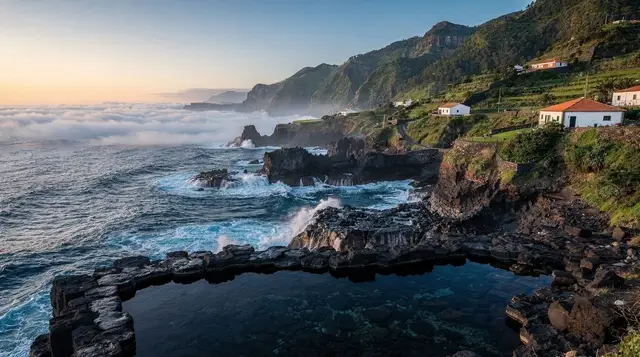
The name translates roughly as “mouth of the sea,” and it is an honest one. Paul do Mar has no sheltered bay, no golden crescent of sand, and no gentle lagoon. What it has is a wide arc of black volcanic boulders and reef facing straight into the open Atlantic, framed by the steep, terraced hillsides of Jardim do Mar above and Prazeres higher still. It is one of the last villages before the road curls on toward Estreito da Calheta and eventually the lighthouse at Ponta do Pargo, and it feels like it.
A Fishing Village That Still Fishes
Unlike much of Madeira’s south coast, where fishing has quietly given way to tourism, Paul do Mar’s harbour is a working one. Small painted boats come and go with the tides, nets are mended on the quayside, and the catch — much of it espada preta, the black scabbard fish that turns up on menus across the island, along with tuna and small reef species — is sold or eaten locally rather than shipped out for a food-tour photo opportunity. The village above the harbour is a tight grid of modest houses climbing the lower slope, with none of the whitewashed uniformity of a resort town.
This working character is exactly what draws a certain kind of traveller here: people who have already seen Funchal’s marina and want somewhere that has not been arranged for them. There is a small cluster of cafés and simple seafood restaurants near the harbour, serving the kind of fresh, unfussy fish plates that do not appear on laminated tourist menus, but do not expect much beyond that. Paul do Mar is not set up for a long, lingering visit with shops and activities to fill an afternoon — it rewards a shorter, more focused stop.
The Break: Why Surfers Make the Drive
Paul do Mar’s reputation, well beyond Madeira, rests almost entirely on the wave that breaks along its rocky point. It is a right-hand point break running over an uneven volcanic seabed, exposed directly to Atlantic groundswell with very little to slow it down before it reaches the coast. That combination — open exposure, a rocky bottom and a well-shaped point — has made it one of the names surfers mention when the conversation turns to Madeira, alongside the island’s other well-regarded breaks further along the coast.
It is not a wave for a first lesson. The rocky, shifting seabed and the power the swell can carry mean Paul do Mar is generally the preserve of experienced surfers and bodyboarders who know how to read a point break and handle a fall onto rock rather than sand. Watching from the harbour wall, especially on a build-up in autumn or winter, is genuinely worthwhile even without setting foot in the water — the scale of a big Atlantic day here is obvious from dry land. For a broader sense of where this break sits among Madeira’s surf spots, and where beginners are better served, the surfing in Madeira guide covers the island’s breaks by skill level.
Reading the Season
| Season | Typical swell | Who it suits |
|---|---|---|
| Autumn–winter (Oct–Mar) | Largest, most consistent | Experienced surfers and bodyboarders |
| Spring (Apr–May) | Moderate, variable | Intermediate surfers watching forecasts |
| Summer (Jun–Sep) | Smaller, less frequent | Visitors happy to watch rather than paddle out |
Why Paul do Mar Is Not Calheta
It is worth being direct about this, because the two villages sit only a short drive apart and are easy to conflate on a first visit. Calheta is a planned resort development: an imported golden-sand beach, a marina, breakwaters that tame the swell, sun loungers and lifeguard cover in season. It is built, deliberately and successfully, for swimming and sunbathing.
Paul do Mar is none of those things. There is no imported sand, no breakwater softening the swell, and no lifeguard station. The shoreline is loose volcanic boulder and exposed reef, the water can carry real force even on an ordinary day, and currents around the point are unpredictable. Treating Paul do Mar as a swimming beach because it looks similar to Calheta on a map, or because the sea looks calm from a distance, is a genuine mistake — and one that matters more here than most, given how quickly conditions on an open Atlantic point can turn.
If a sandy, supervised swim is what you are after, that is Calheta’s role on this coast, not Paul do Mar’s. Anyone weighing open-water swimming anywhere on the island should also read the swimming safety in the Atlantic guide before getting in.
Getting There: The Coast Road West
The drive itself is part of the experience. From Funchal, the VR1 expressway carries traffic quickly out past Câmara de Lobos and Quinta Grande toward Ribeira Brava, after which the road narrows and begins to climb and dip through Campanário, Ponta do Sol and Canhas before reaching Madalena do Mar and Calheta. From there, the ER101 hugs the cliffs through Jardim do Mar and down into Paul do Mar, with tight bends and steep gradients typical of Madeira’s secondary roads.
A small hire car is a genuinely better choice than a large one for this route, and a manual gearbox remains the norm on the island — see the car rental in Madeira and driving in Madeira guides before booking. Allow 45 to 55 minutes each way from Funchal without stops, and considerably longer if you plan to pull over at the viewpoints along the way, which most visitors do. Roadside and harbourside parking in Paul do Mar itself is informal but normally manageable outside the busiest summer weekends.
Travellers without a car are not well served here: buses run along this stretch of coast but infrequently, and the village’s appeal — the drive, the isolation, the freedom to stop where you like — is largely lost without your own transport. The west Madeira day trip guide lays out a fuller loop that takes in Paul do Mar alongside its neighbours for anyone planning the drive properly.
Sunset Over the Point
If there is one reason to plan a visit around a specific time of day, it is sunset. Paul do Mar faces almost directly into the open Atlantic with nothing on the horizon to interrupt the view, and the combination of black rock, breaking surf and a low sun over open water is one of the more dramatic settings on the island’s west coast. It also happens to be one of the more accessible ways to see this stretch of coast without driving yourself after dark on unfamiliar roads: a guided jeep tour timed to reach Paul do Mar for sunset handles the driving on the narrow ER101 bends and leaves you free to simply watch the light change over the point.
Beyond the Village: Jardim do Mar, Prazeres and the West Coast Loop
Paul do Mar rarely needs to be the only stop on a west-coast afternoon. Jardim do Mar, perched just above on a steep terraced slope, is worth the short detour for its own quieter viewpoints over the same coastline. Higher again, Prazeres sits on the clifftop plateau with a cooler climate and a slower pace than the coast below, and its levada paths are a popular way to see the west’s agricultural terraces on foot — a private guided walk along the Levada do Norte near Prazeres is one way to combine the two in a single outing.
Inland and to the east, Serra de Água offers a gentler, greener contrast to the exposed coast, with its own levada walking; a scenic levada walk through Serra de Água is a good pairing for a day that starts with the coast and ends among laurel forest and running water.
For visitors who want to see the west’s waterfalls and ravines rather than its coastline, a guided hike to the island’s hidden waterfalls covers ground most self-drive visitors never find on their own. And for those who prefer to see the whole rugged western half of the island from a 4x4 rather than a walking trail, a Madeira Wild West 4x4 safari loops through this coast and its hinterland in a single organised day.
For a broader sense of what else sits along this side of the island, the west Madeira day trip guide and the Paul do Mar things-to-do page both group the village with its neighbours rather than treating it in isolation.
Eating in Paul do Mar
Food here is simple, fresh and unglamorous in the best sense. A handful of small restaurants cluster near the harbour, serving the day’s catch grilled or fried with little ceremony — espada preta, tuna, octopus and whatever else came in that morning, usually alongside boiled potatoes and a green salad rather than anything more elaborate. Prices are noticeably lower than in Funchal’s tourist-facing restaurants, and portions tend to be generous. This is not the place for an extensive menu or a wine list to match Blandy’s cellars in town; it is the place for a plate of fish eaten within sight of the boat that caught it.
Practical Notes
A visit to Paul do Mar works best as a stop within a longer west-coast day rather than a destination on its own. Most travellers spend two to three hours here: enough time to walk the harbour, watch the surf from the point, eat a simple lunch, and continue on to Jardim do Mar, Prazeres or back toward Calheta. Surfers naturally stay longer, timing their visit around swell forecasts and often basing themselves in the area for several days rather than making a single day trip from Funchal.
There are no large hotels in the village itself; accommodation is limited to small guesthouses and apartments, mostly used by surfers and travellers who specifically want to be close to the break. Facilities are basic — a few cafés, a small shop or two, and the restaurants near the harbour — so it is worth fuelling up and picking up anything you need in Calheta or Ribeira Brava beforehand.
For a wider view of common missteps on this side of the island, including the swimming question addressed above, the Madeira travel mistakes to avoid guide is worth a look before setting out, alongside the general beaches of Madeira guide for anyone still deciding where on the island to actually swim.
Paul do Mar FAQ: Surf, Safety and Getting There
Can you swim at Paul do Mar?
Not really, and not the way most visitors picture a swim. The shore is volcanic boulder and reef, the Atlantic swell arrives with real force, and there is no lifeguard or sheltered bay. Confident, experienced swimmers sometimes go in beside the harbour on the calmest summer days, but this is not a beach for children, casual paddling or anyone unsure of open-water conditions.
Is Paul do Mar good for beginner surfers?
No. The break is a right-hand point break over an uneven, rocky seabed, and it is respected among surfers precisely because it can get big and powerful. Beginners are far better served by a lesson on one of Madeira’s gentler, sandier breaks, or by simply watching from the harbour wall at Paul do Mar instead of paddling out.
How do you get to Paul do Mar from Funchal?
Take the VR1 west towards Ribeira Brava and Ponta do Sol, then follow the ER101 coast road through Calheta and Jardim do Mar to Paul do Mar. The drive takes roughly 45 to 55 minutes and covers some steep, narrow sections, so a small hire car is easier to manage than a large one.
What is the difference between Paul do Mar and Calheta?
Calheta is a purpose-built resort a short drive back along the coast, with an imported golden-sand beach, a marina and calm, swimmable water. Paul do Mar is an older fishing village with a black volcanic shoreline, a working harbour and serious surf — a place to look at the Atlantic, not to swim in it casually.
Is Paul do Mar worth visiting if you don’t surf?
Yes. Even without a board, the drive along the west coast, the setting beneath the cliffs of Jardim do Mar and Prazeres, the working harbour and the sunset are reason enough to stop. Plan on a short visit of an hour or two rather than a full beach day.
When is the best time to see waves at Paul do Mar?
Autumn and winter, roughly October to March, bring the largest and most consistent Atlantic swell, which is also when the strongest surfers and the occasional visiting competitor turn up. Summer swells are smaller and less frequent but the village and harbour are pleasant to visit at any time of year.
Is there parking in Paul do Mar?
Yes, informal roadside and harbourside parking is available and is normally easy outside peak summer weekends. There are no large car parks or facilities geared toward tour buses, which is part of why the village still feels unpolished.
Where do surfers stay near Paul do Mar?
Most surfers base themselves in or around Jardim do Mar, Paul do Mar or Calheta, all within a few minutes of the break, rather than commuting from Funchal each day. Accommodation is simple guesthouses and apartments rather than large resort hotels.