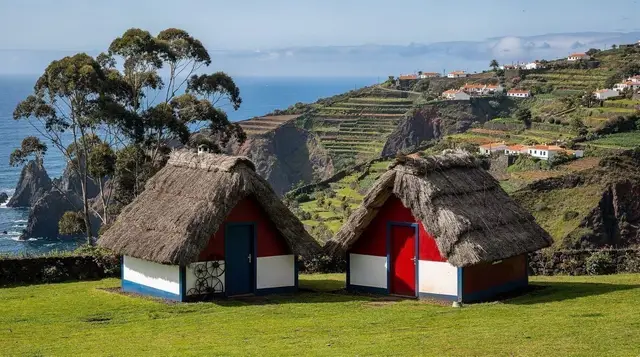
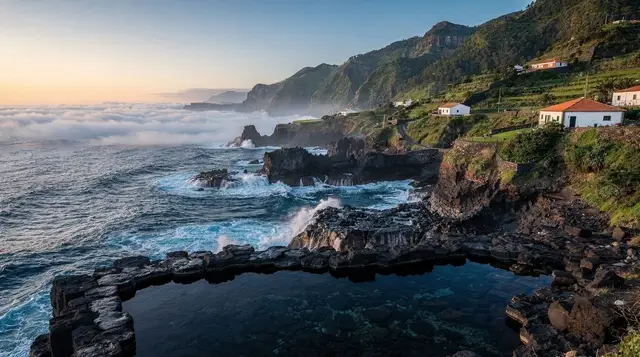
South of the tunnels that carry most drivers straight past it, a short private cable car drops off the coast road at Quinta Grande and lowers visitors roughly 300 metres to a ledge of banana terraces and vines sitting almost at sea level. There is no other way down by land.
A Ledge the Road Never Reaches
Quinta Grande is a small parish on the coast road between Câmara de Lobos and Ribeira Brava, a stretch of the west coast where Madeira’s cliffs drop hard into the Atlantic and the old VR1 tunnels now let most through-traffic bypass the village entirely. Few visitors stop here on their way between Cabo Girão and the resorts further west, which is exactly what keeps it quiet.
What draws people off the road is not the parish itself but what lies below it: Fajã dos Padres, a flat shelf of cultivated land wedged between the base of the cliff and the sea, invisible from the road above and reachable by only two means — a small cable car, or a boat. There is no third option. Search results and older guidebooks sometimes show a car park beside the water; that car park sits at the top, at Quinta Grande, not at the fajã itself. Nobody drives down to the ledge, and nobody ever will — the geography does not allow it.
The Cable Car: Almost the Only Way Down
The cable car is privately operated by the restaurant at the bottom, strung on a cliffside cable that drops around 300 metres in a couple of minutes. It runs on the restaurant’s own schedule rather than a fixed public timetable, generally through the middle of the day and into the evening in the warmer months, and it closes when the restaurant is closed. That single detail catches people out: turn up outside service hours, particularly on a quiet weekday out of season, and the cable car may simply not be running.
Because the ride and the meal are bundled by the same operator, treat a visit as a package rather than two separate errands. Confirm hours and pricing on the day, ideally by phone, before making the drive from Funchal — a wasted trip out here costs the better part of an hour each way. The car itself is small, built for a handful of passengers at a time, and the descent gives a view straight down the cliff face that the road above never offers, with the banana terraces and the restaurant’s roof appearing gradually below.
What Is Waiting at the Bottom
At the base, the ledge is planted almost edge to edge with banana trees, the crop that has quietly outcompeted sugar cane across much of Madeira’s warmer south-facing slopes. Between the plantations, low vines are trained along the terraces, tended for the estate’s own wine rather than for commercial export, and a scatter of mango and other subtropical fruit trees fills the gaps. The name itself comes from the Franciscan friars who farmed this same plot centuries ago — a fajã, in Madeiran usage, is any flat shelf of land isolated at the foot of a cliff, and this one has kept its old tenants’ name long after the friars left.
Below the terraces, a small natural bathing area sits on the rocks, used mostly by lunch guests rather than as a destination swim spot in its own right, and entirely dependent on how calm the sea is on a given day. There is no beach of sand here, and no lifeguard — this is a working smallholding with a restaurant attached, not a resort.
Eating at the Fajã
The one restaurant at sea level serves fresh fish and wine made from the estate’s own grapes, and it is the reason most people make the descent at all. Seating is limited, the setting is unusual enough to draw bookings well ahead in the summer months, and because the cable car’s running hours track the kitchen’s service, arriving to eat is the simplest way to guarantee the lift is actually working when you want it.
Anyone planning a broader taste of the region’s food and drink before or after should look at what else the west coast offers — where to eat by area covers the stretch around here, and Madeira’s wine explains how estate wines like this one differ from the fortified Sercial and Malvasia sold in Funchal’s lodges.
Reaching It by Boat Instead
The second route in is by sea. Small boats out of Câmara de Lobos and Funchal can put in at the fajã, an option some travellers use instead of, or alongside, the cable car — arriving by water and leaving by wire, or the reverse. A cruise along the southern coast often passes close enough to see the terraces from the water even without stopping, and a trip on a traditional xávelha fishing boat out of Funchal gives a slower, more local look at this same shoreline.
Anyone chartering privately for a west-coast afternoon might also consider a private charter departing from Calheta, further along the coast, which can be routed past the fajã on the way out. For a wider view of what boat trips from the south coast cover, the boat trips from Funchal guide is the place to compare operators and routes.
Quinta Grande the Village
Above the cliff, Quinta Grande itself is a modest strip of houses and terraced fields along the coast road, easy to drive through without noticing unless you are looking for the cable car turn-off. It has none of the harbourside bustle of Câmara de Lobos a few minutes east, and none of the market-town feel of Ribeira Brava a few minutes west — its interest for visitors is almost entirely the descent, rather than the village at road level.
Drivers heading this way should note the coast road here still has the tight bends and steep verges typical of the pre-tunnel routes; the driving in Madeira guide and car rental in Madeira guide are worth reading before a first drive along this stretch, and a small hire car makes the parking at Quinta Grande considerably less stressful than a large one, as covered in why a small hire car matters here.
Nearby on the Same Road
Quinta Grande sits between two of the west coast’s better-known stops, and both are easy to fold into the same half-day without retracing much ground. Câmara de Lobos, the fishing village where Winston Churchill once painted, lies a short drive east — its own page covers the harbour, the poncha bars and the cliffside views in full, and a poncha crawl through Câmara de Lobos is a natural way to end the day after coming back up from the fajã.
West of Quinta Grande, Cabo Girão and its glass-floored skywalk sit only a few minutes further along the coast road, detailed in the Cabo Girão skywalk guide, and the road continues on toward Estreito de Câmara de Lobos, Ribeira Brava, Ponta do Sol and eventually Calheta and Paul do Mar.
For travellers stringing several of these together, the west Madeira day trip guide and the best viewpoints and miradouros guide both use this same road as their backbone.
Travellers who want to see the west coast from a jeep rather than a hire car have that option too: a sunset jeep tour toward Paul do Mar runs along much of this coastline later in the day, past the turn-off for Quinta Grande, timed for the light rather than for a stop at the fajã itself. Those more drawn to marine life than to banana terraces might prefer a dolphin and whale watching catamaran trip from Funchal, which covers open water further offshore rather than this sheltered stretch of coast.
Planning a Visit
| What | Detail |
|---|---|
| Getting there | Drive to the Quinta Grande car park on the coast road; no direct road to the fajã itself |
| Down to the fajã | Private cable car (restaurant-operated) or arrival by boat |
| Typical cost | €40–70 per person for cable car and a meal, or the price of a boat trip |
| Opening pattern | Tied to restaurant service hours — confirm before driving out, especially off-season |
| On site | One restaurant, banana and vine terraces, a small rocky bathing area |
| Best paired with | Câmara de Lobos or Cabo Girão, on the same coast road |
Quinta Grande and Fajã dos Padres: Your Questions Answered
Can you drive down to Fajã dos Padres?
No. There is no road to the ledge itself. You park at Quinta Grande, on the main coast road, and either ride the private cable car down or arrange to arrive by boat. Any listing that shows a car park beside the water is describing somewhere else.
How much does the cable car cost?
It is run by the restaurant at the bottom and priced as part of a visit rather than as a standalone lift ticket, typically bundled loosely with a meal or drink. Fares are not published on a fixed public tariff, so confirm the current price and hours locally before driving out.
Is Fajã dos Padres the same as Câmara de Lobos?
No. Câmara de Lobos is the fishing village a short drive east, with its own harbour, poncha bars and cliffside views. Quinta Grande and its Fajã sit on a separate stretch of the same coast road, with no village at sea level, only the cultivated ledge and the restaurant.
What does “fajã” mean?
A fajã is a small flat platform at the base of a cliff, usually formed by a landslide or lava flow, cut off from the road network above. Madeira has several; Fajã dos Padres is one of the few developed for visitors, with the Franciscan friars who once farmed it giving the site its name — “the friars’ fajã”.
Can you swim at Fajã dos Padres?
There is a small natural bathing area on the rocks below the restaurant, used mainly by people who have come down for lunch. It is not a sandy beach and depends entirely on sea conditions on the day.
Is there a restaurant at the bottom?
Yes, one restaurant serves fresh fish and wine from the estate’s own vines, grown on the terraces around it. It is the only food option at the fajã, and it is worth booking ahead in high season since the cable car’s operating hours are tied to its service times.
How long should you plan for a visit?
Budget half a day. The descent and return by cable car take only minutes each way, but most visitors linger for a two- to three-hour lunch, and the site is small enough that there is little to fill beyond that.
What grows on the Fajã?
Banana plantations cover most of the flat ground, alongside vines trained low against the sun and a scatter of mango and other subtropical fruit trees, all irrigated from the cliffs above rather than from a levada at sea level.