Swimming Safety in Madeira: Currents, Swell and Pool Closures
Is it safe to swim in the sea in Madeira?
It can be, but Madeira's Atlantic coast is not the Mediterranean: swell arrives with little warning, most beaches and natural pools have no lifeguard, and popular spots like Porto Moniz or Seixal close on rough days. Check local flags and conditions on the day, not the forecast from the week before.
The Atlantic Is Not the Mediterranean
Every year, visitors arrive in Madeira picturing the kind of sea they know from Greece, Croatia or the south of France: warm, gentle, forgiving. Madeira sits in the open Atlantic, roughly 900km from mainland Portugal, with no landmass breaking the swell for thousands of kilometres in most directions. Storms generated off Newfoundland or in the mid-Atlantic send waves here days later, arriving on a clear, sunny morning with no local warning sign at all. This single fact underpins almost everything in this guide, and it is the fact most travel articles about beaches and natural lava pools skip over.
None of this means the sea here is unswimmable or that you should stay on dry land. Thousands of people swim safely around the island every week, at Prainha, at Porto Moniz, off boats near Garajau. What it means is that “the sea looks calm” is not enough information on its own, and this page exists as the reference other guides on this site point back to rather than repeating the same warnings on every beach and pool page.
Why Natural Pools Close Without Notice
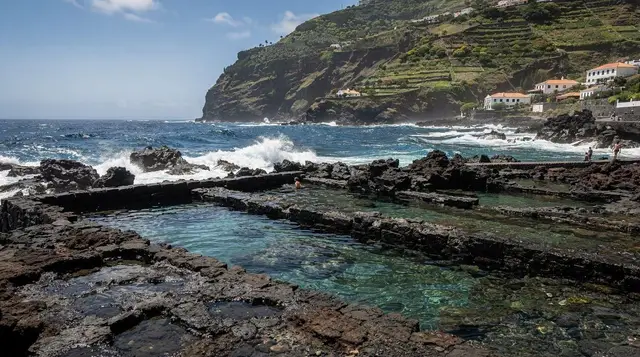
Madeira’s most photographed swimming spots are not sandy beaches but pools formed where old lava flows met the sea: Porto Moniz on the north-west coast and Seixal a little further along. Both sit on a rock shelf that is, in effect, part of the open ocean floor, connected to it by channels and gaps in the rock. When swell builds offshore, water surges into these pools with far more force than the still, turquoise water in a calm-day photo suggests, sometimes rising over the rock in seconds.
Local operators and the municipal authorities close the paid, walled section of the pools when swell crosses a certain threshold, and the free, wilder pools nearby close along with them, or are simply left to the sea. Closures are announced locally, sometimes only on the day, and can happen even when the forecast a few days earlier looked fine. If a pool guide on this site or elsewhere promises you a swim, treat that as a description of what is usually possible, never as a guarantee. The only way to know is to check on the day, and to accept that the answer might be no.
The north coast in general takes the brunt of Atlantic swell more than the south. Seixal and Porto Moniz close more often over an average year than sheltered south-coast spots, but “south coast” is not a safety guarantee either, since swell direction shifts with the season and a storm system can send waves onto either side of the island.
No Lifeguards, Almost Everywhere
This is the second fact that catches visitors out. A small number of the busiest beaches, mainly around Funchal and Calheta, run a lifeguard service during the main summer months, typically with set hours rather than round-the-clock cover. Everywhere else, including most natural pools, remote coves, and the black-sand stretch at Prainha, there is no lifeguard at all, at any time of year.
That changes the calculation for swimming. On a lifeguarded beach, someone else is watching the water, reading conditions, and can respond in minutes. On an unlifeguarded stretch of coast, the responsibility sits entirely with you and whoever you are swimming with. It is worth building this into travel plans deliberately: swim with someone else present, keep to a depth you can stand up in in unfamiliar water, and treat any spot with no other swimmers in it as a spot to be cautious about, not a private paradise.
Flags, where they exist, follow a standard system: green for safe conditions, yellow for caution, red for no swimming. Red flags are not advisory. They go up because someone with local knowledge has judged the sea currently dangerous, and they come down again once conditions ease, sometimes within hours.
Reading Currents and Rip Risk
Rip currents form where water pushed onshore by waves needs a route back out to sea, and it finds the path of least resistance: a gap between rocks, a channel next to a headland, the mouth of a natural pool. Counterintuitively, this water often looks calmer than the surf either side of it, because breaking waves need shallow water and a rip channel tends to be slightly deeper, so it can look like the easy, inviting way in. That appearance is the trap.
Signs worth learning to spot: a channel of flatter, sometimes discoloured or foamy water cutting through the surf line; debris or seaweed moving steadily seaward rather than rolling in with the waves; a gap in an otherwise consistent line of breaking waves. Around Madeira, watch for these especially near headlands like the approach to Ponta de São Lourenço, at river mouths, and at the entrances used to access natural pools.
If you do get caught in a current pulling you out, the standard advice holds here as everywhere: do not swim directly against it. Swim parallel to the shore until you are out of the channel, then let the waves push you back in, or raise an arm and signal for help if one is needed. Panic and exhaustion, not the current’s raw strength, are what turn a rip into an emergency for most swimmers.
Where You’re More and Less Exposed
| Type of spot | Typical exposure | What to watch for |
|---|---|---|
| Walled natural pools (Porto Moniz, Seixal) | High on swell days, sheltered when calm | Posted closures, surging water over the rock shelf |
| South-coast beaches (Calheta, Machico, Prainha) | Generally more sheltered | Still capable of closing after storms further out |
| Exposed capes (Ponta de São Lourenço, Garajau point) | High, most of the year | Strong currents around the point itself, little shelter |
| Porto Santo’s main beach | Usually gentle | Wind-driven chop can build through the afternoon |
| River mouths and pool entrances | Variable, changes through the day | Rip channels forming as tide and swell shift |
Diving, Snorkelling and Surfing With Proper Support
Structured activities with a trained operator remove most of the guesswork above, because the guide is reading conditions professionally, choosing the site for the day, and watching the group throughout. This is the practical argument for booking rather than improvising around Madeira’s less forgiving coast, especially for anyone unfamiliar with Atlantic swell.
For learning to read the sea properly, a lesson with instructors who know the local breaks is a sensible starting point: a beginner surf lesson on Madeira’s Atlantic swell teaches wave reading and basic safety alongside the actual surfing, on a stretch of coast chosen for the day’s conditions rather than fixed in advance.
Underwater, the sheltered reserve at Garajau and the coast near Caniço de Baixo are the island’s established diving sites, with far more predictable conditions below the surface than open swimming spots have on it. A guided outing such as a full-day diving package around Madeira’s reefs and reserve puts a dive professional between you and any current, checking conditions before anyone enters the water.
Snorkelling at genuinely exposed sites, rather than sheltered bays, is where inexperienced visitors most often misjudge things, because the surface can look glassy while a current runs beneath it. A guided trip like a snorkelling excursion around the cliffs of Ponta de São Lourenço gets you into one of the island’s most striking underwater landscapes with someone assessing the site first.
Boat Trips, Fishing and the Open Water
Time on the water rather than in it is, for many visitors, the more sensible way to experience Madeira’s Atlantic setting, and it sidesteps the swimming-safety questions above almost entirely. Boats operate from Funchal, Calheta and Canical, with skippers who monitor swell and simply choose calmer routes or reschedule when conditions do not cooperate, something an independent swimmer cannot do for themselves at a fixed beach.
A trip such as a guided fishing outing from Canical’s old whaling port is a good example: it puts you on Madeira’s Atlantic without any of the currents or closures above being relevant to your day, and it runs from a town with real maritime history behind it, once the centre of the island’s whaling industry and now home to a museum on the subject.
For those keen to combine sea time with the island’s marine reserve, note that the Garajau reserve has protected its waters since 1986, which is part of why its brown groupers show so little fear of visitors today; a guided approach respects that balance rather than disturbing it.
Wind, Season and Timing
Swell and wind both shift with the seasons, and Madeira’s own microclimates complicate the picture further: the south coast runs sunnier and drier, the north greener and wetter, and conditions can genuinely differ between the two sides on the same afternoon. Broadly, the calmest sea conditions tend to fall in late spring and late summer, while autumn and winter bring the Atlantic’s larger swells, more frequent pool closures, and stronger onshore wind. None of this is a fixed rule; a July week can bring a swell spike just as a January week can turn glassy calm, which is exactly why checking the day itself matters more than checking the season.
Afternoon sea breezes are also worth planning around, particularly for anyone snorkelling or swimming off a boat: mornings are typically calmer before thermal winds build through the day, so operators often schedule water activities early for this reason as much as for the light.
A Practical Pre-Swim Checklist
Before getting into the sea anywhere around the archipelago that is not a fully lifeguarded beach, run through a short list: check whether the specific spot has a posted closure or recent local reports of rough conditions; watch the water for several minutes on arrival rather than walking straight in; look for the tell-tale signs of a rip channel described above; note whether anyone else is swimming, and if the spot is empty on an otherwise busy day, treat that as information rather than an opportunity; and keep young or inexperienced swimmers within reach in any unlifeguarded water, since there is no one else watching.
The same caution extends to Porto Santo, whose long sandy beach is generally gentler than Madeira’s rockier coast but still faces open Atlantic exposure and can build a real afternoon chop; and to less obvious activities like kayaking or coasteering, where the same swell and current rules apply even though you are not, strictly speaking, swimming.
Weather that affects the mountains, discussed in the guide to mountain weather, is a separate system from coastal swell, and a fine, still day inland tells you nothing reliable about the sea. Judge the coast on the coast’s own information, checked on the day, at the specific spot, every time.
Atlantic Swimming Safety in Madeira: Your Questions Answered
Is it safe to swim in the sea in Madeira?
Often yes, but conditions change fast and few spots are lifeguarded. Treat every swim as a fresh decision based on that day’s swell, not on what a guidebook or a friend’s photo suggests.
Are Madeira’s beaches patrolled by lifeguards?
Only a handful of the busiest spots run a lifeguard service in summer, and even then usually only during set hours. Most of the coastline, including many natural pools, has no lifeguard at all, at any time of year.
Why do the natural pools at Porto Moniz and Seixal close?
Both sit directly on volcanic rock exposed to open Atlantic swell. When waves build, the sea surges over the rock shelf with enough force to sweep people off their feet, so operators and local authorities close access until the swell drops.
What is the water temperature around Madeira?
The Atlantic here runs from roughly 18°C in late winter to about 23-24°C in late summer. It never feels tropical, and cooler water plus fatigue is a common combination behind swimmers getting into trouble.
Are there rip currents in Madeira?
Yes, particularly around headlands, river mouths and the entrances to natural pools, where water pulled in by waves has to funnel back out to sea. These channels are strongest exactly where the swimming looks calmest, just inside the rocks.
Is Madeira’s coast comparable to the Mediterranean for swimming?
No. The Mediterranean is a largely enclosed sea with a short wave fetch; the Atlantic around Madeira is open ocean, and swell generated by storms thousands of kilometres away arrives here with real force. Assuming Mediterranean-style calm is the single most common mistake visitors make.
What should I check before visiting a natural pool?
Look at the swell forecast for that specific day and area, check whether the pool has posted a closure, and on arrival watch the water for five minutes before getting in. A pool that looks fine on a calm morning can close by afternoon if swell builds.
Is it safe to swim at Ponta de São Lourenço or other exposed capes?
Swimming is not really the point at these exposed capes, and it is generally a bad idea. They face open ocean from multiple directions, currents run strong around the points, and there is no shelter if conditions turn while you are in the water.
tours.beaches-natural-pools
Verified deep-linked GetYourGuide tours. Book through these links and we earn a small commission at no cost to you.
GetYourGuide does not provide a product photo for this activity — the image shows the meeting point, photographed by us.