Surfing in Madeira
Is Madeira a good destination for surfing?
Madeira has genuinely world-class waves, but most of its famous breaks — Jardim do Mar above all — are powerful, reef-lined point breaks built for advanced and expert surfers. Complete beginners are far better served by a lesson at a gentler spot or by switching to kayaking or SUP instead.
Powerful Waves, Not a Beginner’s Break
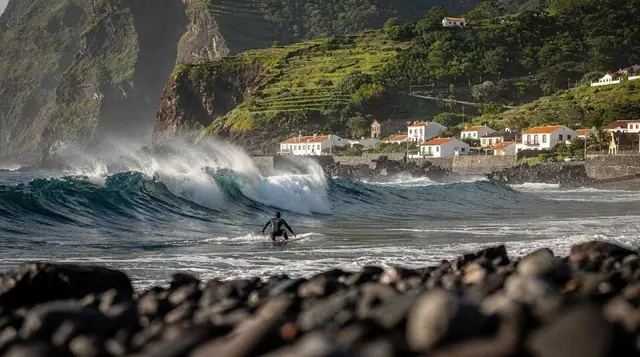
Madeira surfs like the volcanic island it is. There is no lagoon, no gentle sandbar built up over generations, and almost no beach break to speak of. Instead the swell hits rock: reef shelves, boulder points and cliffs that drop straight into deep water, all shaped by an Atlantic fetch that has nothing between it and North America to slow it down. That produces some genuinely excellent waves — Jardim do Mar was, for a stretch of the 1990s and 2000s, spoken of in the same breath as the best big-wave points in Europe — and it also means that the island’s reputation is built almost entirely around experienced surfers.
This is the piece that gets left out of a lot of general Madeira write-ups: the island is not a soft place to learn. If you picture Madeira surfing from a brochure photograph of turquoise shallows and a friendly instructor pushing you into a two-foot roller, recalibrate now. The realistic picture is a powerful left-hand point break peeling over a reef, a swell that can jump from clean and rideable to closed-out and dangerous within a tide cycle, and very few forgiving days for someone who has surfed a handful of times on a foam board. That does not mean nobody should come — it means knowing which spot, which season and which level you are bringing before you book anything.
Where Surfers Actually Go
Jardim do Mar and Paul do Mar: the west coast points
Jardim do Mar is the name every Madeira surf conversation starts with. It is a long, fast, powerful left point break that wraps around a rocky headland below the village, at its best on a solid west or north-west swell in the autumn and winter months. On a big day it draws comparisons to the famous points of Ireland and the Basque coast: long walls, real speed, and a takeoff zone close enough to exposed rock that a mistimed session ends badly. It is not a wave for someone finding their feet. Locals and travelling surfers who rate it tend to have years of reef-break experience behind them.
A few minutes along the coast, Paul do Mar offers a similar character — reef and point-break energy, exposed to the same west swells — with a slightly different lineup and, on smaller days, a marginally gentler shoulder to work with. It is still not a spot to hand a first-timer a board and a “you’ll be fine.” Both villages sit under steep terraced hillsides typical of Madeira’s south-west coast, reached by the coastal road that runs on past ponta do Sol — allow time on the drive, since the road narrows and winds the further west you go.
Porto Moniz and the north-west reefs
Further round the island, the exposed reefs near Porto Moniz pick up north and north-west swell with the same raw power as the west coast points, without the same organised lineup or local surf culture. This is remote, rugged water — beautiful to look at from the clifftop road, considerably less forgiving to paddle out into. Surfers who come here tend to be scouting rather than following a guidebook; it rewards local knowledge more than any other stretch of coastline on the island.
Calheta: the closest thing to an easier day
If there is one place on Madeira where an improving surfer stands a realistic chance of a manageable session, it is around Calheta, where the imported sand and the shape of the bay can occasionally take the hardest edge off the swell. “Easier” here is relative — this is still an Atlantic island with a rocky coastline either side, not a beach-break nursery — but on a modest day, with the right wind, it is the spot most often mentioned by schools working with confident improvers rather than complete beginners.
Porto Santo, for balance
It’s worth a mention that Porto Santo, the flatter island a short ferry or flight away, has the only long stretch of natural sandy beach in the archipelago, and can occasionally throw up a friendlier beach break than anything on Madeira proper. It is inconsistent and entirely swell-dependent, but if a trip includes a day there, it is worth checking conditions rather than assuming Madeira’s reputation for power applies equally.
Spot Comparison at a Glance
| Spot | Break type | Typical level | Best swell direction |
|---|---|---|---|
| Jardim do Mar | Point break, left, reef bottom | Advanced to expert | West, north-west |
| Paul do Mar | Reef and point break | Advanced | West, north-west |
| Porto Moniz reefs | Exposed reef | Advanced, local knowledge helps | North, north-west |
| Calheta | Semi-sheltered, imported sand | Improver to advanced | Small to moderate swells |
| Porto Santo | Beach break (inconsistent) | Beginner to improver, on its day | South-facing, variable |
Wave Character: Why It’s Not Beginner-Friendly
Three things combine to make Madeira’s surf demanding. First, the seabed: this is a young volcanic island with almost no continental shelf to soften incoming swell, so waves arrive with more raw energy per foot of height than most travelling surfers are used to. Second, the coastline itself is mostly cliff and boulder rather than gently shelving sand, which means a wipeout often means rock, not a soft sandy bottom to tumble across. Third, the currents: swell wrapping around headlands like the one at Jardim do Mar creates strong lateral pull that can carry an inattentive surfer well off the lineup within minutes.
None of this is meant to talk anyone out of coming — Madeira’s points are exactly why surfers who already know what they are doing travel here specifically. It is meant as an honest correction to any suggestion that the island is a soft place to pick up the sport. If your surfing so far has been a week of lessons on a foam board at a resort beach, treat Madeira’s named breaks as a watch-and-learn trip, not a paddle-out.
Season: When the Swell and the Comfort Line Up
| Period | Swell | Water temperature | Notes |
|---|---|---|---|
| October–March | Biggest, most consistent | Around 18–20°C | Peak season for experienced surfers; wetsuit essential |
| April–June | Moderate, still reliable | Around 19–21°C | A reasonable compromise of size and comfort |
| July–September | Smaller, less frequent | Around 22–23°C | Warmest water, but flatter days are common |
Winter delivers the swell Madeira is known for, generated by North Atlantic storm systems tracking well to the north, but it also brings the coolest water and the trickiest currents of the year. Late spring softens both without losing the swell entirely, which is why a lot of visiting surfers with real reef-break experience aim for April to June. Midsummer is the most comfortable water temperature by far, but also the flattest — good for the E-foil, kayak and paddleboard side of the coast rather than for chasing a point break.
What to Bring, and What Not to Expect
A full or spring wetsuit covers most of the year comfortably; only a handful of high-summer weeks make boardshorts realistic for anything longer than a short session. Reef boots are worth packing for any of the rocky entries around Jardim do Mar or Paul do Mar — this is not a sand-only coastline, and the entry and exit at low tide can be as demanding as the wave itself. Bring or hire a board suited to the day’s size rather than assuming a single board will do; conditions swing more between sessions here than on a lot of more sheltered coastlines.
Surf schools and instructors operate mainly around Porto da Cruz, Calheta and the Ribeira Brava stretch, aimed at improving surfers rather than absolute first-timers, and board hire is available in the same areas. If a genuine beginner lesson is the goal, book directly with one of these schools and be candid about your level — a good instructor will pick the day and the spot rather than defaulting to the island’s famous names.
If Surfing Isn’t Quite the Level You’re At
Plenty of visitors arrive keen on the idea of riding a wave in Madeira and leave better served by something adjacent rather than a reef break they are not ready for. If that sounds closer to home, the island’s calmer water sports are covered in a separate kayaking, SUP and coasteering guide — a much gentler introduction to the same coastline. Riding a board without needing years of reef experience is also possible: a guided e-foil lesson with an instructor gets you up and gliding above the water in a single session, on flat, sheltered water rather than a breaking swell.
For seeing the same dramatic west coast that Jardim do Mar and Paul do Mar sit on without paddling into it, a full west-coast tour of the island takes in the cliffs, villages and viewpoints by road, at a pace that leaves room to actually look at the surf rather than duck under it.
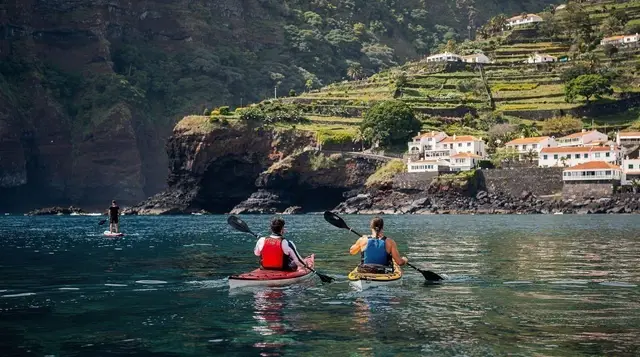
From the water rather than the clifftop, a southern coast cruise from Funchal is a far calmer way to appreciate how rugged this coastline is, and a guided kayak expedition along the island’s hidden coast gets closer to the cliffs and sea caves than a surfboard session ever will, with none of the reef-break risk.
Diving and Other Water Sports Nearby
Surfers who bring a wetsuit for the waves often find they’ve packed for the island’s other water sports too. The diving in Madeira guide covers the marine reserve at Garajau and the reefs off Canico de Baixo, both a short drive from the west coast points and a good option on a flat day. For a broader sense of where the coastline works and doesn’t for swimming rather than surfing, the beaches of Madeira guide is worth reading alongside this one — several of the island’s best-known beaches sit close to spots covered here, but with a very different personality in the water.
Getting There and Practical Notes
A hire car is close to essential for any serious surf trip to Madeira’s west coast — public transport does not run on a schedule that suits dawn checks or chasing a moving swell, and the coastal road out to Jardim do Mar and Paul do Mar has no useful bus link. The car rental in Madeira guide and the wider driving in Madeira guide cover what to expect on the island’s steep, narrow roads, which is worth reading before a first visit regardless of why you’re on the island.
For the best swell window, the best time to visit Madeira guide and the dedicated Madeira in winter guide both go into the trade-offs between peak swell, cooler water and quieter roads in more detail than fits here. A general what to pack for Madeira guide is useful for the rest of the trip once the wetsuit is sorted.
Before paddling out anywhere on this coast, a word on safety belongs here rather than as an afterthought: check conditions locally, respect any surfer already established in the lineup, and never underestimate a reef break because it looks smaller from the cliff road than it is at sea level. The swimming safety in the Atlantic guide and the broader Madeira travel mistakes to avoid guide both cover currents and ocean hazards that apply just as much to a surfboard as to a swim.
Category and Nearby Activities
Surfing sits within Madeira’s wider water sports category, alongside diving, kayaking, SUP, canyoning and coasteering, most of which are considerably more welcoming to a first-timer than the island’s reef breaks. For things to do specifically around Paul do Mar, from watching the surf to eating in the village afterwards, the local activity page rounds out a day that starts on the water and ends somewhere calmer.
tours.water-sports
Verified deep-linked GetYourGuide tours. Book through these links and we earn a small commission at no cost to you.
GetYourGuide does not provide a product photo for this activity — the image shows the meeting point, photographed by us.