Kayaking, SUP and Coasteering in Madeira
What's the difference between kayaking, SUP and coasteering in Madeira?
Kayaking and stand-up paddleboarding are calm, mostly beginner-friendly paddling sessions on flat water, typically 1.5 to 2.5 hours near Caniço de Baixo. Coasteering is a physically demanding scramble-swim-and-jump route along the cliffs, usually 2 to 3 hours, and needs reasonable fitness and comfort in open water.
On the Water Without the Waves
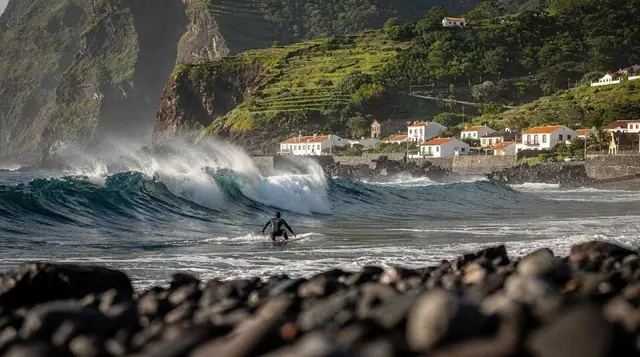
Madeira’s Atlantic swell makes the north coast a serious surf destination, but the south coast, and Caniço de Baixo in particular, sits in a different world. A rocky headland shelters a run of small coves where the water is usually calm enough to see the bottom, and it’s this stretch of coast that has become the island’s real home for kayaking, stand-up paddleboarding and coasteering — three activities that get lumped together in brochures but ask very different things of you.
Kayaking and SUP are, on a normal day, gentle. You paddle a sheltered bay or a short stretch of coastline, look down at volcanic rock and the odd fish, and go home not much more tired than when you started. Coasteering is not that. It’s a route along the base of the cliffs that mixes scrambling, swimming and jumping into the sea, and it will leave you properly worked. Treating the three as interchangeable — “we did a bit of kayaking, well, coasteering, whatever” — is the single most common mix-up first-timers make when booking, and it’s worth sorting out before you pick a tour, not after you’re standing on a rock five metres above the water wondering how you got there.
This guide covers all three from a shared base on the south coast, with what each one actually involves, who they suit, and where they run.
Caniço de Baixo: why this stretch of coast
Caniço de Baixo sits below the town of Caniço, a short drive east of Funchal, and it’s the closest thing Madeira has to a purpose-built water-sports cove. The coastline here is low, rocky and indented rather than a single open beach, which is exactly what keeps the water calm — the coves break up any residual swell before it reaches the entry points. It’s also the base for Garajau marine reserve, Madeira’s protected diving and snorkelling zone, so the water quality and marine life are better than almost anywhere else on the south coast.
Most kayak, SUP and coasteering operators on the island are based here or launch from here for good reason: reliable shelter, easy shore access without a harbour, and a short walk from parking to water. Funchal and its marina also host sessions, useful if you’re staying centrally and don’t want to travel, but expect more boat traffic near the marina and slightly less protection from swell than at Caniço de Baixo.
If you’re building a day around the water, Caniço itself has enough cafés and a promenade to fill the hours either side of a booked session, and it pairs naturally with a look at Garajau or a stop in Canico de Baixo itself.
Kayaking: the easiest way onto the water
Sit-on-top kayaks are the standard here, not the enclosed touring kayaks you might have used elsewhere — easier to get in and out of, self-draining, and forgiving if you tip over, which on flat water in a group of beginners is rare but not unheard of. Sessions are almost always guided, starting with a five- to ten-minute briefing on land covering paddle strokes and what to do if you capsize, then straight onto the water.
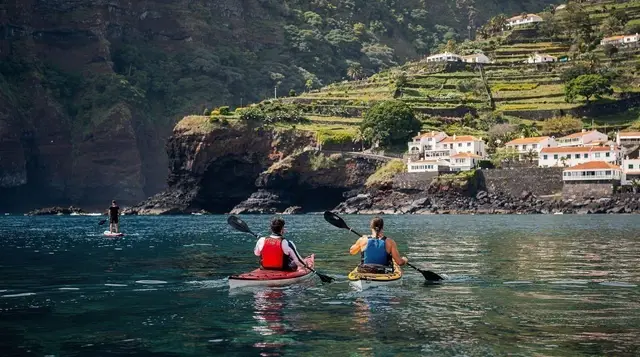
A typical route stays inside the sheltered coves near Caniço de Baixo, sometimes extending along the coast toward the edge of the Garajau reserve, weaving between rock formations and small sea caves that are only accessible by water. Groups are usually small, six to ten people, with a guide paddling alongside rather than leading from a boat. Nobody expects previous kayaking experience, and children old enough to hold a paddle and follow instructions are generally welcome, sometimes in a tandem kayak with a parent.
Duration runs 1.5 to 2 hours including the briefing, of which maybe 60 to 75 minutes is actual paddling — long enough to feel like you’ve done something, short enough that arm fatigue doesn’t become the story of the trip. If you’d rather cover more ground and combine kayaking with a coastal walk, a morning route from the east of the island pairs the two:
a sunrise hiking-and-kayaking morning on Madeira’s east coast takes in the cliffs before putting you on the water, which suits visitors who want variety over a single flat paddle.
Stand-up paddleboarding: the same water, a different balance test
SUP uses the same sheltered coves as kayaking and, in calm conditions, is comparably gentle — but standing up changes the experience. Most people find their balance within the first ten minutes, helped by starting on their knees before standing, and the boards used for beginner sessions are wide and stable rather than the narrow race boards used for fitness paddling elsewhere.
The appeal over kayaking is largely about vantage point: standing gives you a clearer view down into the water, which matters here because the coves near Caniço de Baixo are clear enough to spot fish, sea urchins and the occasional ray from the surface without putting your face in the water. Sessions run the same length as kayaking, 1.5 to 2 hours, and use the same shallow, sheltered launch points, so falling in is a minor inconvenience rather than a hazard — the water is rarely more than a few metres deep near shore.
Some operators run SUP as a flat, guided paddle; a smaller number offer SUP yoga sessions at sunrise or sunset in the calmest coves, which is a niche but genuine option if the timing suits. Either way, it’s the activity of the three best suited to a relaxed morning rather than an adrenaline session.
Coasteering: a different activity, not a wetter kayak trip
This is the one worth being precise about. Coasteering is not paddling — it’s moving along the coastline itself, at the interface between rock and sea, using a mix of scrambling over wet rock, swimming short stretches of open water, and jumping from ledges into deeper pools. A typical route near Caniço de Baixo strings together several of these elements: a scramble around a headland, a swim across a cove too deep or exposed to walk, a jump of two to six metres into clear water, then more scrambling to the next section.
Guides supply a wetsuit, helmet and buoyancy aid, and the route is chosen and paced around the group — nobody is forced into a jump they don’t want to make, and most operators build in an easier “step in” option at each jump point for anyone who’d rather not commit. But the physical engagement is real: you’ll be swimming in open water with some swell movement, climbing wet and sometimes slippery rock, and your legs and shoulders will know about it afterwards in a way a flat-water paddle never produces. Groups tend to be smaller than kayaking or SUP, often four to eight people, with one guide leading and a second sometimes positioned at the trickier jump points.
Sessions run longer than paddling, typically 2 to 3 hours, partly because of the pace and partly because each jump point involves a safety briefing and a queue. This is the activity to book if you want something closer to an adventure sport than a scenic paddle — and the one to skip if what you actually pictured was a calm morning on flat water, because that’s the kayaking or SUP session, not this one.
Comparing the three at a glance
| Activity | Typical duration | Physical demand | Suits |
|---|---|---|---|
| Kayaking | 1.5–2 hrs | Low | First-timers, families, relaxed mornings |
| Stand-up paddleboarding | 1.5–2 hrs | Low–moderate | First-timers, those wanting a better view of the water |
| Coasteering | 2–3 hrs | High | Confident swimmers wanting an active, adrenaline-leaning session |
Price bands follow the same pattern: kayaking and SUP sessions are generally the cheapest of the three since they need less specialist kit and a shorter safety briefing, while coasteering, with its wetsuits, helmets and more intensive guiding, sits higher. None of the three requires a certification or prior booking of equipment on your part — everything beyond swimwear and a towel is provided.
What the water and weather do to your plans
The south coast’s shelter means kayaking, SUP and coasteering run more reliably here than almost any other water activity on the island, but “more reliable” is not “guaranteed.” Wind direction matters more than most visitors expect — a southerly, which is rare but does happen, pushes swell straight into the coves that are normally sheltered, and operators will postpone or cancel rather than run a session that’s become genuinely rough. This happens more often in winter, when Atlantic systems occasionally wrap swell around the whole island, than in the settled months from May to September.
Water temperature follows Madeira’s usual pattern: around 18°C in late winter, climbing to 22–23°C by late summer. Coasteering wetsuits make the temperature largely irrelevant; kayaking and SUP, where you’re mostly dry unless you fall in, feel comfortable year-round in normal clothing over swimwear, though a rash vest is worth having in winter for anyone who runs cold.
If you’re building a trip around guaranteed water time, treat any single booked session as provisional and keep a backup day free, particularly outside the June-to-September window. Operators in Caniço de Baixo are generally good about rebooking rather than simply refunding, since the cancellations are almost always weather calls made the morning of, not a lack of interest in running the tour.
Combining water time with the rest of Caniço de Baixo
Because sessions rarely fill a whole day, most visitors pair kayaking, SUP or coasteering with something else nearby rather than making the special trip out from Funchal for water time alone. Caniço de Baixo and neighbouring Caniço have a short but genuine list of other things worth doing either side of a booked slot — the Garajau marine reserve for snorkelling or diving if you want to see below the surface rather than just paddle across it, or a short guided look at the town itself:
a tuk-tuk tour of Caniço with a drink tasting fills an afternoon at an easy pace after a morning on the water, and works well as a low-effort second half to a coasteering day when your legs would rather not do much else.
If your interest in the water runs toward what’s below the surface rather than the coastline itself, that’s a genuinely different activity — diving in Madeira and the Garajau reserve specifically are covered on their own, and
a beginner scuba diving experience in Caniço is worth a look if snorkelling from a kayak has you wanting to go further down rather than further along the coast. It’s a different booking, a different skill, and a different level of commitment to any of the three activities in this guide.
For visitors who’d rather document the coastline than get in it, a coastal light session also works well around a water sports morning:
a half-day guided photo tour of Madeira can be timed for the golden light either side of a kayak or SUP session, when the coves near Caniço de Baixo are at their best for photos from the shore.
Booking, group sizes and what to expect on the day
All three activities are run as guided sessions rather than equipment rental — you won’t find a stack of kayaks for hire without a guide attached, which is deliberate given how quickly conditions near the rocks can change. Expect to arrive 15 to 20 minutes before the stated start time for kit fitting and the safety briefing, and to leave valuables in a car rather than carry them, since none of these sessions come with secure storage at the launch point.
Groups for kayaking and SUP run larger, often eight to twelve people split between one or two guides, while coasteering groups stay smaller for safety reasons at the jump points. Solo travellers and couples are routinely folded into a shared group session rather than needing a private booking, which keeps prices down; private sessions are usually available on request but cost more and need to be arranged in advance rather than turning up on the day.
None of the three activities requires you to bring your own equipment beyond swimwear, a towel and suitable footwear. Wetsuits for coasteering, buoyancy aids for all three, and paddles and boards for kayaking and SUP are included in the price. What isn’t included, and is worth sorting yourself, is transport to Caniço de Baixo if you’re staying in central Funchal — it’s a short taxi or bus ride rather than a walk, and getting around without a car is worth reading if you’re not renting a vehicle for the trip.
The mix-up worth avoiding
Coming back to where this guide started: kayaking, SUP and coasteering share a coastline and a base, but they are not three versions of the same morning. If what you want is a calm hour or two on flat water with a paddle in hand, book kayaking or SUP and don’t let a coasteering listing’s photos of jumps and cliffs pull you toward something more demanding than you were after.
If what you want is an active, physically engaging route along the coast with swimming and jumping built in, coasteering is the one — and it’s worth arriving with a realistic sense that you’ll be tired, possibly grazed on a knuckle or knee from the rock, and glad you did it, rather than expecting a gentler paddle with a few extra splashes. Reading the activity description on a booking page carefully, rather than the photos alone, is the simplest way to end up on the water you actually wanted.
Kayaking, SUP and coasteering in Madeira: your questions answered
Do I need experience to go kayaking or stand-up paddleboarding in Madeira?
No. Both are run as guided sessions on sheltered water, usually starting with a short briefing on land. Complete beginners are welcome, and most groups are on the water within ten minutes of arriving.
Is coasteering suitable for beginners?
Physically, yes — no climbing or swimming background is required, and guides scale the route to the group. But it is far more demanding than kayaking: expect scrambling over wet rock, jumps from a few metres, and swims in open water, so it suits confident swimmers rather than complete water-shy beginners.
How long do these tours typically last?
Kayaking and SUP sessions run 1.5 to 2.5 hours including the briefing. Coasteering routes usually take 2 to 3 hours, since the pace is slower and includes rest stops before each jump or swim section.
Where is the best place for these activities — Caniço de Baixo or Funchal?
Caniço de Baixo has the calmest, clearest water on the south coast and is where most kayak, SUP and coasteering operators are based. Funchal’s marina and lido area also run sessions, but with more boat traffic and swell exposure.
What should I wear and bring?
Swimwear under quick-dry clothing, a towel, water shoes or old trainers with a good grip, and reef-safe sun cream applied well before you get in the water. Coasteering operators supply a wetsuit, buoyancy aid and helmet; kayaking and SUP usually just need a buoyancy aid, which is provided.
Is there a minimum age for coasteering?
Most operators set a minimum age around 10 to 12, sometimes higher for the more committing routes, and may add a minimum weight for the wetsuit and buoyancy aid to fit properly. Kayaking and SUP have lower or no minimum ages when a child rides tandem with an adult.
Can I kayak or paddleboard near the Garajau marine reserve?
Some guided sessions paddle along the edge of the Garajau reserve, but landing or free-diving inside the protected zone is restricted. If seeing the reserve’s marine life is the goal, ask specifically — not every kayak or SUP route goes that far along the coast.
What’s the best time of year for kayaking, SUP and coasteering in Madeira?
Late spring through early autumn gives the calmest sea and warmest water, roughly 20 to 23°C. Winter sessions still run on settled days, but operators cancel more often when north Atlantic swell wraps around the coast, so build in a backup day if you’re visiting between November and February.
tours.water-sports
Verified deep-linked GetYourGuide tours. Book through these links and we earn a small commission at no cost to you.
GetYourGuide does not provide a product photo for this activity — the image shows the meeting point, photographed by us.