Not a Postcard Village: What Caniço Actually Is
Caniço sits on the south-east coast between Funchal and Santa Cruz, and it is easy to arrive with the wrong picture in mind. This is not a preserved fishing village with cobbled lanes and centuries-old houses. The parish has old roots, but the Caniço that visitors actually experience — hotels, apartment blocks, dive centres, a marina-style seafront promenade — is largely a late twentieth-century holiday development, built outward from a modest agricultural settlement once the coast road made the area easy to reach from Funchal. Treat it as what it is: a modern, sea-facing base, not a heritage stop. That distinction matters, because a lot of general guides gloss over it and send people expecting a traditional centre they will not find here.
What Caniço does have is a genuinely good reason to stay: Caniço de Baixo, the lower seafront quarter, is one of Madeira’s two established diving bases, alongside Garajau a short way along the coast. If diving, a calm evening walk by the water and a base with a car rather than a village to wander on foot sound right, Caniço earns its place on the itinerary. If a historic centre is the priority, it does not, and Câmara de Lobos or the old town in Funchal will serve better.
Caniço de Baixo: The Dive Base
Caniço de Baixo is where the town’s identity actually lives. A cluster of dive schools operates from the small rocky coves and platforms along this stretch of coast, running everything from discover-scuba sessions for complete beginners to multi-dive packages for certified divers working through PADI or SSI progressions. The appeal is straightforward: volcanic reef structures close to shore, decent visibility for most of the year, and water that is genuinely mild by Atlantic standards.
Water temperature runs roughly from 18°C in the depths of winter up to around 24°C in late summer, which means a 5mm wetsuit covers most of the year without needing a drysuit. Visibility is best from late spring through autumn, when the sea is calmer and less stirred by winter swell.
| Season | Water temperature | Typical visibility | Conditions |
|---|---|---|---|
| Winter (Dec–Feb) | ~18°C | Variable, often reduced | More swell, choppier entries |
| Spring (Mar–May) | 19–21°C | Improving | Settling conditions |
| Summer (Jun–Aug) | 22–24°C | Best of the year | Calm, warm, busiest at the centres |
| Autumn (Sep–Nov) | 21–23°C | Still good | Fewer crowds, generally settled |
Caniço de Baixo is frequently mentioned alongside the Garajau marine reserve just to the east, and the two are often confused. They are separate sites with separate character: Garajau is a protected nature reserve known for its brown groupers and formal marine-park status, while Caniço de Baixo is the wider stretch of coast where the dive schools, hotels and lidos actually sit.
For the detail on the reserve itself — its history, its fish life, its rules — the dedicated Garajau page and the Garajau marine reserve guide cover that ground properly; this page focuses on Caniço as a place to stay and dive from. Anyone weighing up which coastal reserve to prioritise can also read the diving in Madeira guide, which compares Caniço de Baixo and Garajau side by side.
Beyond scuba, the same sheltered water suits snorkelling well, and several of the dive centres rent out gear by the half day for anyone who would rather stay on the surface. None of this is sand-and-towel swimming, though — more on that below.
Where People Actually Swim
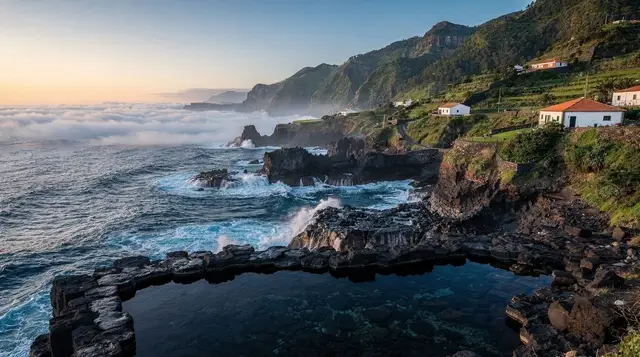
Caniço has no natural sand beach. Swimming here means rocky coves, sea-access lidos with ladders and platforms, and small natural pools cut into the volcanic shore — the same pattern as much of Madeira’s southern coastline. The main public lido area at Caniço de Baixo has changing facilities, sun loungers for hire and reasonably easy water access, which makes it a workable base for a family that wants to swim without driving every day.
Anyone who wants actual sand should look elsewhere: Machico beach, a short drive east, has imported golden sand, and Porto Santo has nine kilometres of it across the water — see the beaches of Madeira guide for the full picture of where the island’s sand actually is, since it is thinner on the ground than first-time visitors expect.
Staying in Caniço
Accommodation here skews toward hotels and self-catering apartment complexes built for longer stays — a week or two rather than a single night — with sea-view balconies, pools and, in several cases, direct access down to the dive platforms. It suits couples and families who want a resort routine: breakfast, a morning dive or swim, an afternoon out, dinner back on the seafront. It is quieter and less commercial than central Funchal in the evenings, which some visitors prefer and others find limiting if nightlife is part of the plan.
A car changes what Caniço can offer considerably. Without one, day trips are limited to what buses and taxis cover well, mainly Funchal and the immediate coast. With a car, the whole east of the island and the mountain roads inland open up within 30–40 minutes. The car rental in Madeira guide and the driving in Madeira guide are worth reading before booking, since Madeira’s roads reward a small, manoeuvrable hire car far more than a large one.
Getting to and from Caniço
The VR1 dual carriageway runs along the coast and puts Funchal about 20–25 minutes from Caniço by car, and Madeira Airport at Santa Cruz closer still, typically 10–15 minutes — a genuine advantage for a late-arrival or early-departure stay. Buses connect Caniço to Funchal reasonably well, run mainly by Horários do Funchal on this stretch of coast, though services thin out heading further east toward Machico and Caniçal. Taxis are a practical fallback for evenings out.
Cruise passengers based in Caniço for a short stopover, or staying nearby before or after a cruise, will find a private tour built around cruise ship timings the simplest way to see the highlights without watching the clock alone.
Day Trips From a Caniço Base
Caniço’s real strength as a base is what sits within easy reach in both directions. East along the coast: Santa Cruz, Machico with its imported sand beach, Caniçal and its whaling museum, and the bare volcanic finger of Ponta de São Lourenço at the island’s easternmost tip — read the east Madeira day trip guide for how to link them into one day. West, Funchal’s sights are close enough for an evening visit as easily as a full day out.
Inland and up, the island’s high mountains are reachable well within a day. A watching-the-sunrise trip to Pico do Arieiro is one of Madeira’s signature experiences, and from a Caniço base it is an early but manageable start; a private sunset tour up to Pico do Arieiro and the Cristo Rei viewpoint covers the same ground at the opposite end of the day for anyone who would rather not set an alarm before dawn.
For a broader sweep of the island’s landscapes in one guided outing, a half-day private 4x4 tour reaches viewpoints and villages that are awkward to string together independently.
Anyone who wants a hiking fix without leaving the coast can look at the trail experience guided walk options; a guided trail experience tour is a reasonable way to try Madeira’s levada walking style with a guide handling navigation, before committing to a longer solo route.
For time on the water beyond diving, a four-hour private catamaran cruise from Funchal marina is a short drive from Caniço and gives a different view of this same coastline from offshore, often with a stop for swimming in open water rather than from the rocks.
Eating in Caniço
The seafront at Caniço de Baixo has a run of restaurants geared toward its resident holidaymakers: grilled fish, espetada beef skewers, and the usual Madeiran staples alongside more generic international menus aimed at long-stay guests. It is not the place to chase Madeira’s most distinctive cooking — for that, the Madeira food guide and the espetada and bolo do caco guide point toward where the island’s food culture is strongest, mainly Funchal’s markets and Câmara de Lobos’ poncha bars. Caniço’s dining is convenient and competent rather than a destination in itself, which suits its role as a base rather than a detriment.
Practical Notes
| Question | Answer |
|---|---|
| Car needed? | Recommended; buses cover Funchal but little else |
| Beach type | Rocky coves and lidos, no natural sand |
| Diving season | Year-round; best visibility May–October |
| Nearest airport | Madeira Airport (Santa Cruz), roughly 10–15 minutes |
| Nearest historic centre | Funchal Old Town, roughly 20–25 minutes |
Caniço rewards a visitor who knows what they are coming for: a comfortable, sea-facing base with genuinely good diving on the doorstep and fast access to both Funchal and the quieter east of the island. It is not the place to look for Madeira’s oldest streets or its most authentic village life — for that, the itinerary needs to include somewhere else. Used for what it actually is, though, it is one of the more relaxed and practical bases on the whole island.