The sand didn’t come from here
Start with the fact most guides leave out: the golden sand at Machico is not Madeira’s own. Madeira is a volcanic island, and its native beaches — where they exist at all — are black or grey basalt shingle, not pale gold. The wide, soft strip you see filling Machico’s bay was trucked and shipped in, sourced from Morocco and the Canary Islands, and spread over the bay as a municipal tourism project completed in 2008. It sits on reclaimed and reshaped ground, held in place by a breakwater, and it is topped up periodically as the sea drags material away.
None of that makes it a bad beach. It makes it an honest one, once you know what you’re looking at: a deliberately built amenity on top of a historically important harbour, not a stretch of coastline that has looked this way for centuries. If a brochure or a fellow traveller tells you Machico has always had a golden beach, that’s simply wrong — for most of its history the town’s waterfront was working shingle and rock, the kind still visible along much of the rest of Madeira’s coast.
Why the town mattered long before the beach did
Machico earns its place in Madeira’s story regardless of what’s underfoot on the seafront. This bay is where Portuguese sailors João Gonçalves Zarco and Tristão Vaz Teixeira made their first landing on Madeira in 1419, a year after Porto Santo had already been reached. Machico became the island’s first settlement, predating Funchal as a centre of population, and its name — according to island legend — comes from an English sailor, Machim, said to have been shipwrecked here decades earlier.
The old town still carries that weight. A small fortress, a parish church with fifteenth-century origins, and narrow streets set back from the modern seafront all sit within a short walk of the sand. It’s worth allotting at least half an hour to the town itself, not just the beach, if the history side of Madeira interests you — see our history of Madeira guide for the fuller landing story and what came after.
What the beach is like today
The beach itself is a straightforward, sheltered stretch of imported sand curving around Machico’s bay, backed by a promenade, cafés, and a line of palm trees planted to complete the resort look. It’s calm, shallow close to shore, and protected by a breakwater at the harbour end — which is precisely why it works so well for families and why it draws crowds on hot weekends from Funchal and Santa Cruz.
Facilities are genuine strengths here: sun loungers and umbrellas for hire, a lifeguard presence in the main season, showers, and a run of cafés and restaurants directly on the promenade serving everything from grilled fish to ice cream. This is the version of a Madeira beach day that asks nothing of you in the way of hiking boots, water shoes, or a strong stomach for waves — which is exactly the point of having built it.
Compared with the island’s natural swimming spots, it’s also the easiest to reach with small children, pushchairs, or anyone who doesn’t want to negotiate volcanic rock underfoot. For a broader survey of where Madeira’s sand, shingle, and lava-pool options sit against each other, see our beaches of Madeira guide.
Machico Beach versus Prainha
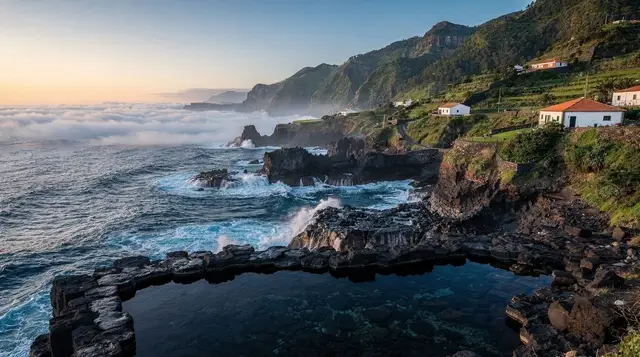
The comparison worth making explicitly is with Prainha, a short drive further east near Caniçal. Where Machico’s beach is imported, landscaped, and urban, Prainha is the opposite on every count: a small cove of genuinely volcanic black sand, formed by the island’s own geology, undeveloped by comparison, and reached down a set of steps rather than a promenade.
| Machico Beach | Prainha | |
|---|---|---|
| Sand origin | Imported (Morocco/Canaries, 2008) | Natural volcanic black sand |
| Setting | Town seafront, promenade, cafés | Small cove, cliffs, fewer facilities |
| Best for | Families, easy access, full amenities | A quieter, more rugged swim |
| Crowds | Busiest on hot weekends | Lighter, but can fill in peak summer |
| Getting there | Flat walk from town centre/parking | Steps down from a small car park |
Neither is “better” outright — they answer different requests. If what you want is an easy, amenity-rich beach afternoon with the kids, Machico delivers it. If you want to stand on sand the island actually made itself, Prainha is the one to drive the extra few minutes for. Doing both in the same day, given how close they sit to Caniçal and Santa Cruz, is entirely realistic — our east Madeira day trip guide lays out a sensible order for the two, plus the other stops in this corner of the island.
Getting there and parking
Machico sits roughly 25–30 minutes east of Funchal along the VR1 expressway, which tunnels through most of the coastline in between and makes the drive far faster than the older coast road ever was. It’s also the closest town of any size to Madeira Airport, only a few minutes further east — which makes Machico a realistic first or last stop on an arrival or departure day, sand and all, if your flight timing allows it.
Parking is available around the town and along the seafront, though it fills quickly in peak summer and on weekends when Funchal residents make the same drive. Buses running the SAM network toward the east also stop in Machico, but as with most of the island’s beaches, a hire car gives you the flexibility to leave when the tide, weather, or crowd level changes your mind.
Swimming conditions and safety
The bay’s breakwater does real work here: it takes the edge off swell that would otherwise reach the beach directly, which is part of why Machico is considered one of the calmer, more family-friendly swimming spots on the island. That said, “calm” is relative to the rest of Madeira’s often-exposed Atlantic coastline, not a guarantee. Conditions can still change with the season and with weather systems passing the island, and a flag system and lifeguard presence typically operate through the main summer months rather than year-round.
Check posted flags before swimming, keep an eye on children in the shallows even when the water looks flat, and don’t assume the same calm conditions hold outside the lifeguarded season. For general guidance on reading conditions anywhere on the island’s coast, our swimming safety in the Atlantic guide is worth five minutes before any Madeira beach day, imported sand or not.
Best time to visit
Machico’s beach works best from late May through September, when the water has warmed and the weather is reliably dry enough to justify a whole afternoon on a sun lounger. Outside those months it’s still a pleasant place to walk the promenade and eat well, but the swimming window narrows considerably, in line with the rest of the island’s coast.
Mornings before midday tend to be quieter than the afternoon rush, particularly on weekends when day-trippers arrive from Funchal once the sun is properly up. If you’re travelling with young children, an early start also means softer light and less crowding on the loungers nearest the water.
Things to do nearby
Machico’s location in the east puts several of the island’s other coastal and marine activities within easy reach, which is worth knowing if a beach afternoon is only part of the plan.
For a straightforward dose of beach-side fun rather than a swim, a banana boat ride out from the bay is exactly the kind of activity Machico’s calm water suits, and it’s popular with families staying nearby. A short drive on to Caniçal opens up the whaling museum and harbour-town history described in our Caniçal and the whaling museum guide, along with the option of a guided fishing trip out of Caniçal harbour for anyone who’d rather be on the water than beside it.
Inland and up into the hills behind the coast, a private guided tour of east Madeira, including a rum distillery stop, covers ground this beach visit doesn’t touch — sugar cane history, hill villages, and viewpoints back down over the bay. For anyone who prefers open jeep travel to a private car, the same corner of the island is covered by tours built specifically around this coastline’s peaks and villages.
If your stay skews toward the outdoors more than the seafront, Ponta de São Lourenço — the bare, wind-scoured peninsula at the island’s easternmost tip — is a short drive further on and about as different a landscape from Machico’s palm-lined promenade as Madeira offers in one direction.
Families and practicalities
Machico is one of the more straightforward beach choices on the island for anyone travelling with children, precisely because of what makes it not-natural: level sand, shallow entry, a breakwater cutting the swell, and cafés and toilets within a short walk rather than a hike. It pairs well with a wider trip built around easier days — our Madeira with kids guide and the dedicated Madeira with kids itinerary both treat this stretch of coast as one of the reliable, low-effort stops in a week that otherwise involves more driving and more steps than most families expect from the island.
For a category-level look at Madeira’s full range of sand, shingle, and volcanic-pool options — useful before deciding whether to base a beach day here or drive further afield — see beaches and natural pools, and for everything else on offer specifically in and around Machico, things to do in Machico rounds up the town’s other activities beyond the seafront.
Lastly, if the volcanic side of the island’s swimming spots appeals more once you’ve compared them, the natural lava pools guide covers Madeira’s other extreme — Porto Moniz and Seixal in the north, both a considerably longer drive from Machico but the clearest contrast to this bay’s imported calm.
Machico Beach FAQ: sand, safety and swimming
Is the sand at Machico Beach real or imported?
It’s imported. The golden sand was brought in from Morocco and the Canary Islands and laid over the bay in 2008 as part of a municipal tourism project. It is not a natural feature of Madeira’s volcanic coastline, and it is periodically topped up as the sea removes material.
Is Machico Beach natural or man-made?
Man-made, at least in its current form. The bay itself and the town around it are historically genuine — this is where Portuguese sailors first landed on Madeira in 1419 — but the sandy beach as it exists today is a landscaped, imported addition completed in 2008.
How is Machico Beach different from Prainha?
Machico’s beach is imported golden sand on a developed town seafront with full amenities. Prainha, a short drive further east near Caniçal, is a small cove of naturally occurring volcanic black sand with fewer facilities. They’re worth treating as two different experiences rather than interchangeable options.
Is Machico Beach good for families?
Yes — it’s one of the more reliable family choices on the island, thanks to shallow, breakwater-calmed water, level sand, lifeguard cover in the main season, and cafés and toilets close by. It asks far less of small children than Madeira’s rockier or steeper natural swimming spots.
How far is Machico Beach from Funchal?
Around 25–30 minutes by car via the VR1 expressway. It’s also one of the closest beaches to Madeira Airport, making it a realistic stop on an arrival or departure day if your flight timing allows.
Is Machico Beach free to visit?
Access to the beach itself is free. Sun lounger and umbrella hire, café and restaurant meals, and any water activities booked from the bay are separate costs on top.
When is the best time to swim at Machico Beach?
Late May to September gives the most reliable combination of warm water and dry weather. Lifeguard presence and flag warnings typically operate through the main summer season rather than year-round, so check conditions if you’re visiting outside those months.
Can I combine Machico Beach with other east Madeira sights in one day?
Easily. Caniçal, Prainha, and Ponta de São Lourenço are all within a short drive, and the VR1 makes moving between them fast. See our east Madeira day trip guide for a sensible order to see them in.