Madeira's Natural Lava Pools: The Complete Guide
What are Madeira's natural lava pools and where are the best ones?
They are seawater pools formed in old volcanic rock, refreshed by the tide rather than chlorine. Porto Moniz has the two best-known examples: a paid, maintained pool complex with changing rooms, and a separate free natural pool that is rawer and more exposed to the sea. Seixal, further along the north coast, has a smaller free set.
Two pools with the same name, and they are not the same place
Every photo you have seen of swimming in volcanic rock on Madeira was almost certainly taken at Porto Moniz, on the island’s northwest tip. What those photos rarely make clear is that Porto Moniz does not have one pool. It has two separate areas, built decades apart, run under different rules, and priced differently, sitting a short walk from one another on the same stretch of coast. Confusing them is the single most common mistake visitors make here, and it changes what you should bring, how much you should budget, and what kind of swim you are actually going to get.
This guide is about the pools themselves: how they were formed, how the two Porto Moniz areas differ, why they close, and where else on the island you will find the same kind of swimming. It does not cover Madeira’s sand beaches, which have their own dedicated guide — the lava pools are a different thing entirely, geologically and practically.
How lava pools happen
Madeira is a volcanic island, and its northwest coast is where that history is most visible at sea level. Basalt lava flows met the Atlantic and cooled into an uneven, cratered shelf of black rock. Over thousands of years the sea has carved that shelf into a network of hollows, channels and shallow basins. At high tide the ocean pours in and fills them; at low tide much of the water is trapped, warmed slightly by the black rock, and calmer than the swell breaking just beyond the outer wall.
That is the basic mechanism behind every lava pool on the island, at Porto Moniz and at Seixal alike. It is also why no lava pool is ever perfectly still. The rock is porous and cracked, so water moves through it constantly, and a big enough wave outside can still push spray, or worse, straight over the top.
The amenaged pools: what the entry fee buys
Porto Moniz’s better-known pool complex sits at the western edge of the village, built up over the natural rock with concrete walkways, changing rooms, showers, lockers and a snack bar. This is the version most tour buses stop at, and the one used in almost every promotional photo of the village. It charges an entry fee at the gate — a few euros per adult, less for children, with the exact figure varying slightly by season — and in exchange you get a supervised, partly enclosed swimming area with defined edges, shallower sections suitable for children, and staff on hand during opening hours.
The trade-off is that this is the busier, more manicured version of a lava pool. On a sunny midday in high season the walkways fill up and the pools themselves can feel crowded. It is still real volcanic rock and real seawater — nothing about it is artificial — but it has been shaped and fenced for safety and comfort, and priced accordingly. Anyone comparing notes with a friend who swam here for free almost certainly means the other area.
The natural pools: free, wilder, and more exposed
A short walk from the ticketed complex, on the opposite side of the headland, Porto Moniz also has an area of genuinely natural pools that nobody has built over. There is no gate, no fee, and essentially no infrastructure beyond a rough access path and, on a good day, a few people laying towels directly on the rock. The basins here are rawer: uneven underfoot, deeper in places without warning, and with no lifeguard watching the water.
This is the area worth seeking out if what you actually want is the wild version of the experience — swimming in a rockpool with the open Atlantic visible just beyond the wall, rather than a managed leisure facility that happens to be carved from lava. It is also the area where conditions matter most. Because there is no barrier holding back a bad swell and no staff to close it for you, you are entirely responsible for judging the sea yourself before getting in. Good footwear for the approach — the volcanic rock is sharp and often wet — matters more here than at the ticketed pools.
Treating these two areas as interchangeable is the mistake to avoid. One is a paid, staffed, partly enclosed facility; the other is free, open and unsupervised. They share a coastline and a name, but not much else.
| Amenaged pools (Porto Moniz) | Natural pools (Porto Moniz) | |
|---|---|---|
| Cost | Entry fee at the gate | Free, no ticket |
| Facilities | Changing rooms, showers, lockers, snack bar | None beyond a rough access path |
| Supervision | Staffed during opening hours | Unsupervised |
| Depth and footing | Managed, steps, shallower sections | Uneven, deeper in places, no steps |
| Crowds | Busiest midday in high season | Quieter, fewer visitors |
| Closure risk | Closes on the worst swell days | Closes itself — dangerous in a swell |
When the pools close, and why you should check first
The single fact worth carrying with you to Porto Moniz is that neither pool is guaranteed to be open, or swimmable, on the day you show up. The north coast of Madeira faces open Atlantic swell with nothing to break it for thousands of kilometres, and a strong swell — most common from autumn through winter but possible at any time of year — can send water straight over the rock shelf. On those days the amenaged complex will shut its gates for safety, and the natural pools become genuinely dangerous even though nothing physically stops you from getting in.
This is not a rare event confined to storm season. It is a regular feature of visiting this coast, and the reason experienced visitors check conditions before making the drive rather than after. If you arrive to find the amenaged pools closed, resist the temptation to treat the free natural pools as the fallback option — a swell strong enough to shut the managed complex is also strong enough to make the open pools unsafe, whatever the water looks like from the car park.
Porto Moniz on a rough day is still worth the visit for the drive and the spectacle alone. Watching waves detonate against the black rock from the safety of the walkway, without getting in, is its own reason to come, and pairs naturally with the rest of a north coast day trip.
Getting to Porto Moniz
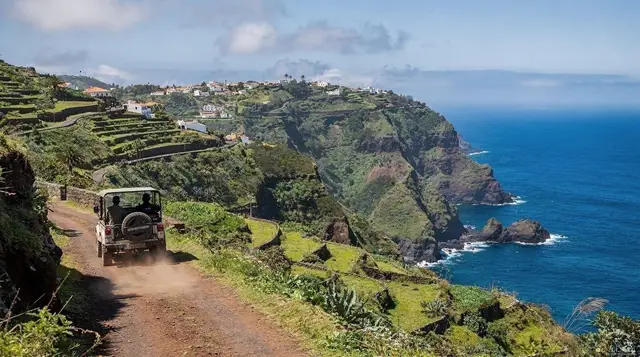
Porto Moniz sits at the far northwest corner of the island, and the approach is part of the experience. From the south the road runs over the Paúl da Serra plateau and down through a series of tunnels and cliffside bends; from the north coast it hugs the sea past waterfalls that spill directly onto the tarmac. Both routes are manageable in a small hire car if you are comfortable with narrow roads and steep drops — see the island’s driving guide and car rental notes before booking one — but they are not routes to rush, and they are not the place for a car larger than you need.
If you would rather not drive the cliff roads yourself, a direct transfer removes that decision entirely: a direct transfer from Funchal to the Porto Moniz volcanic pools covers the drive both ways and drops you at the pools with time to use either area before heading back.
For a slower look at the same coastline, with stops along the way rather than a straight run to the pools, a small-group option covers more ground: a guided day tour of Madeira’s west coast that takes in the coastal viewpoints en route to Porto Moniz and a photography-focused alternative slows the pace further for anyone who wants time to actually shoot the coastline rather than just pass through it:
a full-day guided photography tour of Madeira’s north west, including the Porto Moniz coastline.
Whichever way you arrive, plan for at least two to three hours at Porto Moniz if you want to see both pool areas and the village itself, and check the weather and swell picture the night before rather than the morning of, since a closure decision is often made early.
Beyond Porto Moniz: Seixal and the rest of the coast
Porto Moniz gets the crowds and the photographs, but it is not the only lava pool on Madeira. Further east along the north coast, the village of Seixal has its own smaller area of natural pools, formed the same way and just as free, but with a fraction of the visitors. There are no changing rooms and no staff here either, so the same rules apply: check the sea state before getting in, and bring proper footwear for the rock.
Seixal pairs naturally with its own black-sand beach and with a set of roadside waterfalls nearby, and makes a good half-day stop for anyone who has already done Porto Moniz and wants the quieter version of the same idea. A guided option covers the village and its coastline on foot, with a food stop built in:
a guided walking tour of Seixal that includes its natural pools and a pastel de nata stop.
Between Porto Moniz and Seixal, the entire northwest shoreline is volcanic rock meeting open sea, and smaller pockets of pool-like water show up in places without names or facilities of any kind. None of them come close to Porto Moniz or Seixal in scale, and none are worth a special trip on their own — but if you are driving the coast road and see cars parked at an unmarked pull-in, it is usually because someone has found another small pool worth a look.
What to bring and what to expect
Neither pool area on Madeira behaves like a swimming pool at home, and packing for one the way you would for the other leads to a bad afternoon. Bring proper water shoes or sturdy sandals rather than flip-flops — the rock at both the amenaged and natural pools is sharp, uneven, and often slick with algae near the waterline.
A rash vest or wetsuit top is worth carrying outside peak summer, since the water temperature sits closer to 18 to 23 degrees Celsius depending on season and does not warm up the way a resort pool would. At the free natural pools, bring your own towel and anything else you might need, since there is nothing to buy on site; at the amenaged complex, the snack bar and lockers cover the basics but do not expect a wide selection.
Photographers should note that the best light at Porto Moniz tends to be late afternoon, when the sun drops toward the sea and lights up the spray off the outer rocks — useful to know if you are trying to time a visit around the north west photo tour mentioned above, or simply driving yourself.
Porto Moniz’s natural pools: your questions answered
Are the Porto Moniz lava pools free?
Only one of the two areas is. Porto Moniz has a maintained, ticketed pool complex with changing rooms and lifeguards, and a separate natural pool area that is free to enter and has almost no facilities. They sit near each other but are not the same place.
Why do the pools close sometimes?
A strong swell from the north Atlantic can make the natural pools dangerous or wash straight over the rock shelf, and the amenaged complex will close its gates on the worst days for safety. This happens most in autumn and winter but can occur at any time of year.
Is Porto Moniz worth visiting if the pools are closed?
Yes. The village, the aquarium, the cliffside road from the north, and the view of waves breaking over the lava shelf are worth the trip on their own, even on a day when swimming is not sensible.
Do I need to book the Porto Moniz natural pools in advance?
No booking is needed for either area. The amenaged pools charge an entry fee at the gate; the natural pools have open access with no ticket at all.
Is the water in the lava pools warm?
No warmer than the open Atlantic around Madeira, roughly 18 to 23 degrees Celsius depending on the season. The rock walls take the edge off the swell but do nothing to the temperature.
Are there other lava pools on Madeira besides Porto Moniz?
Seixal, further east along the north coast, has a smaller free natural pool area with its own black-sand beach nearby. It sees far fewer visitors than Porto Moniz and has essentially no facilities.
Can children swim in the Porto Moniz pools?
The amenaged complex, with its shallower sections, steps and lifeguard presence, is the safer choice for children. The natural pools have uneven rock, deeper water in places and no supervision, and are better suited to confident swimmers.
For general sea safety around the island, including currents and swell beyond the lava pools, see the Atlantic swimming safety guide. For a wet-weather backup plan on a day when the coast is too rough for swimming, the rainy day plan for Madeira covers alternatives that do not depend on the sea cooperating.
tours.laurissilva-nature
Verified deep-linked GetYourGuide tours. Book through these links and we earn a small commission at no cost to you.
GetYourGuide does not provide a product photo for this activity — the image shows the meeting point, photographed by us.