The village where the coast meets a swimming pool
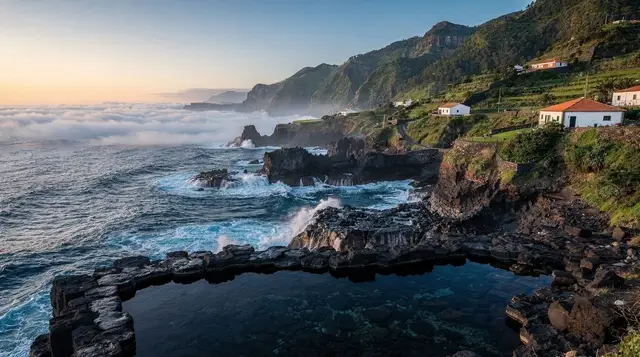
Porto Moniz sits on the far north-western tip of Madeira, where a violent stretch of Atlantic coastline has been softened, in two different ways, into somewhere you can actually swim. The village itself is small — a fishing harbour, a scatter of restaurants serving fresh limpets, and the road that finally gives up hugging the cliffs and turns south towards Ponta do Pargo and the plateau of Paul da Serra. What brings almost everyone here is the water: pools carved into black basalt at the point where waves that have crossed open ocean since Newfoundland finally break.
It’s worth saying clearly, before anything else, what Porto Moniz actually offers, because guides tend to blur it into one attraction. There are two separate pool areas, run differently, priced differently and behaving differently in bad weather. Confusing them is the single most common mistake visitors make here.
Two pool areas, not one
The first is the complexo das piscinas, the maintained lava pool complex right by the main road, easy to spot by its car park and entrance building. This is a managed facility: an entry fee, changing rooms, lockers, showers, a snack bar, and lifeguards on duty during the season. The pools here are still natural — real volcanic rock, real seawater, no chlorine — but the edges have been smoothed, walkways added, and depth is more predictable. This is the version most families and first-time visitors should aim for.
A short walk away, closer to the harbour, are the free wild pools — the ones locals used long before the paid complex existed. No entrance fee, no lifeguard, no changing rooms beyond a rough corner to get dressed in. The rock is rawer, the pools shallower and more irregular, and the sense of being right on an exposed coastline is much stronger. They’re free, but they demand more caution and more of your own judgement about the sea.
| Paid lava pools | Free wild pools | |
|---|---|---|
| Cost | Entry fee (small, per adult) | Free |
| Facilities | Changing rooms, lockers, showers, café, lifeguard in season | None |
| Water | Smoothed volcanic basins, more predictable | Raw rock, shallower and more irregular |
| Best for | Families, first visit, less confident swimmers | Confident swimmers, photographers, quieter moments |
| Closes in swell | Yes | Yes, often first |
Neither is “the real one” and the other a tourist version — both are genuinely natural, tide-fed pools. The difference is management and comfort, not authenticity.
The paid complex, in practice
The complexo das piscinas opens roughly in line with normal daytime hours, with a longer season from spring through autumn; opening hours shrink in winter and the pools can close for maintenance or bad weather at short notice. Expect a modest per-person entry fee, cheaper for children, with lockers usually costing a small deposit. Bring your own towel — none are provided — and reef-safe sunscreen if you have it, since these are enclosed volcanic basins rather than open sea.
The pools themselves are a series of connected basins of varying depth, some shallow enough for children to stand, others deep enough for proper swimming, all linked by walkways over black rock. Waves break over the outer wall and refresh the water constantly, which is part of the appeal and part of the reason conditions can change within the hour. A lifeguard station overlooks the main basin during opening hours, but that’s a presence, not a guarantee — read the section on swell below before you assume you’re covered.
The café by the entrance does simple food and drinks, and is a reasonable place to wait out a closure if the pools aren’t swimmable when you arrive.
The free wild pools, in practice
Walk past the paid complex towards the older part of the harbour and you’ll find the free pools — a looser scatter of natural basins among the rocks, used by generations of locals before any entrance fee existed. There’s no facility building, no lifeguard, and no soft edges: the rock is sharp in places, algae makes some surfaces slippery, and depth varies pool to pool without signage to tell you which is which.
This is the more atmospheric option and the better one for photography — the paid complex’s walkways and entrance building don’t intrude on the frame here — but it asks more of you. Watch other people swimming before you get in, keep footwear on until you’re actually in the water, and treat any pool showing white water washing over its rim as closed for the moment, whatever anyone else is doing.
The one rule that matters more than any other
North-coast swell is not a rare event at Porto Moniz — it’s the coast’s default character for a meaningful part of the year, and it closes both pool areas without warning. This is genuinely true in August as well as January: the Atlantic doesn’t check the calendar. When swell is running, staff at the paid complex will close the gates or rope off basins; at the free pools, there’s nobody to stop you, which is exactly why more caution is needed there, not less.
Do not plan a Madeira trip around swimming at Porto Moniz on a specific day. Build in flexibility — a north-coast loop that also takes in Seixal and its own natural pools, or a day you could swap for Cabo Girão if the coast is closed — rather than a single-shot plan that only works if the sea cooperates. Anyone who tells you the pools are reliably open every day of summer either hasn’t been often enough or is glossing over the bad days.
If you want a fuller picture of how these tide-fed pools work across the island, not just at Porto Moniz, our guide to Madeira’s natural lava pools and separate Atlantic swimming safety notes cover the mechanics in more depth than fits here.
Getting there and parking
Porto Moniz is roughly 1h15 from Funchal via the VR1 motorway and its tunnelled southern stretch, then the coastal road along the west and north. It’s a genuinely different drive from the interior mountain routes: mostly fast and well-surfaced, with the final approach into the village narrowing and dropping towards the sea. See our notes on driving in Madeira and car rental if this is your first time behind the wheel here — a small hire car makes the village’s tight streets considerably less stressful.
Parking near the pools fills up around midday in high season; arriving before 10am or after 3pm gives you a better chance of a space close to the entrance. There’s a public car park a short, flat walk from both pool areas.
Without a car, Porto Moniz is reachable by bus from Funchal, though journey times run considerably longer than driving and services thin out on Sundays — check current timetables before relying on this for a single-day trip.
Doing Porto Moniz without your own transport
If you’d rather not drive the coastal road yourself, a guided north-coast trip covers Porto Moniz alongside other stops in a single day, with someone else handling the cliffside sections. A 4x4 day tour along the north coast, calling at Porto Moniz is the most direct option if the lava pools are your main goal.
For a route weighted more towards the north-east, a private 4x4 tour of the north-east coast works well combined with a separate pools visit. Travellers who want an open-air, more adventurous version of the same coastline can look at the guided north-coast buggy tour instead.
Planning a visit around the tide, not the clock
Because both pool areas depend on the sea rather than opening times alone, the best plan for Porto Moniz has two parts: pick a window with generally calmer conditions, and stay flexible on the day. Late spring through summer (broadly May to September) sees the Atlantic settle more often than not, which is why it’s the season most visitors should aim for — but “more often than not” is not “guaranteed,” and swell can still shut things down mid-visit even in July.
Two to three hours is enough time at the pools themselves — swim, dry off, eat something at the café — but most people fold Porto Moniz into a longer north-coast day rather than a there-and-back trip. See our west Madeira day trip guide for how to sequence it with Porto Moniz at the centre, or our broader best time to visit Madeira guide if you’re still choosing your travel dates. First-timers building their whole trip should also read common Madeira travel mistakes, which covers pool closures alongside other easy-to-miss planning traps.
What’s next along the coast
Porto Moniz is not the end of the north coast, just its western hinge. Heading east, the road runs towards São Vicente, a village with its own volcanic story told underground rather than at sea level — São Vicente’s lava-tube caves are a natural next stop and get their own dedicated coverage on this site rather than being folded in here. Many visitors combine both villages into a single north-coast day: pools at Porto Moniz in the morning while the sea is often calmer, caves at São Vicente after lunch, regardless of tide conditions.
Further options nearby include the black-sand pools at Seixal, the dramatic service cable car down to a working plot of land at Achadas da Cruz, and, if you’re continuing the loop back towards Funchal along the south, the glass skywalk at Cabo Girão.
Porto Moniz’s natural pools: frequently asked questions
Are the Porto Moniz pools natural or man-made?
Both areas use real volcanic rock and are filled directly by the sea rather than by pumped or treated water. The paid complex has had its basins smoothed and linked by walkways for safety and comfort; the free wild pools nearby are essentially untouched. Neither is artificial in the sense of a built swimming pool — the water and the rock are genuine.
What does it cost to swim at Porto Moniz?
The maintained lava pool complex charges a modest per-person entry fee, with a reduced rate for children and a small deposit for lockers. The free wild pools near the harbour cost nothing at all. Budget for parking on top of either option in high season.
Can the pools close even in summer?
Yes, and this is the most important fact on this page. North-coast swell can close both pool areas at any time of year, including peak summer weeks. The paid complex will rope off or shut basins when conditions turn; at the free pools, there’s no staff to stop you, so judge the sea yourself and don’t swim if waves are washing over the rocks.
Which pool area is better for families with young children?
The paid complex, generally. It has shallower, more predictable basins, a lifeguard presence during opening hours, and facilities for changing and cleaning up afterwards, which matters more with small children than with confident adult swimmers.
How long should I plan to spend at Porto Moniz?
Two to three hours covers swimming, drying off and a bite at the café. Most visitors combine this with other stops along the north coast — São Vicente’s caves are the natural next stage — rather than treating Porto Moniz as a full day on its own.
Is Porto Moniz worth visiting if the pools turn out to be closed?
Yes, though it’s a different visit. The village, harbour and coastal views hold up on their own, and the drive itself, particularly the final approach along the cliffs, is part of the appeal. It’s still worth building flexibility into your plan rather than treating a swim as guaranteed.
Do I need to book anything in advance?
No advance booking is needed for either pool area — you simply pay on arrival at the paid complex, or walk straight into the free pools. The only thing worth checking ahead is sea conditions and, in high season, arriving early enough to park.
Can I visit Porto Moniz without a car?
Yes, by public bus from Funchal, though journey times are considerably longer than driving and Sunday services are reduced. A guided north-coast tour is a more time-efficient option if you don’t want to self-drive the coastal road.