Where lava meets the Atlantic
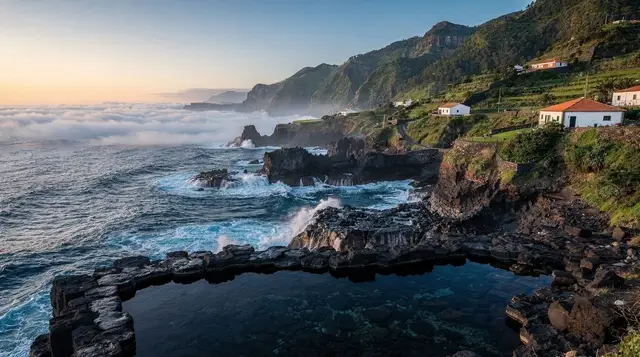
Porto Moniz sits at Madeira’s north-western tip, the point where the sheltered, sun-baked south coast finally gives way to the open, wave-battered north. The village itself is small and unremarkable — a strip of restaurants, a car park, a church — but almost everyone who drives here does it for one reason: the water trapped in the black volcanic rock at its edge, refilled twice a day by the tide and churned by whatever swell is running.
What catches most first-time visitors off guard is that Porto Moniz is not one pool complex. It is two, right next to each other, built for different kinds of visit, and conflating them is the single most common misunderstanding about this stop. Get the distinction straight before you plan the rest of your day.
Two pools, not one
The Piscinas Naturais do Porto Moniz are the walled, managed complex: a series of connected volcanic basins with concrete edges smoothed for safety, changing rooms, showers, lockers, a small entry fee, and usually a lifeguard on duty in season. The water here is still seawater, still cold, still tinted that deep volcanic green-black, but the setting is controlled. This is the pool most photographs of Porto Moniz actually show, and it’s the sensible choice for anyone travelling with children or anyone nervous about swimming over uneven rock.
A short walk away, closer to the old part of the village, are the free natural pools — no ticket booth, no lifeguard hut, no smoothed edges. These are rock pools in something closer to their raw state: irregular, slippery underfoot, with sharper transitions between shallow and deep, and far more exposed to whatever the sea is doing that day. They’re the wilder, more atmospheric option, and the one locals are more likely to use, but they demand more caution and more swimming confidence.
Neither is better in the abstract. The walled pools suit anyone who wants a straightforward, supervised swim; the free pools suit confident swimmers who want the place with fewer barriers between them and the volcanic rock. What matters is knowing which one you’re heading for, since guides and photos online often blur the two together.
| Piscinas Naturais (paid) | Free natural pools | |
|---|---|---|
| Entry | Small fee, around €3-5 | Free |
| Facilities | Changing rooms, showers, lockers | None |
| Lifeguard | Usually present in season | Rarely, if ever |
| Terrain | Smoothed concrete edges | Raw, uneven volcanic rock |
| Best for | Families, first-timers, calmer confidence | Confident swimmers, quieter mood |
The one rule that overrides everything else
Do not build a day around a guaranteed swim at Porto Moniz. The pools are open to the Atlantic, and the north coast of Madeira takes the brunt of every swell rolling in off open ocean — unlike the sheltered south, there’s no headland or bay softening the impact here. When a north swell picks up, both the paid and the free pools are closed to bathers, sometimes for a single afternoon, sometimes for days at a stretch, and the closure can happen with very little warning if conditions change quickly.
This is worth repeating because so many trip reports and older guides describe the pools as a simple, dependable swim stop. They aren’t. Before committing an hour of driving from Funchal or folding this into a longer west coast loop, check current conditions locally — the tourist office, your accommodation, or a quick search for that day’s sea state will tell you more than any guidebook description can. If the pools are shut, the village and the coastal scenery are still worth the detour, but don’t arrive with swimming as the only plan.
Even on a calm day, both pool areas sit directly against the open sea, and the water is genuinely cold — noticeably colder than the beaches of Porto Santo or the sheltered south coast. Wear proper water shoes if you have them; the volcanic rock is uneven and can be sharp, especially around the free pools.
Getting there from Funchal
The drive from Funchal to Porto Moniz takes roughly an hour to an hour and fifteen minutes, mostly along the VR1 motorway before it hands off to the coastal ER101 for the final stretch. The route itself is part of the appeal — the ER101 threads along cliffs and through short tunnels with the Atlantic dropping away below, and several viewpoints along the way are worth a stop in their own right.
Most visitors combine Porto Moniz with other stops on the north-west coast rather than treating it as a single-destination day. A natural pairing is Seixal and its own black-sand beach and natural pools a short drive further east — a distinct place with its own character, not a second Porto Moniz, and worth reading about separately before you decide whether to add it to the same day. The São Vicente caves sit on the same stretch of coast, as does the village of São Vicente itself, and the volcanic tubes there make a good complement to the surface-level drama at Porto Moniz.
Heading further west, Achadas da Cruz and its small service cable car down to a working coastal plot is a worthwhile detour for anyone who has time, while Ponta do Pargo marks the island’s westernmost point and its lighthouse. A well-built west coast loop can take in Porto Moniz, Seixal, and one or two of these further points without feeling rushed, provided you leave Funchal reasonably early.
For anyone driving themselves, our driving in Madeira guide covers the specifics of the north coast roads, and our car rental guide explains why a smaller car makes more sense than it might seem on paper. If you’d rather not drive, the north coast is one of the harder areas to reach by public transport, and organised tours are the practical alternative — see the buses and public transport guide for what’s realistic without a car.
Seeing Porto Moniz on a guided tour
If you’d rather not navigate the ER101’s cliffside curves yourself, or you want to combine Porto Moniz with stops that are awkward to string together independently, a guided 4x4 tour is the most common alternative. The Porto Moniz north coast 4x4 tour runs specifically along this stretch, taking in the coastal viewpoints between Funchal and the village without you needing to worry about parking or tunnel traffic.
A broader option covering more of the west is the 4x4 west tour taking in Porto Moniz, Seixal and Fanal forest in a single day, which is a sensible way to see three of the north-west’s signature stops without renting a car or planning the route yourself. A similar itinerary runs as the Tropical Tide jeep tour through Porto Moniz and Fanal forest, with a different operator and pace.
Travellers wanting a more flexible, smaller-group pace can look at the private tour of Porto Moniz and Fanal forest, which covers the same west coast highlights with the itinerary adjusted to your group rather than a fixed stop list.
What else to do in the village
Porto Moniz itself is small enough to see on foot in under an hour once you’ve dealt with the pools. The church and the handful of streets around it give a sense of a working fishing village rather than a resort, and there are several restaurants along the seafront specialising in fresh fish — worth timing your visit around lunch if the pools are closed and you want the trip to still feel worthwhile.
The Aquário da Madeira, a small aquarium built into an old fort near the pools, focuses on marine life found in the waters around the island and makes a reasonable fallback for families if swimming isn’t possible that day. It’s modest by international standards but gives useful context for what’s living in the pools you may or may not get to swim in.
Photographers should note that the pools photograph best with waves breaking over the outer rocks — which is, unhelpfully, exactly the condition that gets them closed to swimmers. A day with moderate swell and closed pools can still be the most dramatic day for photography, so don’t assume a closure ruins the visit if photography rather than swimming is the priority.
When to go
Late spring through early autumn generally brings calmer seas to the north coast and a better chance of open pools, though nothing is guaranteed at any time of year — Madeira’s Atlantic exposure means conditions can shift within a season or even within a week. Winter months see rougher water more often, and closures are more frequent, though the coastal drive and village itself remain open and worth seeing regardless.
Arriving earlier in the day tends to mean smaller crowds at the paid pools, particularly in peak summer months when coach tours from the south coast start arriving mid-morning. The free natural pools see fewer visitors overall simply because they require more confidence and offer less in the way of facilities.
For a wider view of how Porto Moniz fits into a north coast day, see our north Madeira day trip guide and the broader natural lava pools guide, which compares Porto Moniz to the other volcanic pools around the island, including those at Seixal. If safety around Atlantic swimming is a concern, our swimming safety guide is worth reading before any coastal swim stop on the island, not just this one.
Porto Moniz: your questions answered
Are the Porto Moniz pools free or do you have to pay?
Both exist side by side. The walled Piscinas Naturais charge a small entry fee, typically around €3-5 per adult, and include changing rooms and showers. A separate set of natural pools nearby is free to use but has no facilities and rougher, unmanaged terrain.
Can the pools close for the day?
Yes, and it happens regularly. North Atlantic swell can make both the paid and free pools unsafe for bathers, sometimes at short notice. Always check current conditions locally before making the drive, rather than assuming the pools will be open.
How long does it take to drive from Funchal to Porto Moniz?
Around an hour to an hour and fifteen minutes via the VR1 motorway and the coastal ER101, depending on traffic and how many viewpoint stops you make along the way.
Is Porto Moniz the same as Seixal’s black sand beach and pools?
No. Seixal is a separate village a short drive east of Porto Moniz, with its own black-sand beach and its own natural pools. The two are often visited on the same day but are distinct places with different characters.
Is the water cold at Porto Moniz?
Yes, noticeably colder than beaches on the sheltered south coast or at Porto Santo, since these pools sit directly against the open Atlantic. Expect a bracing swim even in summer.
Do I need a car to visit Porto Moniz?
A car or an organised tour is strongly recommended. Public transport to the north-west coast is limited and impractical for a single-day visit, making a rental car or a guided 4x4 tour the two realistic options.
Is Porto Moniz suitable for young children?
The paid Piscinas Naturais, with their smoothed edges and usual lifeguard presence, are the more suitable option for families. The free natural pools involve uneven rock and are better suited to confident swimmers and older children.
What should I do if the pools are closed when I arrive?
Treat the village itself, the coastal drive, and nearby stops like Seixal or the São Vicente caves as the reason for the trip rather than the swim alone. The small aquarium near the pools is also a reasonable fallback, especially for families.