Madeira Buses and Public Transport Explained
Can I rely on buses to reach Madeira's hiking trailheads?
Not reliably. Horários do Funchal, SAM, Rodoeste and EACL connect Funchal to the main towns on the coast, but very few services reach trailheads like Pico do Arieiro or the Rabaçal levadas, and timetables thin out sharply on Sundays and public holidays.
Four operators, one island
Madeira does not have a single island-wide bus company. It has four, each responsible for a different slice of the map, each with its own timetables, and in places its own fare rules. Understanding which operator covers which corner of the island is the first thing that makes the network usable rather than baffling.
Horários do Funchal runs the city network and the routes that hug the coast closest to the capital, out towards Câmara de Lobos in one direction and Caniço in the other. SAM takes over east of the city, serving Machico, Santa Cruz and on towards Canical. Rodoeste covers the west, running through Ribeira Brava towards Ponta do Sol and Calheta. EACL is the north coast operator, connecting Funchal over the mountains to São Vicente, Porto Moniz and Santana.
None of the four is designed with hikers in mind. They exist to move residents between towns, to schools, to hospitals and to markets. That is worth remembering before you build a levada-walking week around bus timetables, because a network built for commuting and one built for reaching a trailhead car park are not the same thing, even when they happen to pass close to each other on a map.
| Operator | Main area | Reaches from Funchal |
|---|---|---|
| Horários do Funchal | City and near coast | Câmara de Lobos, Caniço, the airport |
| SAM | East | Machico, Santa Cruz, Canical |
| Rodoeste | West | Ribeira Brava, Ponta do Sol, Calheta |
| EACL | North | São Vicente, Porto Moniz, Santana |
Horários do Funchal: the network you will actually use most
If you are staying in Funchal itself, Horários do Funchal is the operator you will meet daily. Its routes cover the city thoroughly — the hotel zone along the Lido promenade, the old town, the market, and up the hill towards Monte — and this is genuinely one of the better urban networks in Portugal for a city this size. Buses are frequent on the main corridors during the day, stops are clearly signed, and route numbers are displayed on the front of each bus.
Where Horários do Funchal also earns its keep is on the near coast either side of the city: services run out to Câmara de Lobos in one direction, useful for a poncha evening without a car, and towards Caniço and Canico de Baixo in the other. There is also an airport route, connecting Madeira Airport to central Funchal, though it runs far less often than a taxi and is not really built for a family with cases.
Day and multi-day travel passes exist for this network and are worth it if your trip is genuinely city-and-near-coast based. They are not valid on SAM, Rodoeste or EACL services, so buying one because you plan a north-coast day trip is a mistake worth avoiding.
SAM: the east
SAM’s routes fan out east from Funchal towards Machico — the site of the first Portuguese landing in 1419 — and on to Santa Cruz and Canical, home to the Whale Museum. These are relatively frequent, reasonably fast thanks to the VR1 motorway tunnels, and genuinely useful if your plan is to see the towns rather than the trails.
Where SAM starts to fall short is the Ponta de São Lourenço peninsula, the exposed volcanic finger at the island’s eastern tip and one of the best walks on Madeira. Buses reach Canical and the villages nearby, but the trailhead itself sits further out, with no bus timed to drop you at the start and collect you at the end.
This is one of the clearest examples on the island of a well-served town sitting a frustrating final stretch from a poorly served trail. A private transfer built specifically for this reserve, such as the Ponta de São Lourenço natural reserve transfer, exists precisely because the public network leaves that gap.
Rodoeste: the west
Rodoeste covers the west, through Ribeira Brava and Ponta do Sol towards Calheta and the villages of the southwest coast. Coverage of the towns themselves is decent, and Ribeira Brava in particular functions as a useful interchange point if you are trying to piece together a west-coast day without your own car.
The catch is the mountains behind the coast. Rodoeste’s routes are built along the coast road, not up into the interior, so places like Rabaçal — the starting point for the Levada das 25 Fontes and Levada do Risco, two of the island’s best-known walks — are effectively out of reach by scheduled bus. The road to the Rabaçal car park is closed to private cars anyway, served instead by a shuttle from the car park itself, which is a different and much shorter service from a Rodoeste route out of Funchal. Anyone planning a Rabaçal day around a Rodoeste timetable is planning around a service that does not go there.
EACL: the north
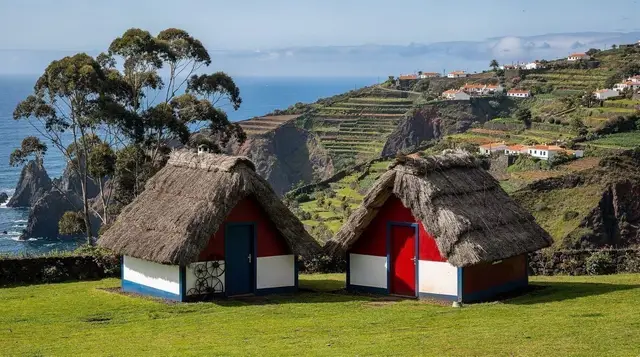
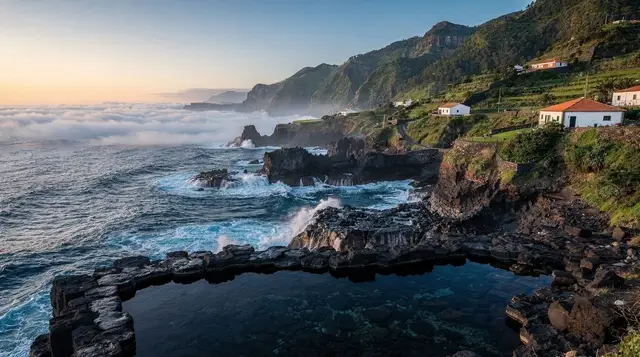
EACL’s routes cross the mountains to reach the north coast — São Vicente, its lava-tube caves, Porto Moniz and its natural pools, and Santana with its thatched houses. These are long journeys, often over an hour each way once the road climbs and drops through the interior, and services are markedly less frequent than the near-Funchal routes.
A day trip to Porto Moniz by EACL bus alone, out and back in a single day with time to actually see the pools, is possible but tight, and it removes any flexibility to detour to São Vicente’s caves or a Santana thatched house on the way. This is one of the routes where the maths tips clearly towards a hire car or an organised tour: not because the bus doesn’t exist, but because the time cost of using it eats most of the day you came to spend on the coast itself.
What the network is genuinely good at
To be fair to all four operators, the Madeira bus network does one thing well: moving you between towns and larger villages along roads it was built to serve. If your day looks like Funchal to Machico, Funchal to Ribeira Brava, or a Câmara de Lobos evening for poncha, buses are a perfectly workable, inexpensive option, and one that avoids the stress of mountain driving that puts some visitors off hiring a car at all. The VR1 motorway tunnels in particular mean that town-to-town journeys along the south coast are faster by bus today than they were a generation ago, when the same trip meant a winding coast road.
Within Funchal itself, the network is dense enough that a car becomes a liability rather than a help — parking is difficult and metered, streets are narrow, and most of what a first-time visitor wants to see sits within a short ride of the centre. For a Funchal city day covering the old town, the market and the cathedral, buses (or simply walking) beat driving without much argument.
Where the network fails you: trailheads
This is the piece worth being blunt about, because it is the mistake that causes the most frustration on the ground. Madeira’s signature walks — the Pico do Arieiro to Pico Ruivo traverse, the best levada walks at Rabaçal and Caldeirão Verde, the Ponta de São Lourenço peninsula — nearly all start at car parks or trailheads that sit some distance beyond the nearest town a scheduled bus actually reaches.
The reasons are structural, not an oversight. Bus routes follow roads built for residents and freight, which means the coast and the larger valleys. Levada paths and mountain trailheads sit up single-track roads, at dead ends, or beside car parks with no throughput of local traffic to justify a regular service. A bus operator scheduling around commuter demand has no reason to run an early-morning departure timed for sunrise at Pico do Arieiro, and none of the four do.
The practical result: if a walk is genuinely reachable by public transport, treat that as a bonus, not the default assumption. For everything else, the realistic choices are a hire car, a taxi arranged in advance, or a tour that includes transfer to the trailhead. Before committing to any specific trail, it’s worth checking hiking permits and trail fees as well — since 2021, Madeira’s official PR-numbered trails require an online reservation and a small per-person fee, a detail that has nothing to do with buses but trips up just as many first-time visitors.
Bus, car or tour: a practical comparison
| Option | Reaches trailheads | Typical cost | Flexibility | Best for |
|---|---|---|---|---|
| Public bus | Rarely | Low, paid per journey | Low — fixed routes and times | Town-to-town trips, Funchal itself |
| Hire car | Yes, almost everywhere | Moderate, fixed for the trip | High | A hiking week, mixed itineraries |
| Taxi | Yes, on request | Higher per trip | High, but booked each time | One-off transfers, small groups |
| Guided tour or transfer | Yes, by design | Bundled into the tour price | Set itinerary, no driving stress | First-timers, mountain roads, sunrise trips |
If you would rather not drive Madeira’s steep, narrow interior roads at all, a general sightseeing tour is a reasonable way to see the island’s highlights without relying on bus timetables. A half-day option like Show Me Funchal covers the city’s landmarks without a car, while a short Funchal city tour works well for a first orientation lap on a day when the bus timetable doesn’t quite line up with your plans.
Fares and buying tickets
Fares vary by operator and by distance rather than following a single islandwide structure. As a rule of thumb, short hops within Funchal on Horários do Funchal cost only a few euros, while longer cross-island routes on SAM, Rodoeste or EACL cost more the further you travel. Tickets can usually be bought from the driver on boarding for cash, though Horários do Funchal also sells rechargeable cards and passes at kiosks in the city, which work out cheaper than paying cash fare by fare if you’re using the city network daily.
Keep in mind that a Horários do Funchal pass does not carry over to SAM, Rodoeste or EACL services, so a multi-day plan that mixes a few days in Funchal with a north-coast excursion will usually mean paying separately for that one longer trip rather than relying on a single pass to cover everything.
Practical notes before you plan around the bus
A few points are worth carrying into your planning rather than discovering on the road. Timetables thin out sharply on Sundays and public holidays, sometimes to nothing at all on smaller rural routes, so a Sunday plan that depends on a specific departure needs checking the day before. Luggage space on board is limited, which makes buses a poor choice straight off a flight with cases in tow — a taxi or transfer suits that journey better. And because routes are built for residents, the last useful departure back towards Funchal from a rural town can be earlier in the evening than visitors expect, which matters if a full day out turns into a scramble to get back.
For a fuller, more general answer to “do I need a car in Madeira” — covering buses, taxis, hire cars and tours together rather than the bus network in isolation — the guide to getting around without a car is the better starting point. This page exists to go one layer deeper on what the bus network specifically does and does not cover. For the driving side of that same question, see driving in Madeira and car rental in Madeira.
If your trip includes a full day exploring one of the island’s wine-producing valleys inland from Funchal, an organised option such as the Funchal agriculture green tour reaches terraced farmland that no bus route serves directly, which is a fair summary of the bus network’s limits away from the coast in one sentence.
Getting around Madeira by bus: FAQ
Which company runs Madeira’s buses?
There isn’t one. Horários do Funchal covers the city and the nearby coast, SAM serves the east towards Machico and Santa Cruz, Rodoeste covers the west towards Ribeira Brava and Calheta, and EACL covers the north coast towards Santana and São Vicente. Each has its own timetables and, in places, its own fare structure.
Does the bus go to Pico do Arieiro or Pico Ruivo?
Not on a useful schedule for hikers. There is no regular public bus timed to get you to the Pico do Arieiro car park for sunrise or back from Achada do Teixeira after a Pico Ruivo walk. Most visitors use a hire car, a taxi, or a tour transfer for these routes.
Can I buy a multi-day bus pass?
Horários do Funchal sells day and multi-day passes valid on its city and near-coast network, but these do not cover SAM, Rodoeste or EACL routes further out, so a pass is only worth it if you are staying close to Funchal.
Do buses run on Sundays?
Some do, but frequency drops sharply, and a handful of rural routes stop altogether. If a Sunday trip depends on a specific bus, check the operator’s timetable the day before rather than assuming a weekday frequency.
How do I get from Madeira Airport into Funchal by bus?
Horários do Funchal runs an airport service into the city centre, though it is far less frequent than a taxi or a pre-booked transfer, and buses are not designed to carry a lot of luggage comfortably.
Is the bus cheaper than renting a car?
Per journey, yes. Over a week with several out-of-town trips, a small hire car usually works out better value once you count several separate bus fares, waiting time, and the trips a bus simply cannot make.
Do buses run to Porto Moniz and the north coast?
EACL connects Funchal to the north coast, including Porto Moniz, São Vicente and Santana, but journeys are long, indirect over the mountains, and infrequent, so a full round trip in a single day by bus alone is tight.
What’s the difference between the bus and a guided tour for day trips?
A public bus takes you to a town and leaves you to find your own way from there. A guided tour or private transfer takes you to the trailhead, viewpoint or reserve entrance itself, which matters most for places the bus network was never built to reach.
Transfers and transport passes on GetYourGuide
Verified deep-linked GetYourGuide tours. Book through these links and we earn a small commission at no cost to you.
GetYourGuide does not provide a product photo for this activity — the image shows the meeting point, photographed by us.