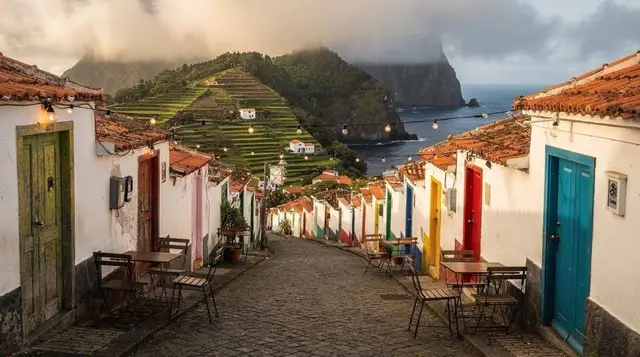
Zona Velha: Funchal’s Old Fishing Quarter
Long before Funchal grew into the hotel strip along the Lido promenade and the modern marina fanned out below it, the city was a scatter of fishermen’s houses clustered where the Ribeira de Santa Luzia meets the sea. That original quarter is Zona Velha, the “old town”, and it is still the most atmospheric few streets in the city: narrow, cobbled, sloping gently towards the water, and largely untouched by the kind of redevelopment that has smoothed out other parts of central Funchal.
By day the old town is quiet, a little scruffy in places, and easy to underestimate on a quick pass. By evening it turns into the liveliest few hundred metres in the city, as restaurant terraces spill onto the cobbles and the smell of grilled fish drifts down the lanes. Both moods are worth seeing, and neither takes more than an hour or two, which is why the old town pairs so naturally with a stroll to the Mercado dos Lavradores a few streets inland, or with a wander down to Funchal marina and the harbour end of the seafront.
If you would rather have the history and the layout explained as you walk, a guided walking tour through Zona Velha covers the doors, the church squares and the market in a couple of hours with a local guide, which is a reasonable shortcut on a first visit or if your time in Funchal is limited to a single afternoon.
Rua de Santa Maria and the Painted Doors
The street that defines the old town is Rua de Santa Maria, a narrow lane running roughly parallel to the sea through the heart of Zona Velha. Its signature feature, and the single most photographed detail of the old town, is its run of painted doors. The project behind them, Arte Portas Abertas (“Open Doors Art”), began in 2010 as a response to the derelict, shuttered doorways that lined the street after decades of decline: local artists, and later visiting ones, were invited to repaint individual doors, transforming a street of peeling paint into an open-air gallery.
The results range from tightly detailed portraits and Madeiran folk scenes to bold abstract work, and because the project has continued for well over a decade, the collection is not fixed. Doors are repainted, new buildings are added, and a street you photographed on one trip can look different on the next. Walking Rua de Santa Maria slowly, door by door, rather than rushing to a handful of famous ones, is the way most visitors end up spending the most time here.
The street is also the backbone of the old town’s restaurant scene. Fish and seafood dominate the menus, unsurprisingly for a former fishing quarter, and tables are laid directly on the cobbles for much of the length of the street once the sun starts to drop. Prices skew towards tourist-friendly rather than cheap, and quality varies house to house more than the identical-looking terraces suggest, so it is worth glancing at a couple of menus rather than sitting at the first table you see.
Evenings on the Terraces
Funchal’s old town is, above almost anything else on this coast, an evening place. The cobbled lanes that feel workaday at noon fill with candlelight and conversation after dark, and the short stretch of Rua de Santa Maria and the streets running off it become genuinely animated: waiters coaxing passersby toward tables, grills smoking outside doorways, live music drifting from one or two of the longer-established restaurants.
Scabbard fish, locally espada preta, turns up on almost every menu here, usually pan-fried with banana, and it is worth trying at least once even if the description sounds unusual. Espetada, cubes of beef grilled on a skewer of bay laurel and served hanging from a small stand at the table, is the other dish you will see repeatedly.
Neither is unique to the old town, but the concentration of restaurants doing both well, in a genuinely historic setting, is what makes an evening here worth building a Funchal day around. Our broader food guide and the dedicated page on espetada and bolo do caco go into both dishes in more depth, and where to eat by area compares the old town’s options against the marina and the Lido strip.
For visitors who want to extend the evening onto the water rather than staying on the cobbles, boats leave from nearby Funchal harbour for sunset trips that pair naturally with an old town dinner either side. An evening sail on a traditional Xavelha boat times its return to the harbour close to old town dinner hour, and the same operator also runs a daytime trip along the coast on the same boat, which works well earlier in the day if you would rather keep the evening free for the restaurants themselves.
Prices on the terraces are not unreasonable by Western European standards, but it is worth knowing that menus aimed squarely at tourists sit alongside quieter places used by locals, and the difference is not always obvious from the street. A short walk one street back from the busiest stretch of Rua de Santa Maria usually turns up better value without losing the atmosphere, and the streets are short enough that comparing a few is a five-minute detour, not a project.
Mercado dos Lavradores: Flowers, Fruit and the Fish Hall
A short walk inland and slightly west from Zona Velha brings you to the Mercado dos Lavradores, Funchal’s covered market and, alongside the old town itself, the other essential stop in this part of the city. The building dates from 1940 and is a fine, largely intact example of Art Deco design: a tiled facade, a central courtyard, and two levels organised by produce rather than left as a single sprawling hall.
The ground floor is given over almost entirely to flowers and fruit, and it is where most visitors spend their first few minutes, drawn in by stalls piled with strelitzia (bird of paradise flowers), passion fruit, custard apples and other produce that will be unfamiliar to most European shoppers. It photographs beautifully, and the flower stalls in particular, staffed largely by women in traditional Madeiran dress, are one of the enduring images of Funchal.
It is also where the market’s one well-known trap sits. Vendors on the fruit floor routinely offer a taste of something exotic, a slice of passion fruit or a piece of custard apple, and it can feel like straightforward local hospitality. It is not: the fruit is then weighed, and the price charged for what you tasted, or for a whole piece cut for you, is often set well above what a fixed-price stall nearby would charge. This is a known routine rather than a rare bad apple, and the fix is simple: ask the price before you eat anything that is handed to you, or shop instead at a stall where prices are clearly marked and skip the unsolicited samples entirely. Treat any free taste as the opening move of a sale, not a gift.
Upstairs, a separate hall houses the fish market, and it is worth the short flight of stairs even if you have no intention of buying anything. This is where you see espada preta laid out on ice in quantity, its long black body and oversized eyes unmistakable, alongside tuna, limpets and whatever else the boats have brought in that morning. The smell is stronger here than downstairs, unsurprisingly, but the hall itself, with its high windows and Art Deco detailing, is worth a look purely as a building. Our dedicated market guide covers stall-by-stall detail, typical prices and the best time of day to visit if you want more than the overview here.
The market operates as a working produce hall serving the city, not primarily as a tourist attraction, which means it is at its liveliest and freshest early on weekday and Saturday mornings; Sundays it is largely closed. Pairing a mid-morning market visit with lunch, then an afternoon in the old town streets before an evening meal on the terraces, is the natural order for a first visit to this side of Funchal, and it maps closely onto the general shape suggested on our one day in Funchal guide and the wider one-day Madeira itinerary for visitors combining it with other stops.
Getting There and Finding Your Way Around
Both Zona Velha and the market sit within easy walking distance of the rest of central Funchal. From the cruise terminal or Funchal marina, the old town is a flat, scenic 10 to 15 minute walk along the seafront, and it is the route most cruise passengers and hotel guests take rather than bothering with a taxi. From the Lido hotel strip further west, allow closer to 30 to 40 minutes on foot, or a short bus or taxi ride into the centre.
Driving into the old town itself is not recommended: the streets are narrow, largely pedestrianised or heavily restricted, and parking is scarce and metered on the surrounding roads. If you are self-driving elsewhere on the island that day, the nearest useful parking is around the marina or the modern city centre, leaving the old town and market as a walking loop from there.
Landmarks worth using as reference points as you navigate include the Sé Cathedral, whose square sits between the modern centre and the old town, and the São Tiago Fortress at the eastern end of Zona Velha, overlooking the sea; both are useful markers if the old town’s lanes start to feel like a maze, which they occasionally do.
What This Corner of Funchal Does Not Cover
It is worth being clear about the boundary here, because the two are often lumped together on a first visit. Monte, the hillside village above Funchal reached by cable car, and the cable car ride itself, are not part of this guide: the cable car’s lower station sits close to the old town, but the ride, the pilgrimage church of Nossa Senhora do Monte, the toboggan run down from it, and the gardens up there are enough for their own half day, and are covered fully on our Monte page and the cable car and toboggan guide.
If you are planning a full day that includes both the old town and Monte, our Funchal in one day guide sequences the two sensibly rather than trying to force them into the same couple of hours.
For visitors who want to go further afield after the old town and market, jeep and buggy trips into the mountains leave from central Funchal and can be booked as a natural follow-on: a 4x4 tour to Pico do Arieiro and Santana covers the island’s high peaks and thatched houses in a day, while a shorter trip to the Eira do Serrado viewpoint above Curral das Freiras fits into a half day and pairs well with an old town morning.
Practical Notes for Your Visit
The old town has no opening hours as such; its streets are open around the clock, though the atmosphere described above is very much an evening phenomenon and the daytime version is a quieter, more workaday place. The market keeps conventional trading hours, broadly 7am to 8pm on weekdays and Saturdays, with a shorter Sunday closure, and is calmest in the first hour after opening.
Comfortable, flat-soled shoes matter more here than the “old town” label might suggest: the cobbles on Rua de Santa Maria and the surrounding lanes are uneven and can be slippery when wet, which happens more often than the south coast’s sunny reputation implies. Card payment is widely accepted in restaurants, but market stalls, particularly on the fruit floor, often expect cash, which is one more reason to agree a price out loud before any produce changes hands.
Wallets and phones deserve the ordinary vigilance you would use in any busy market and evening dining district; Funchal is a low-crime city by most measures, and the main practical risk in this part of town remains commercial rather than criminal, namely the fruit-tasting routine described above rather than anything more serious. For a wider view of common first-visit missteps across the island, our travel mistakes to avoid guide is worth a skim before you land, and readers who want a first-person account of the scabbard fish and the market’s charms and pitfalls might enjoy our piece on trying espada preta for the first time.
Funchal Old Town FAQ: Zona Velha, the Painted Doors and the Market
What is the difference between Zona Velha and the rest of Funchal?
Zona Velha is the compact old fishing quarter at the eastern edge of central Funchal, built around the harbour before the city grew. It is where the painted doors, the narrow cobbled lanes and most of the evening restaurant terraces are concentrated, distinct from the newer marina and hotel strip to the west.
Are the painted doors of Rua de Santa Maria still being added to?
Yes. The Arte Portas Abertas (Open Doors Art) project began in 2010 to brighten shuttered, derelict doorways along Rua de Santa Maria and has since spread to nearby streets, with local and visiting artists repainting doors over time, so the collection changes from one visit to the next.
Is the fruit tasting at Mercado dos Lavradores really free?
No. Vendors on the fruit floor often hand out slices to taste, then weigh and charge for whatever you touched or ate at a high per-kilo price. Agree a price before tasting anything, or decline politely and buy from a stall with visible fixed prices instead.
What is espada preta and where do I see it at the market?
Espada preta, black scabbard fish, is a deep-sea species landed almost nowhere else in Europe in volume and is a Madeiran signature dish. It is displayed on ice on the fish floor upstairs at Mercado dos Lavradores, glossy black skin and huge eyes, alongside tuna and other local catch.
When is the best time of day to visit Funchal old town?
Late afternoon into the evening, when the market has closed but Rua de Santa Maria’s terraces are filling up and the light is good for photographing the doors. Midday is fine for the market itself but the old town’s restaurant streets feel sleepier before around 6pm.
Does this area cover Monte or the cable car?
No. Monte and the cable car that climbs to it from near the old town are a separate half-day out, covered on our dedicated Monte page, since the toboggan run, the cable car ride and the pilgrimage church all deserve their own planning rather than being squeezed into an old town visit.
Can I walk to the old town from the cruise port or marina?
Yes, easily. Both the cruise terminal and Funchal marina are within a 10 to 15 minute walk of Zona Velha along the seafront, which is the route most cruise passengers and hotel guests take rather than driving or taking a taxi for such a short distance.