Where to Eat in Funchal: A Guide by Neighbourhood
Where should I eat in Funchal?
Zona Velha (the old town) is best after dark, when its lantern-lit lanes and Rua de Santa Maria fill with restaurants. The city centre around the cathedral and Mercado dos Lavradores suits lunch and market food. The seafront promenade and marina work for a relaxed evening with a view, at a slightly higher price.
Choosing where to eat by where you are
Funchal is small enough to walk across in half an hour, but its eating-out character changes block by block. The old town comes alive after dark. The centre, around the cathedral and the market, is where the city itself eats lunch. The seafront trades a little authenticity for a sea view and a breeze. None of these areas is objectively “better” — the right one depends on whether it’s 1pm or 9pm, and whether you’re staying two minutes from Rua de Santa Maria or up near the botanical garden.
This guide sorts addresses by neighbourhood rather than by dish, so you can pick somewhere close to where you already are. For the dishes themselves — what espetada and bolo do caco actually are, how poncha is made, what to look for at the fish counter — the specialist guides linked throughout cover that ground properly; this page won’t repeat it.
Zona Velha: the old town, best after dark
The Zona Velha is Funchal’s historic fishing quarter, a grid of narrow lanes below the cathedral where a 2010 project invited local and visiting artists to paint the old wooden doors. That project, Arte Portas Abertas, turned a run-down district into the city’s most photographed street art and, not coincidentally, into its densest concentration of restaurants. By early evening the lanes fill with tables, grills smoking on the pavement, and staff standing in doorways with menus in four or five languages.
This is the honest bit that most guides skip: not everything here is what it looks like. Rua de Santa Maria itself splits roughly into two kinds of address. A handful of kitchens have genuinely fed this neighbourhood for generations, cook to order, and happen to sit on a street that tourism later discovered. Others opened specifically to catch the evening crowd, with laminated photo-menus, a tout on the door, and a kitchen built for volume rather than for a regular clientele.
Both can be perfectly enjoyable for a first-night espetada and a jug of poncha — but only one is the “authentic old town” experience the marketing implies, and it’s worth knowing you’re choosing rather than stumbling into it. A rough tell: a menu with photos of every dish and a member of staff actively recruiting from the doorway usually means the second kind; a short, handwritten or chalkboard menu with mostly local diners at 9pm usually means the first.
Either way, come after 7pm rather than at lunchtime — the Zona Velha is genuinely quiet during the day, with shutters down on streets that will be packed a few hours later. The steep lane up towards São Tiago Fortress has a smaller, calmer set of tables than Rua de Santa Maria itself, worth trying if the main street is full. For dish-by-dish detail on what to order here — the skewer, the flatbread, the local wine list — see the dedicated espetada and bolo do caco guide; this section is only about which street to walk down.
a guided evening food tour through the old town’s kitchens is a reasonable shortcut on a first night, if you’d rather have someone else filter the two categories above for you than gamble on a doorway.
The city centre: lunch, the market, and where Funchal actually eats
North and east of the old town, around the cathedral and Mercado dos Lavradores, the crowd shifts. This is where office workers grab a lunchtime prato do dia, where the market traders eat between shifts, and where menus are as likely to be in Portuguese only as in five languages. It’s a better bet for lunch than the old town, which can feel half-asleep before early evening.
The market itself, open Monday to Saturday and busiest on Friday and Saturday mornings, has a small upstairs food area alongside the fruit, flower and fish halls — including the fish level where the espada preta, the black scabbard fish pulled from deep water off Madeira, sits on ice looking like nothing else in a European market. The full walkthrough of what’s worth seeing and buying is in the separate Mercado dos Lavradores guide; the one rule worth repeating here is not to accept a free fruit sample without asking the price first, since a few stallholders weigh and charge for whatever you touched.
Streets radiating from the market and cathedral, particularly the blocks past Avenida Arriaga towards Santa Catarina Park, carry a mix of small tascas, bakeries and simple grills with none of the old town’s evening theatre. Prices here tend to sit noticeably below equivalent dishes in the Zona Velha or on the seafront, partly because the clientele is mostly Madeiran rather than visiting. If a two-course lunch with a glass of local wine at old-town prices sounds steep, this is the area to try instead.
For something sweet in the centre, both a hands-on bolo de mel workshop where you make the honey cake yourself and a static honey cake museum visit with tastings sit within a short walk of the market, useful if rain shortens your afternoon and you’d rather be indoors.
The seafront and marina: views over value
Along the Lido promenade and around the Funchal Marina, restaurants trade a little on their setting: a table facing the harbour, cruise ships docked nearby, sunset over the Atlantic. It is the most relaxed of the three areas to eat in — no lanes to navigate, wide pavements, easy for anyone who has spent the day walking or driving and wants somewhere simple to sit down.
The trade-off is price. A dish that would cost noticeably less two streets back in the centre often carries a premium here for the view alone, and the kitchens skew towards safe, broad-appeal menus rather than the more traditional cooking found in the centre or the better old-town addresses. That’s not a criticism if a relaxed evening by the water is what you want on a particular night — it’s simply worth knowing you’re partly paying for the location.
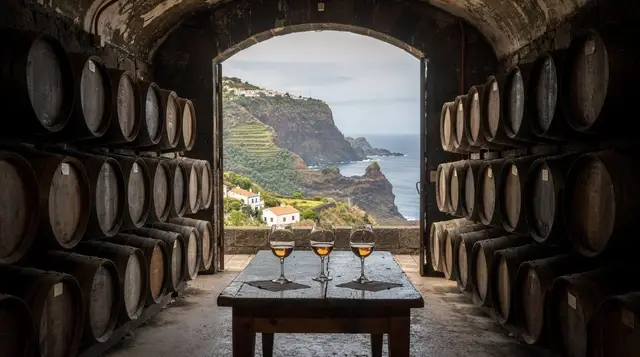
This stretch is also where Funchal’s Madeira wine heritage is easiest to combine with a meal: Blandy’s Wine Lodge, a short walk inland from the marina, runs tastings that pair naturally with an evening out in this part of town, and several nearby restaurants keep serious Madeira wine lists rather than the single house option common elsewhere. For sweeter tastes, a chocolate tasting overlooking the bay works well as a late-afternoon stop before dinner along the front.
If your appetite runs more towards seeing the city than sitting still, a broader city tour that takes in the seafront, marina and centre together is a way to get oriented before deciding, over the following days, which of these three areas you actually want to keep coming back to.
A rough price comparison by area
Prices below are for a typical main course at dinner, per person, without drinks — a guide to relative cost between areas rather than a fixed menu price.
| Area | Typical main course | Character | Best time to go |
|---|---|---|---|
| Zona Velha (old town) | €12–€22 | Lively, mixed authentic and tourist-facing | Evening, after 7pm |
| City centre / market | €7–€14 | Local, quieter, better value | Lunch, weekdays |
| Seafront / marina | €14–€26 | Relaxed, view-led, pricier | Sunset onward |
These bands overlap in practice — a very good Zona Velha kitchen and a mediocre seafront one can land on the same price — but they hold as a first-pass guide when deciding where to walk on a given evening.
Practical notes across all three areas
Booking matters more in the Zona Velha than anywhere else covered here, particularly on Rua de Santa Maria in July and August, over New Year, and during the Flower Festival fortnight after Easter. The centre and seafront rarely need a reservation outside those weeks. Service charge is not automatic on the bill in most independent restaurants; a small amount left in cash is appreciated rather than expected. Tap water is safe to drink across the city, so there’s no need to buy bottled water at every meal, and asking for “água da torneira” rather than bottled water is a small habit that saves money over a week.
Walking between the three areas is easy and doesn’t require route planning: the old town, the cathedral and market, and the marina all sit within about fifteen minutes of each other on foot, mostly flat, following the seafront or the parallel streets just inland. That makes it entirely realistic to have a coffee near the market in the morning, lunch in the centre, and dinner in the Zona Velha the same day without once needing a taxi.
If you’re planning a full day around the city rather than just a meal, the one day in Funchal itinerary and the broader things to do in Funchal page slot alongside this guide, and the one-day Madeira itinerary is useful if food is only one part of a tighter schedule.
Questions about eating in Funchal, answered
Is the Zona Velha touristy?
Parts of it clearly are, especially the streets nearest the seafront with English-language menus and staff calling out to passers-by. Rua de Santa Maria itself mixes both: a few kitchens that have fed locals for decades sit metres from places built entirely for cruise-day footfall.
Where do locals actually eat in Funchal?
Away from the postcard lanes: the streets just north of the cathedral, the area around Mercado dos Lavradores on a weekday morning, and the residential blocks past Avenida Arriaga where lunch menus are aimed at office workers, not visitors.
Do I need to book a table in the old town?
In summer, at Christmas and New Year, and around the Flower Festival and Atlantic Festival, yes, especially for the well-known addresses on Rua de Santa Maria. Outside peak weeks, walking in and choosing between two or three open tables is normal.
Is it cheaper to eat in the city centre than by the sea?
Generally yes. A seafront table with a marina or ocean view usually adds a premium over an equivalent dish a few streets back, even when the kitchen is the same standard.
What should I eat on my first night in Funchal?
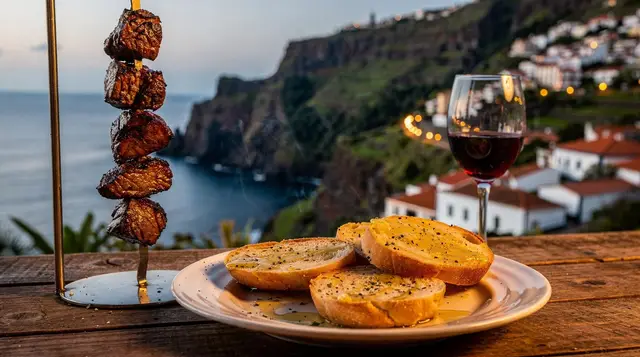
Espetada (skewered beef on a bay-laurel branch) and bolo do caco (garlic-butter sweet-potato flatbread) cover the two dishes most visitors ask about, and both are on menus in every neighbourhood covered here.
Are the fruit-tasting stalls at the market a scam?
Not a scam exactly, but a known trap: some stallholders hand out free samples of exotic fruit and then weigh and charge for whatever you touched next. Ask the price before tasting, or say no thank you if you are only browsing.
Can I eat well in Funchal without a car?
Easily. Every area in this guide is within walking distance of the Zona Velha and the marina, and the seafront promenade connects them without a single hill.
Food, wine and poncha tours on GetYourGuide
Verified deep-linked GetYourGuide tours. Book through these links and we earn a small commission at no cost to you.
GetYourGuide does not provide a product photo for this activity — the image shows the meeting point, photographed by us.