The city that everyone passes through
Funchal is where almost every trip to Madeira starts and, for a lot of visitors, where it stays. It’s the capital of the autonomous region, home to roughly 105,000 of the archipelago’s 250,000 residents, built in a natural amphitheatre that climbs from a small harbour up steep volcanic slopes toward the mountains. The name comes from funcho, the wild fennel that once covered the bay when the Portuguese captain João Gonçalves Zarco landed here in 1419 — a year after Bartolomeu Perestrelo and Tristão Vaz Teixeira had already reached Porto Santo.
Funchal isn’t a single sight to tick off. It’s a base: a place with a genuine old town, a working market, decent restaurants, and — via one short cable car ride — direct access to the cool, green hills above the coast. This page covers the city itself as an anchor point. The toboggan run at Monte, the CR7 Museum, the Lido promenade and Praia Formosa, the cathedral, and the Quinta do Palheiro gardens all have their own detail pages, linked below rather than repeated here.
Zona Velha: the old town and its painted doors
The Zona Velha — Funchal’s old fishermen’s quarter, tucked between the marina and the city centre — is the part of Funchal that photographs best and rewards slow walking. Its narrow lanes run down to a small pebble beach and a working harbour, still overlooked by the sixteenth-century walls of São Tiago Fortress.
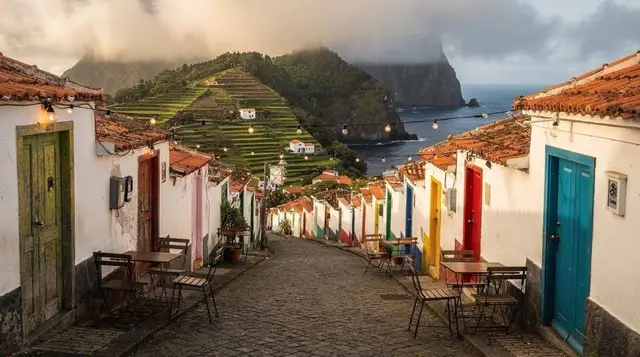
The single street visitors remember is Rua de Santa Maria. Since 2010, a project called Arte Portas Abertas (“Open Door Art”) has turned dozens of the street’s shop and house doors into individual paintings — some whimsical, some political, some simply beautiful, repainted and refreshed over the years as artists rotate through.
It’s free to walk, best in the soft light of late afternoon, and it’s also the single densest concentration of restaurants for dinner in the old town, so a stroll here in daylight followed by a table after dark is the natural way to see it. For a slower, guided version of the neighbourhood with tastings folded in, a Funchal guided walking tour with tastings is a straightforward way to get context on streets that otherwise look, from outside, like any other pretty alley.
Beyond Santa Maria, the Zona Velha is worth wandering without much of a plan: fishing boats pulled up on the shingle, small chapels, and views back up the amphitheatre of the city toward the hills. The old town is compact enough to see properly in two or three hours, longer if you stop to eat.
Mercado dos Lavradores: flowers, fruit and the fish floor
A ten-minute walk from the Zona Velha, the Mercado dos Lavradores (“Farm Workers’ Market”) is Funchal’s other unmissable stop, and the one visitors most often get wrong by turning up in the afternoon, once the good stalls have thinned out. Go in the morning.
Built in 1940 in an Art Deco style — geometric tiles, clean municipal lines, a central courtyard — the market has three distinct layers. The entrance courtyard is given over to flower sellers in traditional dress, their stalls piled with strelitzia and orchids. The ground floor is fruit and vegetables, heavy with tropical produce that doesn’t grow on the mainland: custard apple (anona), passion fruit, bananas grown a few kilometres from the stall.
The upper floor is the fish market, and it’s the part that stops most visitors in their tracks: whole espada preta, the black scabbardfish hauled up from several hundred metres down in deep-water canyons off the coast, laid out with their eel-like bodies, oversized eyes and rows of teeth. It’s one of Madeira’s signature ingredients, usually served fried with banana — a pairing that sounds odd and works.
One thing worth knowing before you go in hungry: some fruit sellers offer a free taste and then weigh and charge for a full bag before you’ve agreed a price. It’s a minor, well-known trick rather than a scam, but it’s worth agreeing the price — or the fact that you’re not buying — before you accept the sample. For a longer walk through the building stall by stall, see the dedicated market guide.
From harbour to hills: the cable car to Monte
Funchal’s other defining piece of infrastructure is the cable car, opened in 2000, that runs from a terminal near the Zona Velha up to the village of Monte. The ride takes about 15 minutes each way and climbs roughly 560 metres, swinging over rooftops, terraced gardens and increasingly steep valley sides as the town falls away below.
It’s worth treating as a destination in itself rather than a shuttle. Monte has its own church, Nossa Senhora do Monte, where the exiled Austrian emperor Charles I is buried, the Monte Palace Tropical Garden, and — a short walk from the cable car terminal — the start of the famous wicker toboggan run down toward Livramento, which has a full page of its own since it isn’t a way of getting back to central Funchal: the descent stops partway down the hill, and the return leg from there is by taxi or bus.
The cable car is also, practically speaking, the easiest way for a visitor without a car to get a real taste of Madeira’s hills in an afternoon: cool, misty, densely planted, a different climate entirely from the sunny harbour fifteen minutes below. For visitors who want to go further into the mountains rather than just up to Monte, a private tuk-tuk run is a way of seeing more ground without driving yourself; see the Funchal: Pico do Arieiro private tuk-tuk tour for a version that goes on to the island’s high peaks. For the more famous — and considerably earlier — version of that same road, see the sunrise at Pico do Arieiro.
The rest of the city, briefly
Funchal has more than the old town and the market, and most of it clusters within easy walking distance or a short taxi ride of the centre:
- The cathedral (Sé), the CR7 Museum, and the seafront Lido promenade and Praia Formosa each have their own detail page — worth reading before you go, since none of the three is well served by turning up cold.
- Blandy’s Wine Lodge, in the city centre, is the place to taste and understand Madeira wine without leaving town, and pairs naturally with an evening in the Zona Velha.
- The Funchal Botanical Garden and the Quinta do Palheiro are two genuinely different gardens that visitors regularly confuse; the Quinta is further out and worth a dedicated half-day.
- The marina and cruise port sit at the eastern edge of the harbour — useful orientation points if you’re arriving by ship for a single day, in which case Funchal in one day is the itinerary to follow.
Getting around the city — and the parking trap
It’s tempting to assume that because Funchal is Madeira’s biggest town, it will be the easiest place on the island to drive. It isn’t. The old town and the streets rising away from the harbour are steep, narrow and largely one-way, several are cobbled, and central street parking is limited and metered, with the Zona Velha in particular better avoided by car altogether. Most visitors who hire a car — a sensible move for reaching the north coast or the mountains — park once at a hotel or a paid car park and cover the city centre on foot or by taxi.
Within Funchal itself, walking covers almost everything described here: Zona Velha to the market is about fifteen minutes, and the cable car terminal is a similar distance further along. Horários do Funchal buses run frequently within the city and along the near coast, and yellow taxis are easy to find around the marina and market for anyone who’d rather not walk back up from the harbour. For getting further afield — Camara de Lobos, Cabo Girão, the trailheads in the hills — see the general guide to driving in Madeira or car rental before deciding whether to hire at all.
A day and an evening in Funchal
| Time | What | Where |
|---|---|---|
| Morning | Flowers, fruit, fish floor | Mercado dos Lavradores |
| Midday | Old town wander, lunch | Zona Velha |
| Early afternoon | Cable car up, garden or church | Monte |
| Late afternoon | Wine tasting | Blandy’s Wine Lodge |
| Evening | Painted doors, dinner | Rua de Santa Maria |
For visitors who’d rather have the whole day narrated and organised, a guided walking tour of Funchal with tastings covers the Zona Velha and market with a local guide filling in the history the doors and stalls don’t explain themselves.
For an evening on the water instead, a sunset-to-sunrise catamaran trip from Funchal turns the same harbour into the starting point for a very different kind of view of the island. And since the coast around Funchal is one of the more reliable places in Europe to see cetaceans, a guaranteed dolphin and whale watching trip by RIB is worth building into a second day if the mountains aren’t the priority.
Funchal as a base for the rest of Madeira
Funchal’s real advantage is its position: on the coast road that tunnels efficiently east toward Machico and the airport, and within thirty to sixty minutes by car of most of the island’s headline hikes and viewpoints, including Pico do Arieiro, Câmara de Lobos and Cabo Girão. Staying here rather than closer to a single trailhead means longer drives on some days, but it also means restaurants, an airport transfer that doesn’t depend on a hire car, and — on a rainy day in the hills — a city with enough indoors to fill an afternoon.
For a first visit, treating Funchal as the fixed point and building day trips outward from it, rather than trying to base yourself in the mountains or the north, is the approach that works for most itineraries; see one week in Madeira for how that typically breaks down day by day.
Funchal FAQ
How many days do you need in Funchal?
A single day covers the Zona Velha, the market and the cable car up to Monte, but most visitors are glad to have Funchal as a base for three or four nights, using it as the jumping-off point for the mountains and the north coast.
Is Funchal easy to drive and park in?
No. The old centre is a grid of steep, narrow one-way streets, several hire-car companies discourage bringing a car into the Zona Velha at all, and street parking in the centre is scarce and metered. Most visitors park once, at a hotel or a paid garage, and walk.
What are the painted doors in Funchal?
They’re on Rua de Santa Maria in the Zona Velha, part of a project called Arte Portas Abertas that has been running since 2010: dozens of shopfront and house doors turned into small paintings by local and visiting artists. The street is also the densest run of restaurants for dinner in the old town.
What is the Mercado dos Lavradores?
Funchal’s main market, built in 1940 in an Art Deco style, best visited in the morning. Flower sellers fill the entrance courtyard, tropical fruit stalls fill the ground floor, and the upper level is the fish market, where the black scabbardfish (espada preta) hauled from Madeira’s deep-water canyons is laid out whole.
How long is the cable car ride to Monte?
About 15 minutes each way, climbing roughly 560m from the Zona Velha terminal to Monte. It opened in 2000 and is the easiest way up into the hills above the city without a car.
Does the cable car connect to the wicker toboggan?
It connects to Monte, where the toboggan run starts, but the toboggan itself is a separate paid activity with its own history and its own quirks, covered on its own page rather than here.
Should you eat fresh fruit from the market stalls?
Be careful with sellers who hand you a sample and then weigh and charge for a full portion before you’ve agreed a price. It’s a known trick at the Mercado dos Lavradores; agree the price first, or buy from a stall with visible fixed prices.
Is Funchal a good base for hiking the levadas and the mountains?
Yes — most of Madeira’s hiking trailheads, including Pico do Arieiro and the Rabaçal levadas, are reachable from Funchal by hire car, taxi or organised tour within 30–60 minutes, which is why so many visitors stay in the city rather than closer to the trails.