Garajau Marine Reserve
What is the Garajau Marine Reserve and can I dive there freely?
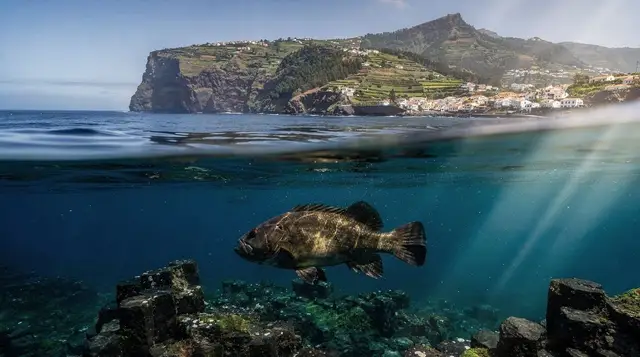
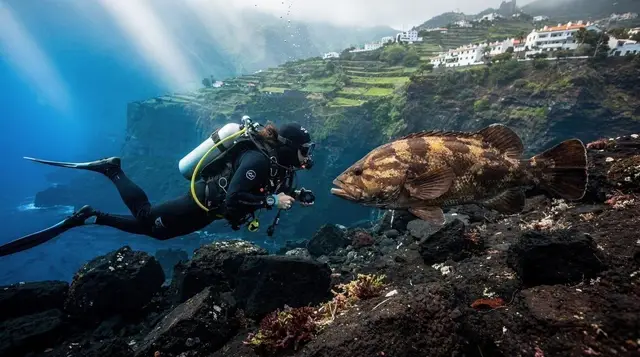
Garajau is a protected marine reserve on Madeira's south coast, established in 1986 to stop spearfishing and let fish populations recover. Diving and snorkelling are only permitted through licensed operators or with an official reserve permit, which is why its brown groupers have grown famously unafraid of people. A bronze Cristo Rei statue, raised on the clifftop above in 1927, looks down over the protected water.
A protected stretch of coast, not just a dive site
Ten minutes east of Funchal, the coastline drops into a small headland crowned by a bronze Christ the King statue and, beneath the waves, a reserve most visitors have never heard of until they’re already in the water with a grouper staring back at them. Garajau is Madeira’s oldest marine protected area, created in 1986, and that single fact explains almost everything else about the place: why the fish behave the way they do, why you can’t simply hire a mask and walk in, and why divers who’ve been coming here for years still talk about it differently from every other patch of coast on the island.
It’s easy to fold Garajau into a general list of “great diving near Funchal” and move on. That undersells it. A reserve is a legal designation with rules, boundaries and nearly forty years of consequences — and understanding those is more useful to a visitor than another paragraph about visibility.
What “reserve since 1986” actually means
Before 1986, this stretch of coast was fished like any other — nets, lines, and spearfishing, which is particularly effective at clearing out exactly the large, curious fish that make a reef interesting to look at. The designation that year banned spearfishing outright inside the reserve boundaries and restricted other fishing and extraction. It was Madeira’s first marine reserve, predating the later protections at Ponta de São Lourenço and further afield by years.
The practical effect took time to show. Fish populations don’t rebound overnight, and it’s really only over decades that a reserve like this changes character. What Garajau has now, nearly forty years on, is a resident population of large brown groupers that have simply never learned to be afraid of a diver’s silhouette. They hold their ground, drift closer out of what looks like curiosity, and will sit motionless a metre from a mask in a way that would be unthinkable on an unprotected reef. That’s not a trick of feeding or habituation by hand — it’s the accumulated effect of decades without spearfishing pressure, and it’s the single reason most operators name when explaining why they keep bringing people back here.
None of this means the reserve is a free-for-all now that the fish are tame. It means the opposite: the tameness is the reward for strict rules, and the rules are still enforced.
What’s allowed, and what isn’t
| Activity | Status inside the reserve |
|---|---|
| Spearfishing | Prohibited |
| Line or net fishing | Prohibited without specific authorisation |
| Anchoring on the reef | Prohibited |
| Removing shells, urchins, rock | Prohibited |
| Diving with a licensed operator | Permitted |
| Snorkelling with a licensed operator or permit | Permitted |
| Touching or chasing marine life | Discouraged / restricted by operators |
The practical upshot for a visitor is simple: you don’t turn up at Garajau with your own snorkel gear and swim out into the reserve unsupervised the way you might at an open beach. Access for diving and snorkelling runs through licensed operators, most of them based a short drive away around Caniço, who hold the relevant authorisation to bring groups in. Booking with one of them isn’t bureaucracy for its own sake — it’s the mechanism that has kept the reserve a reserve for nearly forty years, and it’s also, in practice, the easiest way to actually see anything worthwhile, since a guide knows where the groupers tend to hold station and what the current is doing that day.
The Cristo Rei above the water
The statue on the headland predates the reserve by nearly sixty years. Raised in 1927 and modelled on the more famous monument in Rio de Janeiro — though on a far smaller scale — it stands on the clifftop looking out over the same water the reserve now protects. Visitors sometimes assume the two are connected, that the statue was somehow part of the conservation project; it wasn’t. It was a religious monument built decades before anyone in Madeira was thinking about marine protection, and it simply happens to overlook what later became the reserve.
That said, the pairing works. A short walk to the viewpoint at the statue’s base, looking down over the cliffs and the water where the groupers live, is worth doing whether or not you get in the water yourself, and it’s the easiest way to understand the geography of the place before a dive: the headland juts out, the reserve wraps around its base, and the drop-off starts close to shore.
Getting in the water
Two broad routes in exist. The first is a snorkelling trip, usually run from a boat or a short swim from a shore access point, aimed at people who want to see the groupers and the reef structure without diving certification. The shallower shelves near the entry points are calm enough for reasonably confident swimmers in good conditions, and a guided trip means someone is watching the current and pointing out what to look for rather than you searching blind.
a guided swim through the reserve is the most direct way to get in the water here without a dive qualification, aimed squarely at seeing the reef and its fish rather than covering distance. For a smaller, slower version of the same idea, a private snorkelling trip with lunch built around the reserve suits a couple or a family who’d rather not share a boat with a full group.
The second route is diving proper. The reserve’s deeper drop-offs, swim-throughs and rock formations are built for certified divers, and the groupers tend to hold at depths and angles that reward a slower, more deliberate approach than snorkelling allows. Operators typically run Garajau as one stop within a longer day that covers other sites along the south coast, which suits divers who want variety rather than a single-site repeat visit.
a full day of diving that includes the reserve is the standard way experienced divers see Garajau properly, usually paired with a second site so the day isn’t spent entirely in one spot. Divers looking specifically for the more dramatic underwater terrain along this coast, rather than Garajau alone, sometimes book a dive trip built around the more striking rock formations east of Funchal instead, which passes through similar water without being reserve-specific.
What you’ll actually see
The groupers are the headline, and fairly so — brown grouper (locally garoupa) that will approach within touching distance and hold still, which is rare enough on any reef to be worth the trip on its own. But the reserve supports more than one species worth watching for: moray eels tucked into crevices along the rock face, shoals of damselfish and bream working the shallower water, occasional octopus changing colour against the volcanic rock, and the kind of dense, undisturbed rock structure that only develops where nothing has been dragging a net or a spear gun through it for decades.
Visibility and water temperature follow the same seasonal pattern as the rest of Madeira’s south coast: clearer and warmer from late spring through autumn, with sea temperatures climbing toward the low twenties Celsius in summer and dropping into the high teens over winter. None of it is dramatically warm by tropical standards, but it’s comfortable in a wetsuit year-round and genuinely pleasant for a good stretch of the year.
Practicalities: getting there and booking
Garajau sits just off the coast road east of Funchal, close enough that most operators either collect divers and snorkellers from central Funchal hotels or meet at a set point near Caniço. Independent travellers with a hire car can reach the headland and viewpoint easily enough under their own steam — the statue and the clifftop are open to anyone, no permit required — but the reserve itself, underwater, is the part that needs a licensed operator.
Because access is managed rather than open, it’s worth booking ahead rather than turning up and hoping. Group sizes on the guided swim and snorkel trips tend to be kept deliberately small, partly for the sake of the experience and partly because a reserve with a fragile equilibrium doesn’t benefit from large numbers of people churning up the water at once. If you’re travelling with people who won’t be diving or snorkelling, the clifftop and the statue make a reasonable stop on their own, with views back along the coast toward Caniço and out to sea.
For visitors building a wider itinerary around this side of the island, Garajau slots naturally alongside other stops on the east coast — Ponta de São Lourenço for its bare volcanic headland, or Câmara de Lobos for a different, more historic stretch of the same coastline. A day built around the reserve, a walk, and lunch back in town is a manageable way to see this side of Madeira without overplanning it — see our east Madeira day trip guide for one way to sequence it.
Photographers and anyone chasing a wider view of the coastline before or after the water often pair the reserve with a half-day guided photography trip that covers viewpoints along this stretch, since the light on the cliffs here in the early morning or late afternoon is some of the best on the south coast.
Beyond diving: the wider reserve
It’s worth remembering that a marine reserve is a management area first and a dive attraction second. The rules that keep spearfishing and anchoring out of Garajau exist because the coastline supports more than the specific animals divers come to see — it’s a functioning piece of coastal ecosystem that happens to also be a rewarding place to swim. Visitors who come away thinking of it purely as “the place with the tame fish” are missing half the point, but they’re also, in a roundabout way, the reason the fish stayed tame: paying to visit through a licensed operator, rather than turning up with your own gear, is what keeps the incentive structure around the reserve intact.
If your interest in Madeira’s marine life extends beyond a single reserve, the island’s waters more broadly are worth a look — whale and dolphin watching runs year-round from Funchal, and operators serious about the animals they’re showing you tend to follow the same kind of approach guidelines that keep Garajau’s groupers calm; our guide to responsible whale watching covers what to look for when choosing a boat.
For a broader sense of what’s out on the water beyond the reserve, boat trips from Funchal covers the wider range of options, and anyone keen on a slower, more physical way to explore the coast might look at kayaking, paddleboarding and coasteering as an alternative to a boat.
For a broader look at where diving fits into a Madeira trip beyond this one reserve, our general guide to diving in Madeira is the place to start. And if you’re weighing up how to fit the reserve into a longer stay, an adventure-focused week on the island is one template that gives it proper time alongside the mountains and levadas rather than squeezing it into a rushed afternoon.
Anglers curious about the coast beyond the reserve’s protected boundary — where fishing is permitted rather than banned — sometimes combine a Garajau visit with a guided fishing trip out of Caniçal further along the coast, a useful reminder that Garajau’s rules are the exception on this stretch of water, not the norm.
The one thing to get right
If there’s a single mistake worth avoiding, it’s treating Garajau as a stretch of open coast you can access however you like because the water looks calm and the entry point looks easy. It isn’t open access — it’s a legally protected reserve that has been managed as one since 1986, and the tameness of its groupers is the direct, decades-long result of that protection being taken seriously. Book with a licensed operator, follow their guidance on distance and handling once you’re in the water, and the reserve rewards that respect with an experience that’s hard to find anywhere else on the island: fish that look back rather than flee, in water that’s stayed worth looking at because people were kept out of it in the ways that mattered.
Garajau Marine Reserve: your questions answered
Can I just swim or dive at Garajau on my own?
Not freely. Garajau is a legally protected marine reserve, and access for diving and snorkelling is managed through licensed operators or a permit system rather than open to anyone who turns up with a mask. Casual swimming from the public areas at the edge of the reserve is different from entering the protected zone itself.
Why are the groupers at Garajau so tame?
Spearfishing and most extractive fishing have been banned inside the reserve since 1986. Nearly four decades without that pressure has left the resident brown groupers unusually relaxed around divers, to the point where they will approach and hold eye contact rather than bolt for cover.
When was the Garajau Marine Reserve created, and why?
It was established in 1986, Madeira’s first marine protected area, specifically to halt spearfishing and net fishing along this stretch of coast and allow depleted fish stocks to recover. It predates most of the archipelago’s other protected sites by years.
What is the Cristo Rei statue doing at Garajau?
The statue stands on the clifftop above the reserve, not underwater. It was raised in 1927, inspired by Rio de Janeiro’s monument, decades before the marine reserve existed, and today the two landmarks — one on the rock, one in the water below — are usually visited together.
Is Garajau suitable for snorkellers, or only certified divers?
Both. The shallower shelves near the entry points suit snorkellers reasonably well in calm conditions, while the deeper drop-offs and swim-throughs are for certified divers. Licensed local operators run trips pitched at each level, and a guide is the practical way in either way.
What isn’t allowed inside the reserve?
Spearfishing, any form of fishing without specific authorisation, anchoring on the reef, and removing anything — shells, urchins, rock — are all prohibited. The point of the 1986 designation was to stop exactly this kind of extraction, and enforcement is active, not symbolic.
How does Garajau compare to Canico de Baixo nearby?
They sit on the same stretch of coast and are often mentioned together, but they’re distinct: Garajau is the legally protected reserve with its tame groupers, while Canico de Baixo is a separate diving area with its own dive centres and sites.
What’s the best time of year to visit Garajau?
Late spring through autumn gives the calmest, clearest water and the widest operator schedule, with sea temperatures climbing toward the low twenties Celsius. Winter visits are possible on calmer days but conditions are more weather-dependent, so it’s worth booking with an operator who can reschedule around swell.
tours.diving-snorkelling
Verified deep-linked GetYourGuide tours. Book through these links and we earn a small commission at no cost to you.
GetYourGuide does not provide a product photo for this activity — the image shows the meeting point, photographed by us.