Diving in Madeira: Garajau and Canico de Baixo
Where do you dive in Madeira?
The two reference areas are the Garajau Nature Reserve, a regulated marine reserve since 1986 just east of Funchal, and the open coastal site at Canico de Baixo a little further along the same shore. Water runs from around 18 degrees in winter to 24 degrees in summer, and both areas suit beginners through to experienced divers depending on the site chosen within them.
Where to dive on a volcanic island
Madeira is not a coral destination, and it is worth saying that plainly before anyone books a flight expecting reef colour. What the island offers instead is volcanic structure: walls, arches, swim-throughs and boulder fields dropping into clear Atlantic water, with two areas doing almost all of the diving business on the south coast. One is a legally protected marine reserve. The other is an open stretch of coast with none of that status but excellent shore access and a cluster of dive centres. Treating them as interchangeable is the single most common mistake in how the island’s diving gets described, and it misses what actually makes each of them worth a visit.
Both sites sit within a short drive of Funchal, on the sheltered south coast where the water is calmest. Neither requires a boat crossing of any distance, which keeps the logistics simple compared with diving elsewhere in the archipelago.
Garajau: a marine reserve, not just a dive site
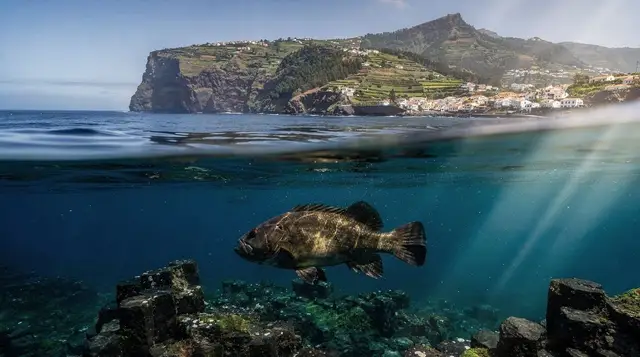
The Garajau Nature Reserve has held protected status since 1986, making it one of the older marine reserves in Portuguese waters. That status is not a marketing line — it is a legal designation that restricts fishing and anchoring within its boundaries, and it is the reason the marine life here behaves differently from an ordinary patch of coast.
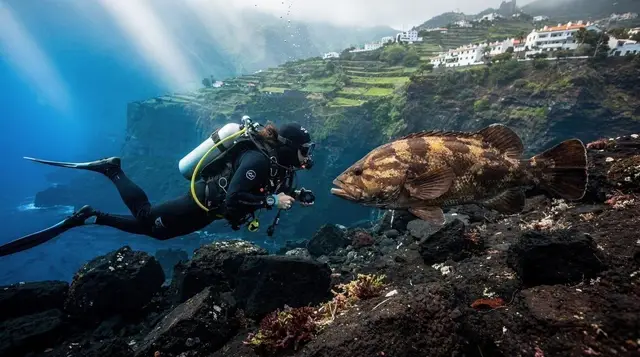
Large brown groupers in particular have grown accustomed to divers over decades of protection and will often approach rather than flee, which is the single most talked-about experience the reserve offers. For the full picture of what lives inside the boundary and how the protection actually works, the dedicated Garajau reserve guide covers it in detail rather than repeating it here.
Access into the reserve is by boat or via a small platform reached by lift down the cliff face, and diving inside the boundary is coordinated through licensed operators rather than open to anyone with a tank. A short guided swim through the shallower part of the reserve is one of the more accessible ways to see it without a scuba qualification.
a guided swim through the Garajau reserve covers the shallow, protected water without requiring a dive certification, and it is the easiest way to see the reserve’s fish life at close range in under two hours.
Snorkelling with a meal afterwards is also sold as a package, aimed at visitors who want the water time without a full dive day built around it.
a private snorkelling outing at Garajau followed by lunch suits people travelling with a mix of divers and non-divers, since everyone gets time in the water and a meal together afterwards.
Canico de Baixo: the working dive coast
A short distance along the same stretch of coastline sits Canico de Baixo, a small settlement built almost entirely around diving. Unlike Garajau, this stretch carries no reserve designation — it is open coast, fished and used like any other part of the shoreline, and the marine life is correspondingly more ordinary. What it does have is infrastructure: several dive centres with direct steps into the water, decades of local knowledge of the nearby sites, and enough day-to-day traffic that courses, equipment hire and repeat dives are all straightforward to arrange without pre-booking weeks ahead.
Sites off Canico de Baixo tend toward volcanic rock formations rather than a single headline attraction — swim-throughs, small caves, and drop-offs that suit a range of experience levels depending which exact spot a centre chooses on the day. It is the more practical base for anyone wanting several dives across a stay, a course, or a first try-dive without travelling further along the coast toward Canico itself.
a first-time open-water scuba experience for complete beginners is run one-to-one with an instructor in shallow, sheltered water off this coast, with no prior certification needed.
Garajau or Canico de Baixo: how to choose
| Garajau | Canico de Baixo | |
|---|---|---|
| Status | Marine reserve since 1986, access regulated | Open coast, no reserve status |
| Best for | Large fish life, groupers used to divers | Course work, repeat diving, easy logistics |
| Access | Boat or cliff-top lift into the reserve | Direct steps and shore entry |
| Typical activity | Guided swims, snorkelling, single dives | Try-dives, certification courses, multi-dive days |
| What to expect | Volcanic terrain plus notably tame fish | Volcanic terrain, caves, swim-throughs |
Neither site should be booked expecting the other’s experience. A visitor who wants the close-up fish encounters that Garajau is known for will not find the same density of large, approachable marine life at Canico de Baixo. Someone wanting a straightforward multi-day certification course, on the other hand, is generally better served by the dive centres clustered at Canico de Baixo than by trying to build a course entirely inside reserve access windows at Garajau.
Water temperature by season
| Season | Approximate sea temperature | Suit typically worn |
|---|---|---|
| January to March | 18-19°C | 5mm wetsuit, hood recommended |
| April to June | 19-21°C | 5mm wetsuit |
| July to September | 22-24°C | 5mm wetsuit, some divers use 3mm |
| October to December | 20-22°C | 5mm wetsuit |
The Atlantic here never gets warm in the way the Mediterranean does in August, and it never turns properly cold either — that steady middle ground is part of what makes year-round diving viable off this coast. Visibility is generally good outside periods of heavy rainfall, when run-off from the island’s steep terrain can cloud the water close to shore for a day or two.
What level of diver do you need to be
Nothing about diving in Madeira requires prior experience. Both areas run introductory try-dives for complete beginners, conducted one-to-one with an instructor in shallow water close to shore, with no certification and often no swimming test beyond basic water confidence. Certified divers at any level, from newly qualified open-water through to advanced and beyond, will find sites suited to them at both Garajau and Canico de Baixo — depth and current vary by exact location, and a briefing before each dive will match the site to the group’s qualifications.
Divers wanting to combine two dives in a single outing, rather than book separately, can do so through a full-day package that typically includes surface interval time and lunch between dives.
a full day out with two guided dives included works out better value per dive than booking two single sessions, and gives a longer window on the water for anyone staying only a few days.
For a different kind of marine encounter away from the reef-and-rock diving described above, operators near Canical also run supervised sessions with rays in shallow water.
a supervised stingray encounter near Canical is a distinct experience from either main dive area, aimed at visitors who specifically want time with rays rather than a general reef-style dive.
Clubs and how a typical dive day runs
Dive centres at both areas follow a broadly similar day. A morning or afternoon slot begins with kit fitting and a briefing covering the site, expected depth, and any current, followed by a short boat ride or a walk down to shore access. A single dive typically runs 40 to 60 minutes depending on air consumption and depth; a two-dive day includes a surface interval of an hour or more, often with food provided. Equipment hire — wetsuit, BCD, regulator, tank and weights — is included in almost every package sold to visitors, so packing a dive bag from home is rarely necessary beyond a mask if a diver has a preferred fit.
Most centres operate in English as a matter of course, given the visitor numbers, and group sizes for guided dives are kept small — typically no more than four divers per instructor for anyone below advanced certification. Courses running over several days are best booked directly with a Canico de Baixo centre in advance during the busier summer months, when slots fill up faster than the reserve-access dives at Garajau.
Getting there and practical notes
Both areas sit on the south coast within easy reach of Funchal by car or taxi, and most dive packages include transfer from central hotels as standard — worth confirming at booking rather than assuming. Parking near Canico de Baixo’s dive centres is limited in peak season, which is another reason an included transfer is usually the simpler option. For visitors staying elsewhere on the island and building a wider look at the coast, the east Madeira day-trip guide and the island’s best time to visit guide help place a dive day within a longer itinerary such as an adventure-focused week.
Anyone travelling with a mixed group of divers and non-divers should note that both areas offer snorkelling as a lighter alternative, and the wider beaches and natural pools guide and natural lava pools guide cover swimming options along the same coast for days when diving is not on the plan.
Divers interested in the island’s other water-based activities can also look at canyoning, surfing, kayaking and coasteering and whale and dolphin watching, all run from the same stretch of coast around Funchal. A wider overview of everything grouped under diving and snorkelling on the island sits on the diving and snorkelling category page, and the Garajau activity listing rounds up operators working that specific area.
Diving in Madeira: your questions answered
Is diving in Madeira good for beginners?
Yes. Several sites at both Garajau and Canico de Baixo sit in shallow, sheltered water and are used specifically for introductory dives and open-water certification, with no prior experience required for a first taster dive.
What is the water temperature for diving in Madeira?
It ranges from around 18 degrees Celsius in late winter to around 24 degrees in late summer. A 5mm wetsuit is the standard choice most of the year, with a thicker suit or hood useful from January to March.
Do I need a certification to dive in Madeira?
No certification is needed for an introductory dive, which is run one-to-one with an instructor in shallow water. Certified divers should bring their card and logbook; local operators can also run PADI or SSI courses on site.
What is the difference between Garajau and Canico de Baixo?
Garajau is a legally protected marine reserve established in 1986 with restricted access and a resident population of large, unafraid fish. Canico de Baixo is an open coastal stretch with no reserve status, popular for its easy shore access and dive centre infrastructure.
Can you see anything interesting diving in Madeira?
Volcanic rock formations, caves and swim-throughs are the main draw rather than coral. Garajau in particular is known for large brown groupers that have grown used to divers; see the dedicated Garajau reserve guide for the full picture of what lives there.
How much does a dive in Madeira cost?
A single guided dive with equipment typically runs in the region of 60 to 90 euros, with introductory try-dives and multi-dive packages priced separately. Full-day packages that combine two dives usually work out cheaper per dive than booking singly.
Is Madeira a good place to learn to dive?
It works well for a first experience: warm-enough water, calm bays at both main sites, and operators used to complete beginners. It is not a coral destination, so divers coming specifically for reef life may prefer Egypt or the Maldives instead.
tours.diving-snorkelling
Verified deep-linked GetYourGuide tours. Book through these links and we earn a small commission at no cost to you.
GetYourGuide does not provide a product photo for this activity — the image shows the meeting point, photographed by us.