Why divers head for this stretch of coast
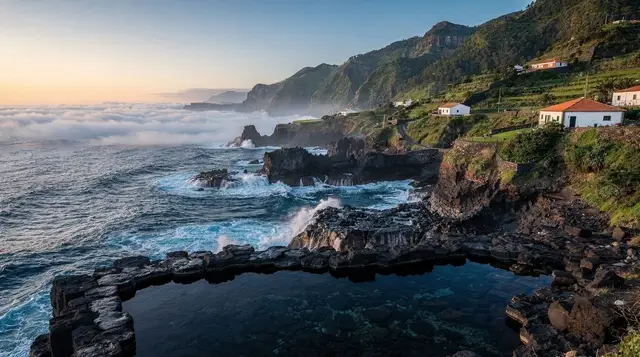
Caniço de Baixo doesn’t look like much from the coast road — a cluster of low-rise apartment blocks and a couple of hotels stepping down towards the Atlantic, a few hundred metres from the village of Caniço itself. What it has instead of a beach or a promenade is a rocky shoreline with easy sea access and, just around the headland, one half of Madeira’s two reference dive areas. The other half is the Garajau marine reserve, and the two run into each other geographically even though they’re administratively distinct: Caniço de Baixo is where the dive centres, the shore entries and the boats are based, and the reserve is where a large share of the actual diving happens.
That combination — a resort with genuine dive infrastructure sitting on the doorstep of a protected reserve — is why Caniço de Baixo, rather than Funchal, is where most serious diving in Madeira gets organised. It’s a working dive town in miniature: air fills, boat slots, course schedules and dive logs, not sunbeds and cocktail menus. If that’s not what you’re after, it’s a fine base for a night or two on the way to somewhere livelier; if diving is the point of your trip, it’s arguably the single best address on the island for it.
Getting to and around Caniço de Baixo
The drive from Funchal takes 20–25 minutes along the VR1 motorway, which tunnels through most of the coastline between the two and makes the trip far quicker than the map distance of 12 km suggests. A hire car is the easiest way to arrive with dive kit and towels in tow — see our car rental guide for the practicalities of hiring on the island — but a taxi from Funchal is a reasonable one-off option too, and several dive centres offer their own pickup from hotels in Funchal or Canico itself for an extra fee.
Once you’re there, Caniço de Baixo is walkable end to end in about fifteen minutes. The resort sits below the main village on a series of terraces linked by lifts and stairways, with the shore-access points, dive centre bases and a handful of restaurants strung along the lower level closest to the water. There’s no real need for a car once you’ve arrived for the day — most people park once and walk to their dive centre.
Diving conditions: temperature, visibility and season
Madeira’s water is warmer and clearer than most people expect from an island this far into the Atlantic, largely thanks to a branch of the Gulf Stream that keeps temperatures moderate year-round. At Caniço de Baixo that translates to sea temperatures of roughly 18°C in February and March, climbing steadily to around 24°C by September, with visibility that regularly runs to 15–20 metres on a calm day and can exceed that in summer.
| Season | Water temperature | Typical visibility | Wetsuit |
|---|---|---|---|
| December–March | 18–19°C | 10–15 m | 5–7mm |
| April–May | 19–21°C | 12–18 m | 5mm |
| June–September | 21–24°C | 15–20 m+ | 3–5mm |
| October–November | 20–22°C | 12–18 m | 5mm |
Diving runs all year, and the reserve’s rocky topography means there’s shelter from most wind directions, but June to October is genuinely the calmest, clearest window and the one most centres would recommend for a first-time or nervous diver. Winter dives are entirely viable — the water is only a couple of degrees cooler — but swell from Atlantic storms can cancel boat trips for a day or two at a stretch, so it’s worth building a spare day into a winter itinerary if diving is the priority.
Dive centres and what a first dive involves
Several PADI-affiliated dive centres operate out of Caniço de Baixo, mostly attached to the hotels along the seafront, and between them they cover the full range from a half-hour try-dive to multi-day certification courses. A typical schedule looks like this:
| Experience level | What’s on offer | Rough duration |
|---|---|---|
| No certification | Supervised try-dive (“baptism”), shallow reef, one-to-one instructor | 2–3 hours door to door |
| Certified diver | Guided shore or boat dive on a chosen site | 2–4 hours |
| Want to get certified | PADI Open Water course | 3–4 days |
| Already qualified, want more | Advanced or specialty courses (wreck, night, deep) | 2–3 days |
A first dive for someone with no certification generally starts with a briefing on land, a shallow confined session to get comfortable with the regulator and mask, and then a short guided dive along the rocky shoreline directly in front of Caniço de Baixo — nothing beyond about 12 metres, and always one-on-one or in a very small group with an instructor. It’s a genuinely low-stress introduction: no boat, no long swim, and an easy exit back up the shore ladders. For general background on what diving in Madeira involves before you commit to booking, our diving in Madeira guide covers certification levels, seasonal differences and how the island compares with other Atlantic dive destinations.
What’s in the water: Garajau reserve life
The reason Caniço de Baixo punches above its weight for diving is what lies just offshore. The Garajau marine reserve has been fully protected since 1986, and decades without spearfishing or netting have left it with a density and boldness of marine life that’s unusual for the eastern Atlantic. The signature encounter is with the reserve’s brown groupers (mero), fish that have grown so used to divers over the years that they’ll approach rather than flee — for many visitors it’s the single most memorable moment of a Madeira dive trip.
Beyond the groupers, expect large shoals of bream and barracuda moving through open water, moray eels tucked into cracks in the volcanic rock, octopus, stingrays over sandy patches, and — on the right day — devil rays passing through in open water. The terrain itself is part of the appeal: Madeira’s volcanic origin means the seabed here is made of swim-throughs, arches, boulder fields and drop-offs rather than featureless sand, so even a shallow dive has real topography to explore. Sites are graded from gentle shore dives suitable for beginners to deeper boat dives with walls and swim-throughs for more experienced divers.
Snorkelling without a tank
Not everyone wants to strap on a tank, and Caniço de Baixo works reasonably well for snorkelling too, particularly around the sheltered inlets closest to the resort where the water is calm and entry is easy from the rocks or ladders. It’s not the dramatic natural-pool scenery you’ll find at Porto Moniz or Seixal on the north coast, but the payoff underwater is arguably better: even snorkelling on the surface here you’ll see far more fish life than at most Madeiran beaches, simply by virtue of being adjacent to the reserve.
Several dive centres rent snorkel gear by the hour or half-day for anyone who wants to try the water without committing to a dive, and guided snorkelling trips are sometimes available alongside the dive schedule — worth asking about directly at the centre rather than assuming, since availability varies by season. If you’d rather stay above the surface entirely, kayaking, paddleboarding and coasteering are the other water-based options along this stretch of coast.
Not a whale-watching base: setting expectations
It’s worth being direct about a mix-up that catches a fair number of visitors out: diving at Caniço de Baixo and whale or dolphin watching in Madeira are two entirely separate activities, run by different operators, from different departure points, for different reasons — and they don’t overlap. Diving here is a shore-based or short-boat-trip activity focused on the reef, the reserve’s resident fish and the seabed itself, typically lasting two to four hours including briefing and kit. Whale and dolphin watching is a longer open-water boat trip searching for cetaceans that move freely through deep water well offshore, and it departs from Funchal marina, not from Caniço de Baixo.
If seeing whales and dolphins is what you’re actually after, the boats for that leave from Funchal, Calheta or Canical — see our whale and dolphin watching guide and our notes on choosing a responsible operator for how to book that properly.
Canical is also home to the island’s Whaling Museum, which tells the story of Madeira’s whaling past and its shift to a modern sanctuary — a good complement to a whale-watching trip, but unrelated to what happens underwater at Caniço de Baixo. Booking a dive expecting to see a whale, or booking a whale-watching trip expecting reef life at close range, will leave you disappointed either way — they’re genuinely different mornings.
Where to eat and where to base yourself
Caniço de Baixo itself has a handful of straightforward restaurants and cafés strung along the seafront terraces, mostly geared towards the hotel guests and divers who make up the bulk of its visitors — fresh fish, simple grills, and the usual espetada skewers rather than anything especially destination-worthy. It’s a fine place to eat after a morning dive, but it isn’t a food destination in its own right, and most visitors looking for Madeira’s better restaurants head into Funchal or up to Canico village for more choice.
As a base, Caniço de Baixo suits divers well precisely because everything is within walking distance — hotel, dive centre, restaurant, shore entry — with no need for a car once you’ve arrived. Anyone who isn’t diving will likely find it quiet, with no real beach and limited evening activity, and might prefer to base themselves in Funchal and drive out for a day of diving instead. Either approach works; it depends whether the diving itself, or having a wider base to explore from, matters more to your trip.
Beyond the water: filling a day trip from Caniço de Baixo
A dive typically takes up a morning or an afternoon, which leaves plenty of daylight for the rest of the east coast. This part of the island rewards a car and a loose plan rather than a fixed itinerary — our east Madeira day trip guide lays out a sensible route taking in Machico, the island’s first Portuguese settlement, and onward towards Ponta de São Lourenço at the island’s easternmost tip.
For a change of scenery entirely, some visitors staying in Caniço de Baixo use it as a base for one of the island’s 4x4 tours rather than driving themselves. The 4x4 adventure tour that picks up from Caniço and crosses to the north coast is a straightforward way to see the mountains and the north in a single day without worrying about Madeira’s steeper roads yourself, and the Caniço-based 4x4 day trip out to Fanal forest, Porto Moniz and the western villages covers similar ground with a different route.
Divers who fancy getting out on the water in a different way sometimes add the guided fishing trip departing from nearby Caniçal, which is a genuinely different activity from either diving or whale watching — traditional line fishing off the east coast rather than wildlife spotting or reef exploration.
Practical notes before you book
Most dive centres ask for a booking at least a day ahead in peak season (July and August), and try-dives in particular fill up on days with good weather, so it’s worth reserving rather than turning up on spec. Bring a swimsuit, a towel and, if you have them, your own mask and fins for comfort — everything else is rented on site. Certified divers should bring their certification card (or a digital copy) and logbook; centres will not take an uncertified diver below the depths covered by a try-dive regardless of claimed experience, which is standard practice and worth expecting rather than being surprised by.
If you’re planning to dive more than once, ask about multi-dive packages, which most centres offer at a meaningful discount over booking single dives separately — useful if Caniço de Baixo is your main base for a few days rather than a single stop on an itinerary built around the things to do elsewhere on the island. For a wider view of boat-based activity in the area, from fishing trips to sightseeing cruises, the boat trips from Funchal guide covers the options that leave from the capital rather than from Caniço de Baixo itself.
Caniço de Baixo diving FAQ
Is Caniço de Baixo a good place to dive in Madeira?
Yes — Caniço de Baixo is one of the island’s two reference dive bases, sitting right beside the protected Garajau marine reserve. Water runs 18–24°C depending on season, visibility is consistently good, and several PADI centres run everything from try-dives to full certification courses.
How far is Caniço de Baixo from Funchal?
About 12 km, roughly 20–25 minutes by car along the VR1 motorway, or a similar time by taxi. There’s no dedicated bus route that makes sense for a dive trip with kit, so most divers arrive by car, taxi, or a centre’s own pickup.
Do I need to be certified to dive at Caniço de Baixo?
No. Every dive centre here runs a supervised try-dive (a “baptism” dive) for complete beginners with no certification required, alongside guided dives for certified divers and full PADI courses for anyone who wants to get qualified during their stay.
What’s the water temperature at Caniço de Baixo?
It ranges from around 18°C in late winter to about 24°C at the end of summer. A 5mm wetsuit is standard practice year-round, since even 24°C feels cool after twenty or thirty minutes underwater.
Is Caniço de Baixo the same as the Garajau reserve?
They’re neighbours, not the same place. Caniço de Baixo is the coastal resort area with the dive centres and shore access; the Garajau marine reserve is the protected stretch of coast just west of it, and it’s the reserve’s dive sites that most Caniço de Baixo boats and shore dives actually visit.
Can I go whale watching from Caniço de Baixo?
Not directly. Whale and dolphin watching boats operate from Funchal marina, Calheta and Canical, not from Caniço de Baixo, and they’re a completely different activity from the reef and wall dives on offer here. If cetaceans are the goal, base yourself at Funchal or Canical instead.
Do I need my own diving gear?
No. Every centre in Caniço de Baixo rents full kit — BCD, regulator, wetsuit, mask, fins, weights and tank — so a swimsuit and towel are genuinely enough to turn up with, though regular divers often bring their own mask and fins for fit.
Is there anything to do at Caniço de Baixo without diving?
Yes. There’s a small stretch of rocky shore with sea-access ladders and a couple of casual restaurants above the water, but the resort has no beach and modest nightlife — most non-diving visitors treat it as a quiet base rather than a destination for its own sake.