A Village the Coast Road Nearly Left Behind
Jardim do Mar sits on a narrow shelf of land pressed between the Atlantic and a wall of cliff, on the western edge of Madeira. For most of its history it was reachable only on foot or by boat, and that isolation shows in everything about the place: the tight grid of cobbled lanes, the terraces of bananas climbing the slope behind the houses, and a stillness that the main coast road further east never quite has. It is not a destination with a single headline sight. It is a place you walk through slowly, and that is the point of it.
The village belongs to the parish of Prazeres, in the municipality of Ponta do Sol, on Madeira’s south-west coast. It sits below Prazeres and close to Paul do Mar, the larger fishing village a short drive along the shore. Together the two form one of the least developed corners of the coast that visitors actually reach — unlike the villages further north, which the levada network and the official trail system route hikers through by the thousand, Jardim do Mar has stayed a place people arrive at on purpose rather than pass through.
The Road Down
The approach is the first thing anyone who drives here remembers. From the plateau above, the road to Jardim do Mar drops through a long sequence of hairpin bends cut into the cliff face, losing several hundred metres of height in a short horizontal distance. It is fully paved and driven daily by residents, delivery vans, and the odd bus, so it is not a road that demands specialist skill — but it is narrow in places, has no barrier over long stretches, and rewards a slow first pass rather than a confident one. A small hire car copes with it far better than a large one, and first-time visitors are usually glad they went down in daylight rather than after dark.
This is the same character of road that defines driving on the whole of this coast, and it is worth reading the general guide to driving in Madeira before setting out, along with some notes on what usually catches newcomers out on the most common mistakes visitors make.
Anyone renting a car specifically to explore this stretch should also see the car rental guide for what size and transmission actually suit these roads. For visitors who would rather not drive the switchbacks themselves, a jeep tour is the practical alternative — the sunset jeep tour to Paul do Mar takes in this same stretch of coast with a driver who knows every bend, timed to arrive as the light turns gold over the water.
Parking in the village itself is limited to a small area near the entrance; cars are left there and the rest of Jardim do Mar is explored on foot, which suits the place far better than driving through it ever would.
Walking the Village
Jardim do Mar’s lanes are cobbled, narrow, and largely closed to cars, which is unusual on a coast where most settlements grew up around a road. Houses press close together, painted in white and pale colours that have faded under decades of salt air, with small chapels and washing lines threaded between them. There is no single must-see building here; the village rewards wandering without a fixed route, following whichever lane looks most interesting and doubling back when it dead-ends at someone’s front step.
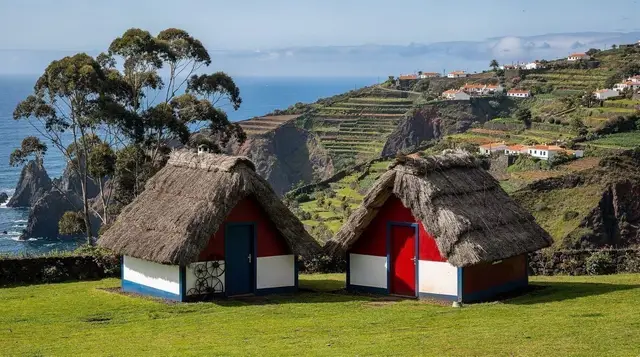
Above the houses, terraces climb the slope in narrow steps, planted mostly with bananas — the crop that has sustained this coast for generations, in the same way vines and sugar cane shaped other parts of the island. The terracing is a reminder of how little flat ground exists here: every metre of cultivable land has been carved and walled by hand, a pattern repeated all along Madeira’s south-west coast from Estreito da Calheta to Ponta do Pargo.
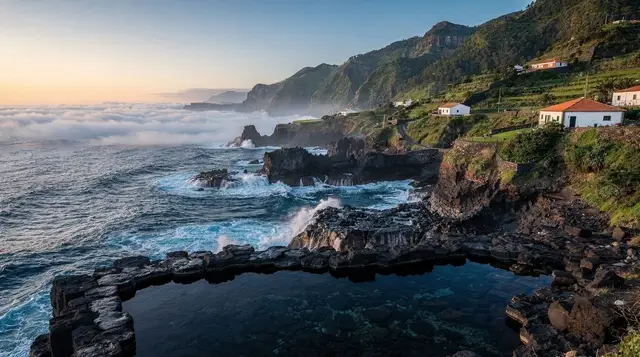
A short walk from the centre brings you to a viewpoint over the shore, where the village’s relationship with the sea is easiest to understand: houses stop abruptly where the rock begins, and the water below is open Atlantic with no harbour wall to soften it. For a wider sense of how this compares with the island’s other panoramas, the guide to Madeira’s best viewpoints and miradouros puts Jardim do Mar’s outlook in context alongside the better-known ones further east.
No Beach, and No Pretending Otherwise
It is worth being direct about one thing: Jardim do Mar has no sand beach. The shore below the village is rock and shingle, shaped and reshaped by Atlantic swell, and swimming here is a matter for confident, experienced swimmers on a calm day rather than a family afternoon plan. Madeira’s main island has no natural continuous sand shoreline at all — the closest thing to it, at Calheta a short drive east, is imported sand laid over the same volcanic rock that forms every other beach on this coast. The only place in the archipelago with genuine, continuous natural sand is Porto Santo, 43 kilometres out in the Atlantic.
Visitors who want a swim as part of a day that includes Jardim do Mar generally build it in at Calheta on the way back, rather than expecting anything of the kind at the village itself. That distinction matters enough that it is worth repeating: come to Jardim do Mar for the walk, the road, and the quiet — not for the water.
Why It Stayed Quiet
Until relatively recently, Jardim do Mar was effectively cut off from the rest of Madeira by land. Boats connected it to Paul do Mar and Calheta, and the cliff paths above were the only overland route out. The road that now switchbacks down from Prazeres changed that, but only within living memory, and the village has never seen the volume of coach traffic that reaches Câmara de Lobos or Porto Moniz. That has kept its character intact in a way that is increasingly rare on this coast: no chain cafés, no purpose-built car park for tour buses, just a fishing village that happens to still look like one.
The trade-off is practical rather than romantic. Facilities are limited to a handful of small guesthouses, a few cafés, and little else. Anyone wanting a full day of organised activity is better served by treating Jardim do Mar as one stop on a wider loop of the west coast — a pattern covered in the west Madeira day trip guide, which pairs it with Paul do Mar, Prazeres, and the villages further along the shore.
Paul do Mar, Next Door
Ten minutes’ drive away, Paul do Mar is Jardim do Mar’s larger neighbour and the working harbour for this stretch of coast. It has a small surf scene, drawn by a reliable left-hand point break, and a slightly more built-up centre with more places to eat. The two villages are often visited together, and the road between them continues the same character of cliff-hugging bends. Anyone spending a full day on this coast typically splits time between the two: the walk and the quiet at Jardim do Mar, lunch and the harbour atmosphere at Paul do Mar.
Above both villages, Prazeres sits on the plateau and gives access to one of the west coast’s better-known levada routes. A private guided walk along it — the Levada Prazeres private guided tour — is a practical way to pair a morning on the water level with an afternoon down in Jardim do Mar, without needing to plan the connecting road yourself.
Getting a Wider View of the Coast
For visitors who want to see Jardim do Mar as part of a longer exploration of the west rather than a single stop, a 4x4 tour covering the full stretch from Câmara de Lobos out past Paul do Mar is a common way to do it without driving the hairpins personally. The Wild West 4x4 safari tour follows roughly this route, taking in the cliffside villages and the viewpoints between them in a single day, with a driver who handles the switchbacks.
It is worth comparing against a self-drive day using the driving guide — the decision usually comes down to how much you want to stop and linger versus cover ground, a trade-off examined more generally in the north versus south comparison of driving styles across the island.
When to Come
Jardim do Mar has no real high season of its own — it simply gets busier when the rest of the west coast does, mainly around Easter and in July and August. Spring and autumn bring the most comfortable conditions for the walk down and back up from the car park: mild temperatures, clearer light for photographs, and lanes that stay empty enough to hear your own footsteps on the cobbles. Winter is quieter still, though the road down can turn slick after heavy rain, and the shore is at its roughest when Atlantic swells run high — a striking sight from the viewpoint, but not a place to get close to the water.
Photographers tend to come for the late afternoon, when low sun catches the terraces and the whitewashed walls of the village at an angle that flattens out by midday. A short visit here fits naturally into a longer photography-focused route around the island, along the lines of the Madeira photography itinerary, which strings together several of the west coast’s more atmospheric stops.
Practical Notes
There is no petrol station in the village, so arrive with a full tank if you are driving from Funchal or further east — the nearest fuel is up on the plateau. Cash is more reliable than card in the smallest cafés. Mobile signal is patchy in places on the descent, though it returns once you are in the village itself. Because the settlement is built for walking rather than driving, comfortable shoes matter more here than in most of Madeira’s coastal villages; the cobbles are uneven and, after rain, can be slippery.
If a visit to Jardim do Mar is part of a wider first trip to the island, it sits well alongside the practical groundwork covered in the general driving in Madeira account of what the island’s roads are actually like to drive, written from experience rather than as a checklist. For a longer stay based on this side of the island, a jeep excursion such as the full-day Madeira Mystery Tour by private 4x4 is one way to see Jardim do Mar alongside other lesser-visited corners of the west without piecing the route together yourself.
None of this makes Jardim do Mar a destination that needs a full day of its own. It rewards a couple of unhurried hours: down the switchbacks, through the lanes, out to the viewpoint, and back up before the light changes. That modesty is exactly why it has kept the character that busier stops on this coast have gradually lost.
Jardim do Mar: Your Questions Answered
Is there a beach at Jardim do Mar?
No. The shore is rock and shingle, shaped by the Atlantic swell, not sand. Madeira’s only continuous natural sand beach is on Porto Santo; anything described as a sand beach on the main island, including at nearby Calheta, has been imported.
How do you get to Jardim do Mar?
By car, on a narrow road that drops from the Prazeres plateau in a long series of hairpins. There is no railway or ferry option, and buses are infrequent, so most visitors arrive by hire car or on an organised jeep tour.
Is the road down to Jardim do Mar difficult to drive?
It is steep, narrow in places, and made up of tight switchbacks, but it is paved and used daily by residents. A small hire car, low gears on the way down, and a lack of hurry are all it takes; it is not a road to attempt in a large vehicle after dark or in heavy rain.
How long do people spend in Jardim do Mar?
Most visitors stay two to three hours: enough to walk the lanes, find the viewpoint, and have a coffee. A handful of small guesthouses exist for anyone who wants to stay the night and see the village once the day’s visitors have gone.
Is Jardim do Mar the same as Paul do Mar?
No, though they sit close together on the same stretch of coast and are often visited together. Paul do Mar is the larger of the two, with a working harbour and a reputation among surfers; Jardim do Mar is smaller, quieter, and further from the water’s edge in daily life.
Can you swim at Jardim do Mar?
Only with caution. There is no sheltered swimming area, and the open shingle shore is exposed to Atlantic swell. Calheta’s beach, a short drive away, is the sheltered swimming option for this stretch of coast.