A village on the road, not a destination in itself
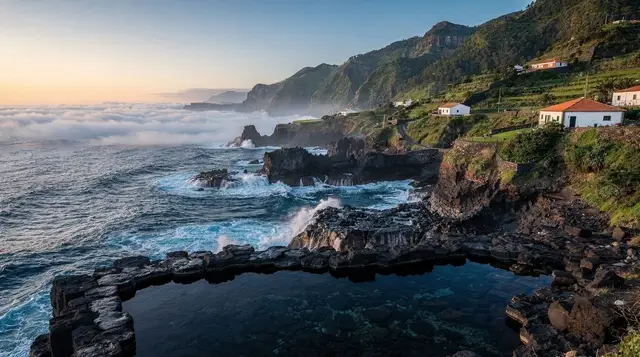
Campanário sits on Madeira’s south-west coast, strung along the old coast road between Câmara de Lobos and Ribeira Brava, at a point where the mountainside drops towards the Atlantic in a series of steep cultivated terraces. It is not a place with a headline attraction, and this page will not pretend otherwise: there is no museum here, no skywalk, no waterfall with a car park and a sign. What Campanário offers is something quieter and, for anyone driving this stretch of coast, genuinely worth five or ten minutes — a working agricultural landscape, largely unchanged in shape for generations, seen from a road that most visitors otherwise drive straight through.
If you are looking for the big set-piece of this coastline, that is Cabo Girão and its glass-floored skywalk, a separate stop closer to Câmara de Lobos. If you are looking for a beach, the nearest options are the natural pools and harbour at Câmara de Lobos to the east, or the sand at Calheta further west. Campanário is neither of those things, and treating it as a minor version of either does it a disservice. It earns its place on an itinerary as a stretch of road worth slowing down for, not a stop worth rearranging a day around.
Where it sits on the coast
Campanário lies roughly midway between Câmara de Lobos and Ribeira Brava, just west of the smaller settlement of Quinta Grande and east of Ribeira Brava itself. The old coast road, the ER101, threads through the village at a height above the sea, with the terraces dropping away below it towards the water and the higher slopes of the Câmara de Lobos municipality rising behind. The newer VE4 expressway runs a faster route slightly inland and above, which is how most rental cars now cover this stretch in minutes rather than the twenty or so it takes on the old road — meaning the old road, and Campanário with it, has grown quieter rather than busier over the years.
That quiet is the point. Where Câmara de Lobos has grown into a proper fishing-town stop with restaurants, poncha bars and a working harbour, and Ribeira Brava has its promenade, market and fort, Campanário has stayed a farming village that happens to sit on a scenic road. Nothing here has been built for visitors, which is exactly why the terraces still look like terraces and not like a viewing platform.
The terraces: poios, vines and bananas
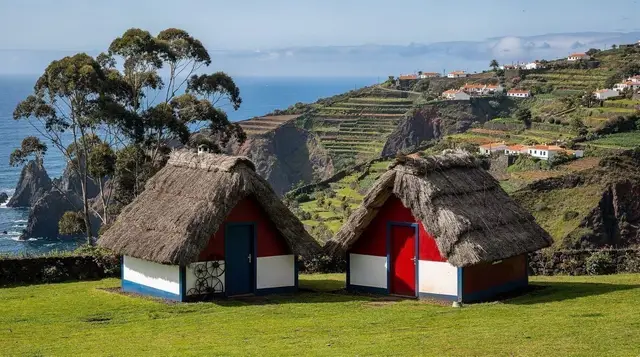
The defining feature of Campanário, and the reason it is worth a photograph even from a moving car, is the poios — the narrow stepped terraces cut into the hillside, retained by dry-stone walls, that carry cultivation down slopes too steep for anything else. This is standard practice across Madeira’s south coast, but Campanário’s stretch is one of the more visually striking because the terraces run in tight, close bands almost to the roadside, with the sea often visible below through the gaps.
Two crops dominate. Grapevines, trained low along wires or trellises, cover a large share of the terraced land; this is Madeira wine country in the working sense, not the tasting-room sense — the grapes grown here feed both ordinary table wine and, for some plots, the fortified Madeira wine trade that the island is known for internationally. If the subject interests you, our guide to Madeira wine explains how the estufagem and canteiro ageing methods work and which grape varieties produce which style, and Blandy’s Wine Lodge in central Funchal is the place to taste and learn rather than the roadside here.
Bananas are the second staple, grown in smaller, more sheltered plots — Madeira banana is a distinct, smaller variety sold across the island’s markets, and you will see the characteristic broad leaves lower down the slopes towards the coast. Between the vines and the bananas, smaller kitchen plots of vegetables fill the gaps, tended in the traditional way, largely by hand, on ground too narrow and steep for machinery.
None of this is staged for visitors. It is working land, farmed by local families much as it has been for generations, and that is worth remembering if you stop to take photographs: stay on the road or its verge, and treat the terraces as someone’s livelihood rather than a backdrop.
What Campanário is not
It is worth being direct about what you will not find here, because guidebooks and map listings sometimes imply more than a village like this can deliver. Campanário has no waterfall walk, no skywalk, no fort, no market hall and no museum. It has not hosted a specific festival or historic event that distinguishes it from its neighbours in the way, say, Machico’s status as the island’s first landing site does. If a source tells you otherwise, treat it with scepticism — the honest description of Campanário is a farming village on a scenic stretch of coast road, and that description does not need inflating.
For the region’s genuine highlights, look slightly either side of the village. Cabo Girão, with a cliff face among the tallest sea cliffs in Europe and a glass-floored viewing platform, sits closer to Câmara de Lobos — read the Cabo Girão skywalk guide before you go, since queues and photography light vary a good deal by time of day. For a proper coastal town stop with restaurants and a working fishing harbour, Câmara de Lobos is a few minutes east; for a market, promenade and small fort, Ribeira Brava is a few minutes west. Campanário sits between them as connective tissue, not as a rival stop.
A brief comparison of the three stops
| Stop | What it offers | Time worth spending |
|---|---|---|
| Câmara de Lobos | Fishing harbour, restaurants, poncha bars, natural pools nearby | 1–2 hours |
| Campanário | Terraced farmland, quiet roadside views, no set attraction | 15–30 minutes |
| Ribeira Brava | Promenade, market, small fort, wider choice of cafés | 1–2 hours |
Used this way, on a single westbound or eastbound drive, the three add up to a satisfying half-day of coast without any single stop needing to carry the whole visit.
Driving through: the practical side
Most visitors will experience Campanário from behind a wheel, since public transport along this stretch is thin and geared to residents rather than sightseers. The VE4 expressway is the fast route, running mostly on viaducts and in tunnels slightly inland and above the coast; it will get you from Funchal past Campanário to Ribeira Brava in well under half an hour, but you will see almost nothing of the village or its terraces from it. The older ER101 coast road drops down through Campanário itself, is slower and narrower, and is the one to take if the point of the drive is the view rather than the destination.
A small hire car suits this road better than a large one — the village streets narrow in places, parking is informal, and the coastal roads generally reward a manoeuvrable car over a spacious one. Our driving in Madeira guide and car rental guide cover the practicalities of hiring and handling Madeira’s roads in more detail, including the gradients and tunnel sections that catch out drivers unfamiliar with the island.
If you would rather not drive this stretch yourself, several west-coast jeep tours pass through or near Campanário as part of a wider circuit. A late-afternoon jeep tour towards Paul do Mar that follows the west coast road past these terraced villages is one way to see the landscape without worrying about parking or oncoming traffic on the narrower sections.
Nearby villages worth knowing
A short distance further along the coast in either direction are smaller settlements that share Campanário’s character — working, terraced, largely undeveloped for tourism. Quinta Grande lies just to the east, effectively continuous with Câmara de Lobos’ outer edge. Estreito de Câmara de Lobos, a little further inland and uphill, is the heart of the vineyard country that feeds much of the wine grown on these slopes, and is a better stop than Campanário itself if wine growing specifically is what interests you.
Further west past Ribeira Brava, Ponta do Sol and eventually Paul do Mar and Jardim do Mar continue the same theme of small, steep, agricultural coastal villages, each with its own minor character but none built around a single headline sight.
Combining Campanário into a day
The honest way to use this page is as one paragraph of a longer west-coast day, not as a reason to leave Funchal on its own. A workable structure: start in Câmara de Lobos for coffee and the harbour, detour up to Cabo Girão for the skywalk, take the old coast road rather than the expressway through Campanário and Quinta Grande to enjoy the terraces at a slower pace, then finish in Ribeira Brava for lunch and the market before either returning to Funchal or continuing further west.
Our west Madeira day trip guide sets out a fuller version of this route with timings, and the three-day Madeira itinerary shows where a west-coast day like this fits against the island’s other highlights.
For travellers who want to add a walk to the same day rather than just driving through, the levada path above Serra de Água is a short way further along the VE4 corridor and considerably gentler than the island’s mountain routes. A guided levada walk near Serra de Água that follows the water channel through the valley above the coast pairs naturally with a west-coast driving day, since it starts and ends close to the same road.
Travellers wanting to see the coastline from the water rather than the road might instead book a boat trip along the southern coast that passes below Cabo Girão and the terraced slopes near Câmara de Lobos, which gives a genuinely different view of the same cliffs and farmland described above.
Wine and food in the area
Because so much of what grows on Campanário’s terraces feeds into Madeira’s wine trade, it is worth knowing where to actually taste the result rather than expecting a cellar door in the village itself — there isn’t one. Estreito de Câmara de Lobos hosts much of the organised vineyard country and the island’s late-summer wine festival, and Blandy’s Wine Lodge in Funchal is the standard place for a proper tasting and a look at how the fortified wine is aged.
Our Madeira wine explained guide is worth reading before either visit, and the Madeira food guide covers the espetada, bolo do caco and other dishes you are more likely to eat well in Câmara de Lobos or Ribeira Brava than in Campanário itself, which has only a handful of small local cafés.
A note on timing and light
If photographing the terraces is part of your reason for stopping, morning and late afternoon light works better than the flat glare of midday, picking out the stone retaining walls and the different greens of vine leaf against banana leaf. The dry season from roughly April to October also tends to give clearer air and better long-distance visibility along the coast than the wetter winter months, when low cloud can sit over this stretch for days at a time. None of this requires planning around — Campanário is, deliberately, a stop you can make on a whim as you pass, not one that needs booking or timing precisely.
Getting the most from a brief stop
Treat Campanário as what it is: a short, worthwhile pause on a longer coastal drive, framed by two more substantial towns and one genuine landmark. Pull off safely where the road allows, take in the terraces, and continue. Travellers who try to make Campanário the centrepiece of a day tend to come away underwhelmed, not because the village has changed but because the expectation was wrong from the start. Set against Câmara de Lobos, Cabo Girão and Ribeira Brava, in the order the coast road gives you, it works exactly as intended.