A working village the coaches drive past
Most visitors to Madeira’s west coast are on their way somewhere else when they pass Madalena do Mar, and that is more or less the point of the place. It sits on a narrow shelf of land between the Atlantic and a wall of terraced hillside, strung along the old coast road between Ribeira Brava and Calheta, and it has never been built up as a resort. There is no marina full of catamarans, no seafront of souvenir shops, no beach club. What there is instead is a working fishing harbour, a church, a scatter of houses climbing the slope, and some of the most striking banana terracing you will see anywhere on the island, rising almost vertically behind the rooftops.
That absence of polish is the whole appeal. If you have already spent a day in Funchal or walked the boardwalks of Porto Moniz, Madalena do Mar is a useful corrective: a reminder that most of Madeira is still an agricultural island first and a tourist destination second. Treat it as a stop of an hour or two on a longer drive along the coast, not as a destination with enough to fill a day on its own — there simply isn’t enough infrastructure here for that, and that is by design rather than neglect.
Getting there and getting your bearings
Madalena do Mar sits on the VE1 expressway corridor that runs along Madeira’s south coast, roughly midway between Ribeira Brava and Calheta. From Funchal it is a straightforward 35 to 40 minute drive west, mostly on fast dual carriageway before the road narrows down towards the village itself. There is no meaningful public transport case for coming here specifically — buses on the Rodoeste network pass along the coast but run infrequently, and this is a place best reached with your own hire car. If you are travelling without a car, it is realistic only as a brief stop on an organised west-coast excursion rather than somewhere to visit independently.
The village itself has one main street running parallel to the shore, a small square by the church, and a harbour at the western end where a handful of working boats are still hauled up on the slipway. Parking is informal and free along the main road; there is no ticketed car park and no need for one, since visitor numbers are low enough that space is rarely an issue outside the busiest summer weekends.
| From | Distance | Driving time |
|---|---|---|
| Funchal | ~28 km | 35–40 minutes |
| Ribeira Brava | ~7 km | 10–12 minutes |
| Calheta | ~6 km | 10 minutes |
| Ponta do Sol | ~3 km | 5–8 minutes |
The banana terraces that frame the road
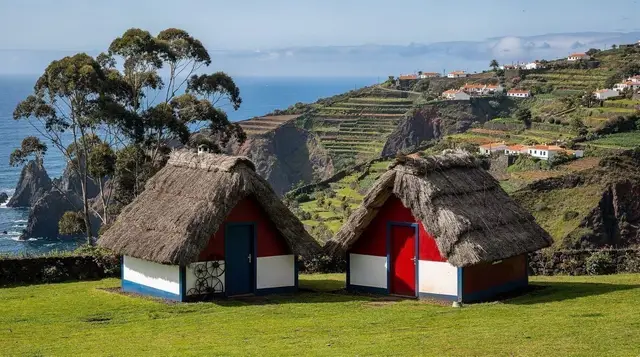
The single most photographed feature of Madalena do Mar is not the village itself but the hillside above it. Steep, south-facing slopes here have been cut into narrow terraces for centuries, and today they carry some of the densest banana cultivation on the island — a patchwork of glossy green plantations climbing in tight steps almost to the base of the cliffs. The VE1 and the old coast road both run beneath this terracing, and the short stretch either side of the village is one of the best places on Madeira to appreciate at close range how much manual engineering goes into farming land this steep.
This is working agriculture, not a garden laid out for visitors. The stone retaining walls, the small irrigation channels feeding each level, and the corrugated windbreaks that protect the fruit from Atlantic gusts are all functional, maintained by local growers rather than any tourism authority. There are no formal viewpoints or interpretive signage — the best vantage points are simply pull-offs along the old road above the village, or the harbour itself, looking back up the slope. Bring a telephoto lens if you want to isolate the terracing against the cliffs; a wide shot from the coast road captures the scale better than the detail.
If banana cultivation and Madeira’s terraced farming interest you more broadly, the drive on towards Paul do Mar and Jardim do Mar continues through similar landscapes on an even more dramatic scale, and a guided route through this stretch of coast is a reasonable way to have the agricultural history explained rather than guessed at — a 4x4 safari through this wilder western stretch of the island takes in exactly this kind of terrain with a driver-guide who can point out what you’re looking at.
The black pebble shore
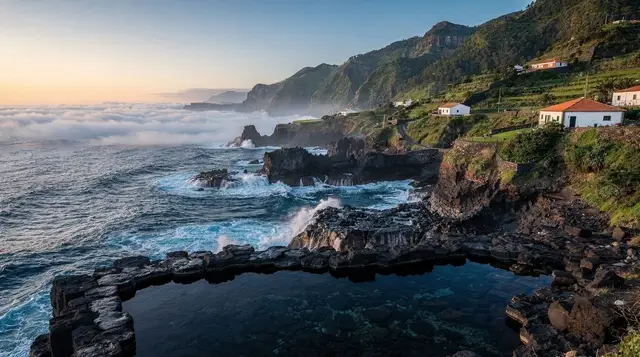
Madalena do Mar’s beach is not a sandy one, and no amount of marketing photography would make it look like one. It is a shore of dark, rounded volcanic pebbles and stones, typical of Madeira’s south coast before the island began importing sand for its handful of tourist beaches. Swimming here is possible on calm days but requires care — the stones shelve steeply in places and there is no lifeguard presence to speak of, unlike the managed lido beaches closer to Funchal. This is a beach used by locals for a quick swim or to launch a small boat, not a place set up for a day of sunbathing.
What it does offer is a genuinely uncrowded stretch of coastline with clear water and, on a still morning, good visibility for anyone who wants to snorkel close to shore. There are no facilities: no showers, no sunbed rental, no beach bar. Bring your own water and shade if you plan to stay any length of time, and expect the pebbles underfoot to make swimming shoes worthwhile. Anyone wanting a proper sand beach on this stretch of coast should be clear that they will find one at Calheta a short drive further west, and that Madalena do Mar was never meant to compete with it.
For a view of this coastline from the water rather than the shore, a short sailing trip out of nearby Calheta is an easy way to see the terraced cliffs and the fishing villages strung along them from offshore — a private charter out of Calheta can be arranged to run along this exact stretch of coast at a pace that suits you.
Life in the village
Away from the harbour and the beach, Madalena do Mar is a small, ordinary Madeiran village rather than a place designed to be walked around. The main street holds a parish church, a couple of small grocery shops, and a handful of cafés and tascas serving the kind of food aimed at fishermen and farm workers rather than visitors — grilled fish landed that morning, espetada, and simple daily menus with none of the English-language signage common closer to Funchal. Prices are correspondingly low; a full lunch here typically costs well under what the same meal would in a Funchal restaurant aimed at tourists, and menus are often Portuguese-only.
There is no museum, no craft market, and no organised activity beyond the fishing that still happens from the harbour. That can feel like an anticlimax if you arrive expecting a sight to tick off, but it is worth reframing: this is one of the few places left on the south coast where daily life has not been substantially rearranged around visitors, and an hour spent simply walking the harbour wall and the back streets gives an honest sense of what agricultural west-coast Madeira looked like before tourism, and largely still does away from the coast road.
Where Madalena do Mar fits on a west-coast day
Madalena do Mar works best as one stop among several rather than a destination in its own right. A typical half-day loop from Funchal takes in Ribeira Brava for its market and seafront, Ponta do Sol for its clifftop setting, Madalena do Mar for the terraces and the pebble shore, and Calheta for lunch and, if wanted, an actual sand beach. All four sit within about fifteen minutes of driving of one another, which makes the detour to Madalena do Mar cheap in time even if it is modest in things to actually do there.
| Nearby stop | What it adds | Distance from Madalena do Mar |
|---|---|---|
| Ribeira Brava | Market, seafront promenade, more facilities | ~7 km east |
| Ponta do Sol | Clifftop village, sunniest microclimate on the coast | ~3 km east |
| Calheta | Imported sand beach, marina, restaurants | ~6 km west |
| Paul do Mar / Jardim do Mar | Dramatic west-coast cliffs, surf village | ~15–20 km west |
| Serra de Água | Mountain valley, levada walking inland | ~15 km north-east |
Travellers who want to go inland from here rather than continuing along the coast have a genuine option: the valley road up towards Serra de Água climbs quickly from sea level into a different landscape of mountain streams and levada paths. A guided levada walk around Serra de Água is an easy way to pair a coastal morning at Madalena do Mar with an inland afternoon, without having to plan the transition yourself.
For those with more time and an interest in the levada network specifically, the Levada Nova / Prazeres area above the west coast has some of the least-walked irrigation paths on the island. A private guided walk on the Levada dos Prazeres gets well away from the crowds that gather on Madeira’s better-known routes, and can reasonably be combined with a morning drive through Madalena do Mar on the way up.
Practicalities: driving, timing and budget
The coast road through Madalena do Mar is in good condition and does not require the mountain driving nerve that some of Madeira’s interior routes demand — this is one of the easier stretches of the island to drive, which is part of why it makes sense as a first taste of driving in Madeira for anyone nervous about the switchbacks further inland. Fuel and parking cost nothing extra here beyond what a normal rental already involves; the real budget line is simply lunch, which in the village tascas runs modestly cheaper than equivalent meals in Funchal or Calheta.
There is little reason to visit outside the April-to-October window specifically for Madalena do Mar, since the appeal — the terraces, the harbour, the pebble shore — holds up in most weather short of a winter storm. That said, Madeira’s winter brings rougher seas along this exposed stretch of coast, which can make the beach unappealing and occasionally closes the slipway to boat traffic; a fine day between spring and autumn shows the village at its best. Budget half a day including the drive and a meal, and treat anything longer as time better spent in Ribeira Brava or Calheta nearby, both of which have more to occupy a full afternoon.
Visitors comparing this stretch of Madeira against other Atlantic island destinations sometimes ask how it holds up; the honest answer is in Madeira versus the Canary Islands, and the short version is that villages like Madalena do Mar are exactly the kind of unpolished, agricultural corner that Madeira still has in abundance and that its more developed Canarian equivalents largely do not.
Questions about visiting Madalena do Mar
Does Madalena do Mar have a sandy beach?
No. The shore is made up of dark volcanic pebbles and stones rather than sand, typical of Madeira’s south coast away from the handful of beaches where sand has been imported. Swimming is possible in calm conditions but there are no lifeguards or beach facilities.
Is Madalena do Mar worth visiting?
It is worth a stop of an hour or two if you are already driving the west coast, mainly for the banana terraces above the village and the quiet, unbuilt-up atmosphere of a working fishing harbour. It is not worth a dedicated trip on its own, since there is little to fill a full day.
How do I get to Madalena do Mar without a car?
It is difficult. Rodoeste buses run along the coast road but infrequently, and there is no train or organised shuttle service. In practice, a hire car or an organised west-coast excursion are the only realistic ways to reach it.
Are there restaurants in Madalena do Mar?
Yes, but modest ones: a small number of village cafés and tascas serving grilled fish and simple Madeiran daily menus, generally cheaper than equivalent restaurants in Funchal or Calheta, and often without English-language menus.
What is the best time of year to visit?
April to October gives the calmest seas and the driest coastal road. Winter visits are still possible, but rougher Atlantic swell can make the pebble beach unappealing and occasionally closes the harbour slipway.
How does Madalena do Mar differ from Ribeira Brava and Calheta?
Ribeira Brava, a few minutes east, has a proper market, seafront and more visitor facilities. Calheta, a few minutes west, has an imported sand beach, a marina and a wider choice of restaurants. Madalena do Mar has neither — its interest is the working fishing village and the banana terraces rather than any built-up seafront.
Can I combine Madalena do Mar with a levada walk?
Yes. The valley road towards Serra de Água climbs inland from close to the village, and the Levada dos Prazeres above nearby Prazeres is another realistic pairing — both make a coastal morning here into a fuller day that also takes in Madeira’s mountain interior.
Is it safe to swim at the pebble beach?
Swimming is possible on calm days but the stones shelve steeply in places and there is no lifeguard cover. Swimming shoes are worth bringing, and it is not a beach to rely on in rough Atlantic conditions.