Sunrise and Sunset in Madeira: Best Times and Places
What time is sunrise and sunset in Madeira?
It varies a lot by season. Expect sunrise around 06:45 and sunset near 20:50 at the June solstice, and sunrise around 07:50 with sunset near 18:00 at the December solstice. Always check the exact time for your date rather than relying on a single figure.
Why “what time is sunrise” has no single answer here
Madeira sits at around 32.65°N, roughly level with Casablanca and well south of Lisbon, but that does not make its day length constant. Between the June solstice and the December solstice, sunrise and sunset each shift by more than an hour, and the total daylight window stretches or shrinks by close to four hours. A sunrise time that is accurate for a July trip will be badly wrong for a January one, and the single most common mistake in guides to this island is printing one fixed clock time as if it applied all year. It does not. Every section below gives a season, not a date, and you should still check the exact time for the day you travel before setting an alarm.
There is a second wrinkle that catches visitors out: Madeira runs on the same official clock as mainland Portugal — Western European Time, one hour behind Central Europe — even though the archipelago sits about 900km southwest of Lisbon, further from the meridian that clock is built around. The practical effect is that both sunrise and sunset land noticeably later in local clock time than you would expect for the latitude. A 6:45am sunrise in June already feels like a lie-in compared with equivalent latitudes elsewhere; it is simply how the clock and the sun line up here.
The two big decisions: where for sunrise, where for sunset
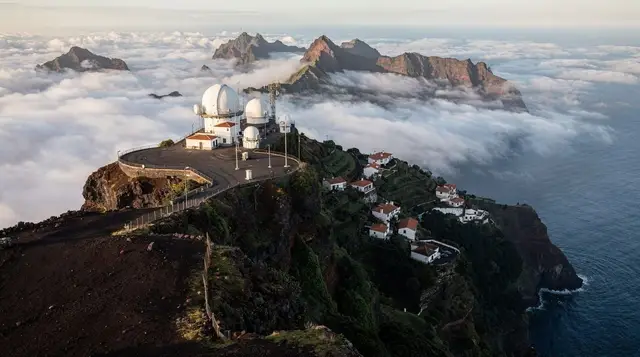
Madeira’s geography makes the choice fairly clean. For sunrise, you want altitude and a clear view east — which almost always means the central mountains, above the cloud layer that tends to sit over the coast at dawn. For sunset, you want the west coast, because the sun goes down over open Atlantic there rather than disappearing behind the island’s own spine of peaks. Trying to do both from the same spot on the same day rarely works: Pico do Arieiro, the reference sunrise point, faces the wrong way and is usually clouded in or windswept by evening, while the west-coast sunset points have no equivalent dawn drama since they look out over the sea to the west, not the sunrise side of the island.
Sunrise: Pico do Arieiro and the case for going up
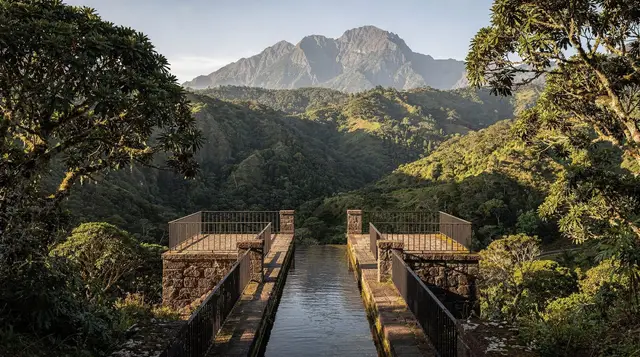
At 1,818m, Pico do Arieiro is the only one of Madeira’s three highest peaks reachable by road, which is the entire reason it became the island’s signature sunrise spot rather than the marginally higher Pico Ruivo or Pico das Torres. On a good morning — and mornings here are good more often than not — the summit sits above a sea of cloud filling the valleys below, with the sun coming up somewhere beyond the silhouette of Pico Ruivo and the PR1 ridge. It is the single most photographed moment on the island.
This guide will not repeat the full departure-time-by-departure-time logistics of getting there, because that detail already has its own page: see the dedicated Pico do Arieiro sunrise guide for exact meet times, what a guided minivan trip involves, and how to handle the walk back down if you continue onto the PR1 trail.
What matters for this page is the seasonal shift: departures from Funchal that leave around 4:00am in June, to catch a sunrise near 6:45am, need to leave closer to 6:00am in December for a sunrise nearer 7:50am. Booking a fixed “4am pickup” tour without checking the season is how people either arrive in the dark and freeze for an hour, or miss the moment entirely.
a guided sunrise hike that continues onto the PR1 ridge afterwards is the version built for people who want the dawn and the walk in one outing, while a 4x4 jeep transfer to the summit suits anyone who wants the view without the hiking. Either way, book ahead: minivans and jeeps fill for sunrise slots, especially in the July-August peak and around New Year.
Alternatives to Arieiro for sunrise
Arieiro is not the only option, just the best-known one. Achada do Teixeira, the shorter approach to Pico Ruivo, gives a similar above-the-clouds effect for less driving on mountain switchbacks and without the summit’s exposed viewing platform crowding up. Eira do Serrado, overlooking Curral das Freiras, catches early light filling the valley below rather than a horizon sunrise, which suits photographers after a different composition.
On the east coast, Ponta de São Lourenço offers a sea-level sunrise over open Atlantic — no mountain drive, no cloud-layer gamble, just an early start and the peninsula’s red volcanic rock catching the first light, though it trades the “floating above the clouds” effect for open horizon.
Sunset: the west coast, and why it beats everywhere else
Because Madeira’s mountains run roughly east to west through the centre of the island, most of the south coast — including Funchal itself — loses the sun behind high ground well before it actually sets. Watching from the capital’s marina or the Lido promenade can still be pleasant, but the sun typically drops behind the ridge above Câmara de Lobos with a good hour of colour still to come. For an unobstructed sunset into open sea, you need to be on the west coast itself.
Cabo Girão, one of Europe’s highest sea cliffs at around 580m, is the closest reliable option to Funchal — roughly 20 minutes by car — and its glass-floored skywalk (see the Cabo Girão skywalk guide) is free to visit and stays open into the evening in the warmer months. The cliff faces southwest, so the sun sets directly out over the water from the viewing platform.
Ponta do Pargo, the island’s westernmost point and site of its lighthouse, is the furthest drive but the most complete sunset: nothing but ocean between you and the horizon, and none of Cabo Girão’s crowds.
Calheta and the villages of Jardim do Mar and Paúl do Mar further along the coast give a lower, sea-level sunset with black volcanic rock in the foreground, better suited to photographers who want texture in front of the colour rather than a clifftop panorama.
Fanal, up on the Paúl da Serra plateau, is worth naming here with a caveat repeated from elsewhere on this site: its famous drama comes from mist threading through the twisted til trees, and mist is not guaranteed. A clear-evening sunset from Fanal is a decent plateau view; a misty one is the most photographed forest scene on the island. Do not plan a trip around Fanal producing fog — see the Fanal forest guide for how to judge conditions before driving up.
a guided sunset outing to Pico do Arieiro itself is the exception to the “west coast for sunset” rule — worth considering specifically because the summit empties out after the sunrise crowds leave, and a clear evening there trades the ocean horizon for a mountain-top view back across the central ridge as the light goes gold.
Sunrise and sunset times by season
These are approximate ranges for Madeira’s clock, useful for planning which departure slot to book — always confirm the precise time for your actual date closer to travel.
| Period | Sunrise (approx.) | Sunset (approx.) | Day length |
|---|---|---|---|
| June solstice (peak summer) | ~06:45 | ~20:50 | ~14h |
| March / September equinox | ~07:15–07:20 | ~19:20–19:30 | ~12h |
| December solstice (peak winter) | ~07:50 | ~18:00 | ~10h15 |
The gap matters most for sunrise trips. A tour operator’s “4am pickup” is calibrated for summer; in December, that same slot would have you standing on an unlit, near-freezing summit for close to two hours before anything happens. Confirm the pickup time quoted against the season you are actually travelling in, not a generic figure carried over from a brochure.
What conditions actually decide
Booking the right time gets you there for the right moment; it does not guarantee a clear one. Two things decide whether a Madeira sunrise or sunset is worth the alarm or the drive.
Cloud cover at altitude versus at sea level. Pico do Arieiro’s whole appeal rests on sitting above a temperature inversion layer that fills the valleys with cloud most mornings — but “most” is not “all”, and a front moving through can put the summit itself inside the cloud rather than above it, in which case there is no sunrise to see, just grey. Check a mountain-specific forecast, not Funchal’s, the evening before; see the mountain weather guide for how conditions differ between the coast and the peaks on the same day.
Wind on exposed viewpoints. Cabo Girão’s skywalk and Ponta do Pargo’s lighthouse platform are both fully exposed to Atlantic wind, which picks up noticeably in the hour either side of sunset. It rarely closes either site, but it does make a tripod worth weighting and a warm layer worth carrying even on an otherwise mild evening.
Packing and practicalities
Temperature is the detail visitors most often get wrong. Funchal at 4am in July is a comfortable 18-19°C; the summit of Pico do Arieiro at the same hour, before sunrise, can sit close to 10°C, and in winter it can brush 0°C. Bring a proper layer even if the forecast for “Madeira” looks mild — that forecast is for the coast, not the mountain. A torch or headtorch is worth having too: several viewpoints, including the approach paths around Arieiro, have no lighting, and sunrise by definition means arriving in the dark.
If you are pairing a sunrise trip with hiking rather than just the viewpoint, the hiking permits and trail fees guide explains the paid-trail system that applies to the official PR routes leading off from the summit — it is separate from, and additional to, any tour price. a small-group sunrise walk that includes the PR1 fee and permit handling removes that step for anyone who would rather not book the trail permit separately. For those wanting the summit without a group, a private guided sunrise hike at Pico do Arieiro runs on your own schedule rather than a fixed departure slot.
Where this fits into a wider trip
A sunrise or sunset outing rarely needs to stand alone. Many visitors fold the Arieiro sunrise into the start of a longer mountain day that continues onto the PR1 ridge or drops down via Achada do Teixeira to Pico Ruivo.
On the west coast, a Cabo Girão or Ponta do Pargo sunset pairs naturally with an afternoon spent around Porto Moniz or Calheta earlier in the day, since both routes run along the same stretch of coastline. For a full framework of where sunrise and sunset fit against Madeira’s other viewpoints, the best viewpoints and miradouros guide and the wider photography spots guide cover the rest of the island’s light-dependent locations.
Sunrise and sunset in Madeira: your questions answered
Is there one fixed sunrise and sunset time in Madeira?
No. Madeira sits at roughly 32.65°N, so day length still swings by about four hours across the year. Sunrise and sunset can each shift by well over an hour between June and December, so check the date-specific time before you plan a trip up to Pico do Arieiro or a coastal sunset.
Why does Madeira’s sunrise feel later than mainland Portugal’s?
Madeira uses the same official clock as mainland Portugal (Western European Time) even though the archipelago sits about 900km further southwest. The sun’s actual position lags the clock, so sunrise and sunset both land later in local time than a mainlander would expect at the same latitude.
Is Pico do Arieiro the best place for sunrise?
It is the classic choice: at 1,818m it sits above the cloud layer more mornings than not, with a road running to the summit. It is not the only option, but it is the one built around a purpose-made viewing platform and a well-worn 4am departure routine from Funchal.
Where is the best place to watch sunset in Madeira?
The west coast, because the sun sets into open Atlantic rather than behind the island’s own mountains. Cabo Girão, Ponta do Pargo and the Calheta and Jardim do Mar shoreline are the most reliable spots, with Fanal adding drama on a clear evening.
Do I need to book anything for sunrise at Pico do Arieiro?
The viewpoint itself is free and unrestricted, but almost everyone who reaches it before dawn does so on an organised transfer or guided hike booked in advance, since public buses do not run at 4am and the mountain road has no lighting.
What should I wear for sunrise at Pico do Arieiro?
Layers you would not otherwise pack for Madeira. The summit sits close to 0°C on winter mornings and rarely above 10°C even in summer before the sun is up, while Funchal at the same hour is a mild 15-18°C. A hat, gloves and a proper jacket are not overkill here.
Can I photograph sunset and sunrise on the same day?
Only with a very long day and a car. Sunrise on the east or central mountains and sunset on the west coast are roughly an hour’s drive apart, so a dawn-to-dusk pairing is possible but means spending most of the daylight hours reversing across the island.
tours.mountain-peaks
Verified deep-linked GetYourGuide tours. Book through these links and we earn a small commission at no cost to you.
GetYourGuide does not provide a product photo for this activity — the image shows the meeting point, photographed by us.