Madeira’s roof, and why nothing drives you there
At 1,862m, Pico Ruivo is the highest point in Madeira, standing a little above its near neighbours Pico das Torres and Pico do Arieiro, the only one of the three that a road actually reaches. That distinction matters more than the numbers suggest: whatever else changes about a Madeira itinerary, the summit itself is walked, not driven, and that single fact shapes every plan built around it.
There are exactly two official ways up. The short one starts at Achada do Teixeira, a car park reached by road, and covers about 2.8km each way on a path built specifically to get walkers to the top without the long mountain crossing. The long one is the PR1 traverse from Pico do Arieiro, roughly 7km one-way through three tunnels, the signature high-altitude hike of the island and the only route that also takes in Pico das Torres along the ridge. Both are described in full below, along with the permit system that governs them and the planning details that decide which one actually suits your day.
The short way: Achada do Teixeira to the summit
If the goal is simply to stand on Madeira’s highest point without turning the day into a mountain expedition, this is the route. From the Achada do Teixeira car park, reached by road from Santana or from the Pico do Arieiro side of the island, a well-built path climbs gently towards the peak. It passes a viewpoint at Ninho da Manta before narrowing into the final stretch, with one short unlit passage near the top that most walkers cross without needing a torch, though carrying one costs nothing. A mountain refuge sits close to the summit, offering a place to rest and shelter from wind before the last push to the top.
Distance is around 2.8km each way, and the path gains height steadily rather than dramatically — nothing like the exposed drops of the PR1 traverse. Most walkers manage the round trip in 1.5 to 2.5 hours depending on how long they linger at the top, which makes it a realistic half-day out from Funchal once driving time is added. It is also, importantly, the only way to stand on the summit of Pico Ruivo without committing to the full traverse — a detail worth knowing before assuming that reaching Madeira’s highest point always means the longer hike.
The long way: the PR1 traverse from Pico do Arieiro
This is the route most visitors picture when they hear “hiking in Madeira”: Pico do Arieiro at 1,818m to Pico Ruivo at 1,862m, roughly 7km one-way, three tunnels cut through solid rock, and stretches of stone stairway carved directly into the basalt with sheer drops on either side and no continuous barrier. Allow 3 to 4 hours in one direction at a steady pace, more if the weather turns or the group is slow on the exposed sections.
The trail is often started early, sometimes right after watching the sunrise from Pico do Arieiro itself — a genuinely spectacular way to begin, but worth separating mentally from the hike that follows. Standing at the viewpoint for sunrise is one commitment; walking the full traverse afterwards, in low morning light and often near-freezing temperatures at altitude, is a considerably bigger one, with its own gear list and its own trail permit. Treat the sunrise as simply where the walk happens to begin, not as part of the hike’s difficulty rating.
Because it is a point-to-point route between two different car parks — Pico do Arieiro at one end, Achada do Teixeira at the other, with Pico Ruivo’s summit roughly in the middle — most people either arrange a driver to collect them, leave a second car at the far trailhead, or join a guided hike where transport is built in. Walking back the way you came doubles the tunnels, the stairs, and the exposure, which is rarely anyone’s preferred plan by the final kilometre.
| Route | Distance | Typical time | Tunnels | Reaches the summit |
|---|---|---|---|---|
| Achada do Teixeira → Pico Ruivo (PR1.2) | ~2.8km each way | 1.5–2.5 hrs round trip | One short, near the top | Yes |
| Pico do Arieiro → Pico Ruivo (PR1) | ~7km one-way | 3–4 hrs one-way | Three, unlit | Yes, partway along |
The trail fee nobody warns you about
This is the detail most guides leave out, and the one that changes an actual day’s budget: since 1 August 2021, every official PR trail on Madeira — including both routes to Pico Ruivo — has required a paid permit. The fee is around €3 per person, per trail, per day, booked in advance online at simplifica.madeira.gov.pt and checked at a control point on the trail itself.
Walking up without one risks being turned back, and turning up at the trailhead assuming entry is free is one of the more common and avoidable mistakes visitors make. For a family or a small group tackling more than one levada or peak trail across a week, this adds up faster than it sounds — worth building into the budget rather than discovering at the barrier. The full booking process and current pricing are covered in a dedicated guide to hiking permits and trail fees.
Trails also close outright after heavy rain or rockfall, on both the PR1 traverse and the Achada do Teixeira approach. Checking current trail status with the IFCN (the forestry and conservation authority that manages the network) before setting out is not a formality — a closed trail with a valid permit is still a closed trail, and mountain weather here can shift a plan within hours.
Weather, safety, and what actually to pack
Madeira’s mountains run on their own climate, largely disconnected from what Funchal is doing at sea level. Near 0°C at dawn on the summit ridge, alongside wind that the coast never delivers and fog that can drop visibility to a few metres without warning, is entirely normal even when the town below sits at a mild 18–20°C. Layers matter more here than almost anywhere else on the island: a warm mid-layer, a genuinely waterproof and windproof shell, and gloves if starting before sunrise are not overkill.
Footwear needs real grip — the PR1’s stone steps are often damp, and the short route from Achada do Teixeira has loose sections too. A head torch is close to essential for the PR1 tunnels and useful even on the shorter path. Carry more water than feels necessary, since there is nowhere to refill along either route, and bring some food; the mountain refuge near the summit offers shelter but not a shop.
None of this is exotic gear — it is the same list any sensible mountain walk anywhere would call for, but it is routinely underestimated by visitors arriving straight from a beach-and-sunshine mindset. A fuller packing rundown for mountain conditions specifically sits in the guide to mountain weather and what to wear, and the tunnel and exposure concerns common to both this trail and Madeira’s levadas are covered in the guide to trail safety, tunnels and vertigo.
Which route actually suits your day
Neither route is objectively “better” — they answer different questions. The short path from Achada do Teixeira suits anyone who wants the summit itself, on a modest time budget, without technical difficulty beyond normal mountain footing. The PR1 traverse suits walkers who want the complete high-altitude experience — the tunnels, the exposed stairways, the ridge walking between two named peaks — and who are comfortable arranging one-way transport between two different trailheads.
A reasonable rule of thumb: if the day already includes an early sunrise at Pico do Arieiro and there is a transfer sorted for the far end, the full traverse is a natural continuation. If the plan is a standalone half-day built around simply reaching Madeira’s roof, the shorter approach from Achada do Teixeira gets there with far less commitment. For the traverse walked as its own dedicated day, the guide to the PR1 route from Arieiro to Pico Ruivo breaks down pacing and logistics in more depth, while the short-route guide does the same for the Achada do Teixeira approach.
Several operators run the traverse as a guided day with transport included at both ends, which removes the logistical headache entirely — useful for a first visit to the island’s high interior. A guided hike along the full Arieiro-to-Ruivo traverse covers exactly this route with a local guide and the transfer sorted in advance. For those who want the classic dawn start worked in first, a sunrise tour at Pico do Arieiro gets you to the viewpoint before first light, with the option to continue on to the summit afterwards.
Combining Pico Ruivo with the rest of the central mountains
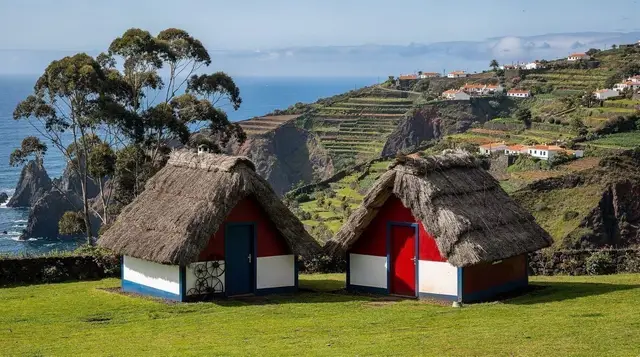
The high interior around Pico Ruivo rewards a full day rather than a rushed detour. Ribeiro Frio, lower down the mountain, is the starting point for the Levada dos Balcões walk, a short and easy contrast to the exposure of the peaks, with one of the island’s best views of the massif for very little effort. Further along the same road, Queimadas is the trailhead for the Levada do Caldeirão Verde, a longer walk through tunnels of its own, while Santana with its triangular thatched houses makes a natural lunch stop between mountain and coast.
Walkers building a full mountain day sometimes pair the short Pico Ruivo route with a visit to Encumeada or push west towards the open plateau of Paúl da Serra and the misty relic forest at Fanal, though that combination works better as two separate outings than one rushed itinerary.
The ancient Laurissilva forest that blankets much of the north below the peaks is a UNESCO World Heritage listing in its own right, and the connection between the mountain trails and the forest they cut through is worth understanding before setting out — the guide to the Laurissilva UNESCO forest covers it well.
For a private full-day option that links several of these stops with the mountain itself, a private full-day tour taking in Pico do Arieiro and Santana covers much of this ground without needing to self-drive the mountain roads. Walkers who prefer to build their own route from Ribeiro Frio rather than the peaks themselves might instead look at a full-day guided hike from Ribeiro Frio to Portela, a gentler but still substantial way to spend a day in the same range of mountains.
Getting there and planning the logistics
Both trailheads are reachable by hire car from Funchal in roughly 45 to 60 minutes, though the roads climbing into the interior are narrow and switch back sharply, and a small car copes far better than a large one. Public transport does not serve either trailhead usefully, which is the main reason most independent walkers either self-drive or book a guided transfer. Parking at Achada do Teixeira is straightforward outside peak season; Pico do Arieiro’s car park fills early on sunrise mornings, so arriving in good time matters more than it might elsewhere on the island.
A realistic day budget, permit included, runs somewhere between €20 and €50 per person depending on whether transport is self-driven, shared, or a fully guided package — details on overall trip costs sit in the wider guide on car rental in Madeira and the driving in Madeira guide for anyone weighing up self-drive against a tour. Whichever route is chosen, book the trail permit before leaving accommodation that morning — connectivity on the mountain roads is patchy, and turning up without proof of booking is an easy way to lose the morning entirely.
Questions about hiking Pico Ruivo
Can you drive to Pico Ruivo?
No. Both official approaches — the short path from Achada do Teixeira and the PR1 traverse from Pico do Arieiro — are on foot only. The nearest car parks are at the trailheads, not the summit.
Is the walk to Pico Ruivo free?
No. Since August 2021, every official PR trail in Madeira, including the routes to Pico Ruivo, requires a paid permit of around €3 per person, per trail, per day, booked online in advance and checked at a control point.
What is the shortest way to the summit of Pico Ruivo?
The path from Achada do Teixeira, roughly 2.8km each way, is the only route to the summit that does not require the full traverse from Pico do Arieiro. Most walkers cover it in 1.5 to 2.5 hours round trip at an easy pace.
How long does the PR1 traverse from Pico do Arieiro take?
Around 7km one-way, typically 3 to 4 hours, through three unlit tunnels and long sections of stone steps cut into the basalt. Most people arrange a one-way transfer or a second car rather than walking back the same way.
Do I need a head torch for the Pico Ruivo trails?
Yes for the PR1 traverse, which passes through three tunnels with no lighting. The short Achada do Teixeira route has one brief tunnel near the summit that is easier to cross without a torch, but carrying one is still sensible.
Is the Pico do Arieiro sunrise the same trip as walking to Pico Ruivo?
Not automatically. The sunrise viewpoint is at Pico do Arieiro itself; continuing on foot to Pico Ruivo means committing to the full PR1 traverse afterwards, which adds several more hours and needs its own separate trail permit.
What should I pack for the walk to Pico Ruivo?
Layers for a temperature that can sit near 0°C at dawn even when Funchal is warm, a waterproof shell, sturdy footwear with grip, a head torch, water, and a printed or downloaded copy of your trail permit.