Farmland before the fishing village
Arco de São Jorge doesn’t try to be a headline stop, and that’s more or less the point of it. It’s a small farming parish tucked into the north coast between São Vicente and Porto da Cruz, a short hop east of the village of São Jorge itself. Where the coast either side gets black-sand coves, lava pools and a working harbour, Arco de São Jorge sits back from the sea on a steep apron of land given over almost entirely to bananas, vines and, in one corner, roses. If you’re driving the ER101 along the north shore, it’s a natural pause of an hour or two rather than a destination you’d plan a day around.
That’s worth saying plainly, because guides sometimes stretch small agricultural villages like this one into “must-see” status they don’t quite earn. Arco de São Jorge earns a stop for what it actually is: a working slice of Madeira’s terraced farmland, seen up close, with a genuinely pretty garden attached. It doesn’t need to be more than that.
Bananas and vines on a steep hillside
The defining feature of Arco de São Jorge is the land itself. From the village, terraces cut into the hillside step down toward the Atlantic in narrow, stacked bands — some planted with banana palms, others with vines trained low against stone walls, a pattern repeated all along Madeira’s cultivated slopes but especially dense and visible here. The terraces exist because the ground is too steep to farm any other way: retaining walls built by hand, often generations ago, turn a near-vertical hillside into something that can carry a crop.
Bananas are the more obvious of the two. Madeira’s banana, smaller and sweeter than the imported varieties most visitors know, grows well in this warm, sheltered stretch of the north coast, and Arco de São Jorge is one of the parishes where you’ll see plantations at their densest — broad green leaves crowding right up to the road in places. February and March, when the harvest is in full swing, are the liveliest months to pass through if you want to see the work rather than just the scenery, though the terraces themselves are green and photogenic for most of the year.
The vines are quieter but just as much a part of the landscape, threading between the banana plots on narrow trellises. This isn’t one of Madeira’s named wine-producing centres in the way Câmara de Lobos or the Estreito are, but small-scale viticulture has gone on across the north coast for centuries alongside the banana crop, feeding the local market and, in a modest way, the island’s wine tradition covered in more depth on our Madeira wine guide.
For a broader sense of how these hillside terraces fit into the island’s farming geography — and how they compare to the drier, sun-facing terraces of the south — a north-coast day trip covering São Vicente, Arco de São Jorge and Santana is the easiest way to see the pattern repeat and shift as you drive.
The Rosas garden at Quinta do Arco
The other reason Arco de São Jorge appears on a map at all is the rose garden at Quinta do Arco, locally known as the Parque Temático das Rosas. It’s a themed garden built around a substantial collection of rose varieties, laid out in beds and pergolas on sloped ground with views back toward the terraces and the sea beyond — a deliberately cultivated counterpoint to the working farmland around it.
Two things are worth being upfront about. First, this is a flower garden, not a botanical institution on the scale of Funchal’s larger gardens — it’s a pleasant, focused stop, best suited to visitors who genuinely want to see roses rather than tick off a big attraction. Second, opening times, admission arrangements and the exact condition of the garden can and do change between seasons and years.
Rather than quote hours or a price here that could be out of date by the time you read this, the honest advice is to confirm current details locally — with your accommodation, a Santana tourist point, or a quick search on the day — before building a special trip around it. Treat the garden as a bonus stop on a north-coast drive, not the sole reason to come this far.
If gardens are a particular draw for you, it’s worth knowing Madeira has two much larger and more established options in and around Funchal, covered separately in our comparison of the Monte Palace gardens against the Botanical Garden. Quinta do Arco doesn’t compete with either on scale — its appeal is the contrast between manicured rose beds and the working terraces right outside the gate.
The village itself
Arco de São Jorge is small even by the standards of Madeira’s north-coast parishes: a cluster of houses along the road, a church, a few small local businesses, and farmland on every side that hasn’t been given over to tourism in any organised way. There’s no promenade, no cluster of restaurants, no gift-shop strip. What you get instead is a genuine working village, which is part of the appeal if you’ve already spent a day or two on Madeira’s more visited stretches of coast and want something quieter.
Practically, that means don’t expect much beyond a handful of small places to eat, and plan your main meal for Santana or São Vicente, both a short drive away and considerably better equipped. The village rewards a slow walk more than a long stay — twenty minutes to look at the terraces from the road, another hour at the garden if it’s open, and you’ve seen what Arco de São Jorge has to offer.
Getting there and driving the ER101
A hire car is effectively the only practical way to reach Arco de São Jorge — our broader notes on driving in Madeira apply here as much as anywhere, particularly the advice on choosing a small car for the north coast’s narrower stretches, covered in our car rental guide.
From Funchal, the fastest route runs west along the VR1 before cutting north on the ER101, or over the Encumeada pass and along the coast road past Porto Moniz and São Vicente if you want to make a full loop of the north coast in one day. Either way, budget 55 to 65 minutes of driving from Funchal, more if you’re stopping along the way, which on this stretch of coast you almost certainly will be.
The ER101 itself, right through Arco de São Jorge, is typical north-coast Madeira: narrow, winding, with sea views opening up between stretches of terraced farmland and the occasional tunnel. It’s manageable driving, but not a road to rush, and pull-offs for photographs are limited, so treat any wide verge as your chance rather than assuming there’ll be a better one ahead.
If you’d rather not drive the mountain and coastal roads yourself, a guided north coast 4x4 tour that takes in Porto Moniz and the terraced villages further east covers this stretch without the concentration a hire car demands, and a private 4x4 tour of the north-east coast can be arranged to focus specifically on the São Vicente-to-Porto da Cruz stretch that includes Arco de São Jorge.
Where it fits: São Vicente, São Jorge, Santana and Porto da Cruz
It helps to place Arco de São Jorge against its neighbours, because the names along this stretch of coast get confused easily.
| Village | What it actually is | Distance from Arco de São Jorge |
|---|---|---|
| São Vicente | Coastal town with lava caves and a river valley | About 20 minutes west |
| São Jorge | Small coastal village, a short-hop neighbour | A few minutes west |
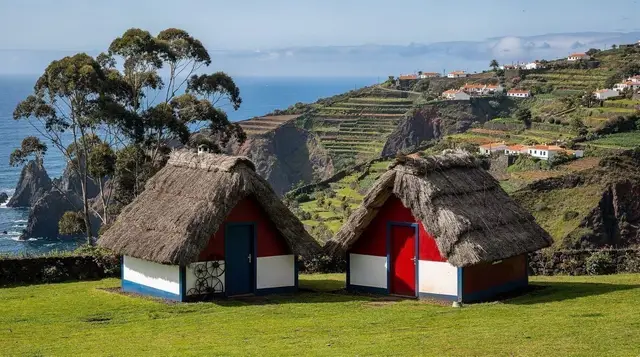
| Santana | Larger village, home to the thatched casas de colmo | About 10 minutes east |
| Faial | Coastal village at the mouth of a valley, gateway to Queimadas | About 15–20 minutes east |
| Porto da Cruz | Fishing village with a working harbour and beach | About 25–30 minutes east |
The distinction that matters most is the one with Porto da Cruz, simply because the two names sound similar and sit on the same stretch of road. Arco de São Jorge is inland farmland — no coastline, no harbour, no beach — while Porto da Cruz, further along the coast, is built around its fishing port and a black-sand beach with genuine sea access. If you’re choosing between the two for a coastal stop, Porto da Cruz is the one with the sea; if you’re after terraces, bananas and a garden, that’s Arco de São Jorge.
Santana, just to the east, is the more substantial stop of the two neighbours and the one most visitors pair Arco de São Jorge with, largely because of the thatched cottages. Beyond Faial, the road climbs toward Queimadas and the trailhead for the Levada do Caldeirão Verde, so a full day could reasonably run São Vicente, Arco de São Jorge, Santana and Faial before turning back or continuing on to Porto da Cruz and Machico.
For travellers with an interest in the island’s laurel forest as well as its farmland, it’s worth knowing that the Laurissilva — Madeira’s UNESCO-listed relic forest — covers much of the high ground directly inland from this stretch of coast, reachable from trailheads near Queimadas and further west near Fanal.
A guided sunset hike through the Fanal forest or an emerald forest 4x4 tour taking in waterfalls on the north side are both reasonable ways to combine the high forest with a lower-altitude stop like Arco de São Jorge on the same trip.
When to visit
There’s no single best month for Arco de São Jorge, because the two things people come for peak at different times. The rose garden is generally at its fullest in late spring and early summer, when growth is strongest across the island; the banana harvest, by contrast, is busiest in February and March, when you’re more likely to see the terraces being actively worked rather than simply standing green and quiet. Neither window is exclusive — the terraces look good most of the year, and the garden isn’t bare outside its peak — but if you have a choice of dates and a particular interest, weight it toward one or the other rather than assuming both line up at once.
Rain is worth planning around too. The north coast is noticeably wetter than the south for most of the year, and Arco de São Jorge sits squarely on that wet side of the island. A grey, damp morning here is common even when Funchal is dry and sunny, so check conditions on the day rather than assuming the weather you left with will hold.
Arco de São Jorge: frequently asked questions
What is Arco de São Jorge known for?
It’s known for two things: the steep banana and vine terraces that drop from the village down toward the sea, and the Quinta do Arco rose garden, one of the larger rose collections on the island.
Is the Rosas garden open to visitors?
Yes, the Quinta do Arco rose garden welcomes visitors, but opening times and admission can change between seasons, so check locally or with your accommodation before making a special trip around it.
How do I get to Arco de São Jorge?
By hire car via the VR1 to the north coast and then the ER101, roughly 55 to 65 minutes from Funchal. There’s no practical public transport route that makes it an easy stop without a car.
Is Arco de São Jorge worth visiting?
It’s worth a short stop if you’re already driving the north coast between São Vicente and Santana, mainly for the terraces and the garden. It isn’t worth a special detour on its own.
What’s the difference between Arco de São Jorge and Porto da Cruz?
Arco de São Jorge is inland farmland: terraces of bananas and vines and a rose garden, with no coastline of its own. Porto da Cruz, further east, is a fishing village with a working harbour and a beach. They’re separate stops with different reasons to visit.
Can I combine Arco de São Jorge with Santana in one day?
Yes. The two are close together on the north coast road, and pairing them with São Vicente or the Queimadas forest makes a full but manageable day out from Funchal.
Is there anywhere to eat in Arco de São Jorge?
Options are limited to a handful of small local places rather than a restaurant scene. Most visitors eat in Santana or São Vicente, both a short drive away.
When is the best time to visit the Rosas garden?
Late spring to early summer generally gives the fullest blooms, though a rose garden’s peak shifts a little with the weather each year, so treat any specific month as a guideline rather than a guarantee.