Santana's Thatched Houses: The Casas de Colmo Explained
Can you visit the thatched houses in Santana?
Yes. Three casas de colmo stand at the centre of Santana village and are open to visitors. They are maintained reconstructions rather than lived-in homes, built to preserve the style rather than to house a family today.
What the casas de colmo actually are
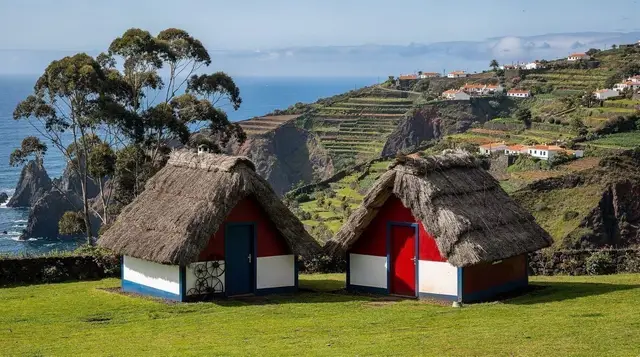
Every photograph of Madeira’s north coast eventually includes them: a cluster of small, triangular houses with steep thatched roofs running almost to the ground, their timber frames picked out in red, white and blue. They stand at the centre of Santana, a farming village on the north-east coast, and they are the single most photographed piece of vernacular architecture on the island. Three of them are open for visitors to walk around, and this guide is about those three specifically — what they are, what they aren’t, and how to see them without wasting a morning.
Get the framing right before you arrive: these are maintained reconstructions kept as a heritage display, not homes with someone living inside. Treat them that way and the fifteen-minute visit makes sense. Treat them as a lived-in village and you’ll leave confused about why nobody’s washing hangs outside and why the doors are locked overnight.
The three houses you can visit
The show houses sit together on a small green in the middle of Santana, a short walk from the main road through the village and close to the tourist information point. Each one is compact — a single room or two, low doorways, a hearth or a simple table inside — and each is furnished to suggest how a rural Santana household lived a century or more ago: wooden stools, earthenware jugs, a spinning wheel in one, farming tools in another. You won’t need a guide or a ticket booth; you simply walk in.
Because there are only three, and each takes a few minutes, don’t plan more than twenty minutes for the visit itself. People who arrive expecting a village-sized open-air museum are usually disappointed; people who arrive expecting three well-kept examples of a vanishing building style tend to enjoy exactly what’s there. If you want the fuller story of how Madeira came to be settled and farmed this way, that’s covered on the island’s history guide rather than repeated here — this page stays with the houses themselves.
A caretaker or local association looks after the upkeep of the roofs and paintwork, which is worth knowing because thatch doesn’t last: a properly maintained straw roof in this climate needs rethatching every few years, and the freshness you see in photographs is the result of ongoing work, not survival from centuries ago.
Why the roof is shaped like that
The triangular profile isn’t decorative. Santana sits on the wet, cloud-catching north side of the island, in the rainiest and windiest part of inhabited Madeira, close to the edge of the Laurissilva forest. A roof that runs in a steep straight line almost to the ground sheds heavy rain fast and presents very little flat surface for wind to catch, which matters when storms roll in off the Atlantic. The design also uses comparatively little structural timber, an advantage in an era when good wood had to be carried up from the valleys or the forest edge rather than bought.
The walls beneath the thatch are typically low, sometimes barely waist height, with the roof doing most of the work of enclosing the space. Door and window frames are painted in strong colour — red, white and blue being the combination most associated with Santana, though you’ll see local variation — mainly to stand out clearly against pale stone walls and pale straw. There’s no fixed meaning behind the specific colours; it became a local convention rather than a code to decipher.
This is a building style adapted to a very specific stretch of coastline, and it’s worth remembering that nowhere else on the island builds quite like this — you won’t find casas de colmo in Funchal or along the drier south coast, only here in the north around Santana and its neighbouring parishes.
What they are not
This is the part worth being blunt about. The three casas de colmo in the village centre are not occupied. Nobody cooks an evening meal in them, nobody sleeps there, and the furniture inside is a period display rather than someone’s belongings. They are kept up specifically so visitors have something authentic-looking to see, and that upkeep is deliberate and ongoing conservation work, not a household going about its day.
It’s true that a small number of genuinely older thatched houses survive scattered across farmland around Santana and neighbouring villages like São Jorge and Arco de São Jorge, some still in family hands, some used as storage rather than living quarters. These are on private land, not signposted for visitors, and not part of any official route — so don’t go looking for “the real ones” expecting a public trail. What you can reliably and respectfully see is the trio in the village centre, and that’s the honest, complete answer to “can I visit a thatched house in Santana.”
Getting to Santana and pairing the visit
Santana sits on the north coast, roughly forty-five minutes to an hour’s drive from Funchal depending on which route you take — the fast VE1/VR1 road system covers part of the journey, with a final stretch of slower coastal or hill road into the village itself. Parking near the village centre is straightforward outside peak midday hours.
Most visitors don’t come to Santana purely for the houses. The village works well as one stop on a wider loop of the north coast, and it sits close to some of the best short walks on the island. Queimadas, a short drive above Santana, is the trailhead for the Levada do Caldeirão Verde — a long-standing favourite covered in full on the Caldeirão Verde levada guide — and the forest around Queimadas gives a genuine sense of the Laurissilva before you’ve walked a step of it. If a full levada isn’t in the plan, even the short paths around Queimadas’ own thatched cottages (themselves maintained rather than lived in, for the same reasons as Santana’s) make a pleasant half hour.
The Santana Theme Park, a short walk from the village centre, runs family-oriented exhibits on island culture, agriculture and geology, and pairs naturally with the houses if you’re travelling with children. For a private look at the village that goes beyond the fifteen-minute walkthrough, a guided visit can put the houses in context alongside the park:
a private tour combining the Santana theme park with the village and its thatched housesMaking it part of a north coast day
Santana rarely justifies a dedicated day trip on its own, but it slots naturally into a longer loop of the north coast, taking in Porto da Cruz, Faial and Boaventura along the way, or a walk at Queimadas before heading back over the mountains. If you’d rather not plan the driving yourself, a guided day out through the east covers most of this ground:
a guided east-coast tour built specifically around Santana and its straw-roofed housesSeveral operators also fold Santana into a broader east-of-the-island itinerary alongside viewpoints, coastal villages and a scenic drive back:
a half-day tour through Santana and the wider eastern countrysideIf a slower, greener pace suits you better than a coach seat, a 4x4 route through the forest above Santana toward the island’s waterfalls is worth considering:
a 4x4 forest tour taking in waterfalls near SantanaAnd for anyone whose real interest in the area is agricultural rather than architectural, Santana also sits within Madeira’s wine country, with harvest-season visits combining a farm setting with the same rural landscape that shaped the thatched-house tradition:
a wine tasting and harvest experience with lunch near Santana
Santana at a glance
| What | Detail |
|---|---|
| Number of visitable casas de colmo | Three, in the village centre |
| Cost to enter | Free (opening hours limited) |
| Time needed | 15–20 minutes for the houses alone |
| Are they lived in | No — maintained reconstructions |
| Nearest levada trailhead | Queimadas, a short drive above the village |
| Drive from Funchal | Roughly 45–60 minutes |
| Best paired with | Santana Theme Park, Queimadas, a wider north-coast loop |
What to see and eat nearby
Santana’s other draw is straightforwardly rural: small farms, dairy cattle on steep green fields, and some of the freshest island produce you’ll find outside a market stall. If food is part of your plan, the north coast style of cooking leans on the same ingredients covered on the island food guide, and the espetada and bolo do caco guide is worth reading before you sit down anywhere in the village — both dishes turn up on menus around Santana as often as they do in Funchal.
For a wider sense of what else the north coast offers beyond one village, the north Madeira day trip guide lays out a fuller loop, and the best viewpoints and miradouros guide flags a few stops worth adding on the drive over or back. Santana itself has a dedicated activity listing if you want to see everything on offer in one place: things to do in Santana.
Santana’s casas de colmo: your questions answered
Do people still live in Santana’s thatched houses?
No, not the ones visitors see in the village centre. The handful of casas de colmo that remain occupied are scattered on private land outside the visitor area, and they aren’t part of any public route.
How many thatched houses can you actually go inside?
Three, at the small cluster in the centre of Santana. They’re furnished as a period display, and each is small enough that a visit takes only a few minutes.
Why are the houses shaped like triangles?
The steep two-sided roof running almost to the ground sheds Santana’s heavy rain and shrugs off strong wind, while needing far less structural timber than a house with vertical walls.
What do the red, blue and white paint colours mean?
There’s no fixed symbolism. The colours mark out the door and window frames against the pale walls and golden thatch, and the combination became the village’s visual signature rather than a coded meaning.
Is there an entry fee for the thatched houses?
The three show houses in the village centre are free to walk around, though opening hours are limited and it’s worth checking locally, since a caretaker sometimes closes them outside peak hours.
How long does a visit to Santana need?
The houses themselves take fifteen to twenty minutes. Most visitors pair them with the nearby Santana Theme Park or a stop at Queimadas on the way to the Levada do Caldeirão Verde, turning it into a half-day out.
Is Santana worth visiting if you skip the houses?
Yes. Santana sits at the edge of the laurel forest with some of the north coast’s best short walks starting nearby, so the village works as a base even without the thatched houses drawing you in.
History and heritage tours on GetYourGuide
Verified deep-linked GetYourGuide tours. Book through these links and we earn a small commission at no cost to you.
GetYourGuide does not provide a product photo for this activity — the image shows the meeting point, photographed by us.